
The Ultimate Drumset Groove Machine: 10⁵⁷ unique drum patterns for Practice, Creativity, and Songwriting - No Joke!
The Ultimate Drumset Groove Machine: A Powerful Drumset Groove Maker for Practice, Creativity, and Breaking Writer’s Block
If you have ever sat behind a drum kit staring at the same handful of grooves and wondering what to play next, you are not alone. Every drummer eventually hits a wall where ideas feel repetitive. That is exactly why this ultimate drum groove machine was created: a flexible, checkbox-driven drumset groove generator designed to produce an enormous range of rhythm ideas instantly.
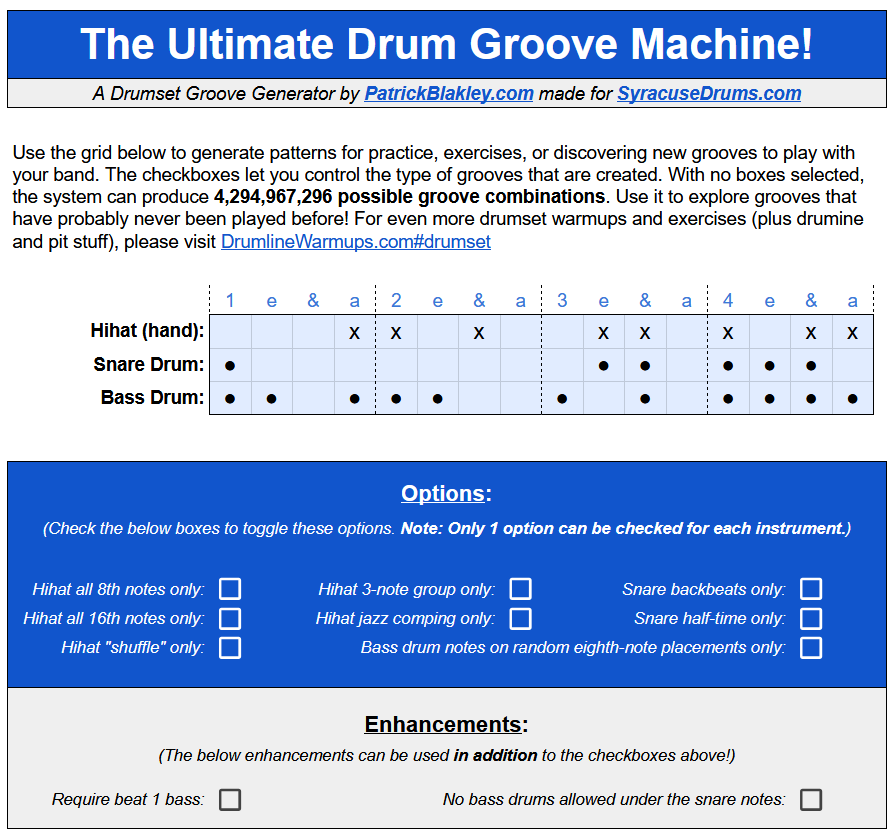
This is not just a random pattern tool. It is a structured system that turns controlled choices into an almost limitless library of drum grooves for practice, songwriting, and creativity. A mix between drum tabs and sheet music, drummers who use drumset tabs or drumset sheet music will find this easy to adapt to!
What the Drum Groove Machine Actually Is
At its core, the drum groove machine is a drumset groove creator worksheet system. It uses selectable parameters, primarily checkboxes, to define how grooves are constructed. Each checkbox represents a specific rhythmic constraint or instrument behavior.
Instead of guessing what to practice, you define the rules and let the system generate results.
This creates a structured way to explore groove possibilities across:
Bass drum patterns
Snare placement options
Hi hat combinations
Note density and subdivision control
Rule-based exclusions to avoid overlapping hits
The result is a drum practice tool that feels more like a creative engine than a worksheet. Create generative drum tabs or sheet music!
The Power of Checkbox-Based Groove Parameters
The most interesting part of this system is the checkbox selection design. Each checkbox changes the output space of possible grooves.
Some of the key parameters discussed during development include:
1. Bass Drum Placement Rules
One of the core constraints is controlling where the bass drum can appear. For example:
Bass drum locked to beat 1
Allowing or disallowing additional 16th note placements
Preventing overlap with snare or hi hat hits
This alone dramatically changes the groove personality.
2. Snare Drum Constraints
Snare options help define backbeat structure:
Traditional 2 and 4 placement
Open variation options
Muted or ghost note logic depending on selection
This lets you shift from standard rock patterns to more experimental textures.
3. Hi-Hat Density Controls
Hi hat checkboxes determine rhythmic density:
Straight 8th notes
16th note subdivisions
Partial or broken patterns
Selective omission for groove space
This is where grooves start to feel busy or minimal, depending on intent.
4. Overlap Prevention Logic
A key design feature is the rule that prevents conflicting note placement. This ensures grooves remain physically playable and clean. It also forces more creative spacing choices.
5. Combination Locking System
Each checkbox effectively locks or unlocks a set of rhythmic possibilities. The more combinations you allow, the larger the groove pool becomes.
How Many Drum Grooves Can It Actually Create?
This is where things get interesting. When the full system is enabled and no restrictions are applied, the number of possible groove combinations becomes enormous. The system can generate 18,446,744,073,709,551,616 unique drum grooves, which is approximately 18.4 quintillion potential grooves.
That number is difficult to visualize because most of us rarely encounter quantities anywhere near that large. One way to put it into perspective is to imagine playing one completely new groove every second without ever repeating an idea. Even at that impossible pace, it would take more than 584 billion years to work through every possible combination. The universe itself is only about 13.8 billion years old, so you would need a rather unreasonable amount of patience to finish the entire list.
Of course, the purpose of a groove generator is not to force a drummer to work through every possible combination. In fact, doing that would be a terrible practice strategy. The value comes from having an enormous pool of possibilities that can be narrowed down into something useful for a particular drummer, lesson, or practice session.
Once checkbox restrictions are applied, the system can intelligently reduce that massive pool of possibilities into focused practice sets. A teacher can limit the available options to target specific skills, coordination challenges, rhythmic concepts, or stylistic ideas. A student can then work within those parameters rather than randomly jumping between unrelated grooves.
This creates an interesting balance between variety and structure. The system can provide an almost unlimited supply of new material while still allowing the drummer or teacher to control exactly what types of grooves are being generated. Instead of running out of exercises, you can keep exploring new combinations while maintaining a clear practice objective.
The sheer number of possible grooves is therefore less about trying to reach the end of the list and more about demonstrating the flexibility of the system. With the right restrictions, the same tool can function as a beginner exercise generator, a coordination workout, a practice challenge, or a source of more advanced rhythmic material. There is plenty of room to explore without sacrificing structure.
Breaking Through Writer’s Block for Drummers
One of the biggest advantages of a drum groove generator is its ability to eliminate creative paralysis and help drummers move beyond the same familiar patterns they tend to play automatically. Every drummer has experienced the moment when they sit down at the kit and think, "What should I play?" You start with a familiar beat, try a variation, return to another groove you have played a hundred times, and eventually realize that you are circling around the same handful of ideas.
A groove generator approaches that problem from a completely different direction. Instead of requiring you to invent something from scratch, you can generate a collection of valid drum grooves and then explore the results for ideas that catch your attention. Rather than staring at a blank page and trying to force yourself to be creative, you might suddenly have 20 grooves in front of you that you have never played before.
That can be particularly useful when composing for drumset. A generated groove can provide the starting point for a new musical idea, even if you ultimately change it significantly. Sometimes the most useful part of an exercise is not the finished groove itself, but the unexpected combination of rhythms that makes you think, "I would never have put those together." The generator can act as a source of prompts that gets the creative process moving.
The same concept can be useful when preparing for a band rehearsal or studio recording session. Instead of relying exclusively on the grooves that immediately come to mind, you can generate possibilities ahead of time and experiment with them at the kit. This gives you a larger vocabulary of ideas to consider before you walk into rehearsal or a recording session. It can also be a useful way to develop alternative approaches to a song when the first idea you come up with is not quite working.
A groove generator can also turn a warm-up session into something more musical and practical. Warm-ups do not have to consist entirely of repetitive technical exercises. Playing through unfamiliar grooves can challenge your coordination, reading, timing, and ability to adapt while still feeling like you are actually making music. Instead of simply moving your hands and feet to get loose, you can use the warm-up to encounter new musical situations.
The underlying benefit is decision fatigue. When you have unlimited possibilities but no starting point, having unlimited possibilities can actually make it harder to begin. A structured generator removes some of that burden by giving you something to work with immediately. You are not staring at an empty page wondering what to create. You are selecting from a mathematically generated pool of drum groove ideas.
Because the generated patterns can be presented in a format similar to drumset tabs or traditional drumset sheet music, the process also connects directly to the way drummers already learn and communicate musical ideas. You can look at a pattern, sit down at the kit, and find out what it sounds and feels like.
The generator does not replace creativity. It gives creativity something to react to. Sometimes the fastest way to come up with a great idea is to stop trying so hard to invent one and simply give yourself something interesting to play.
Using the Drum Groove Machine as a Practice System
Beyond creativity, this tool functions extremely well as a structured drum practice guide.
Here are practical ways drummers can use it:
1. Daily Groove Warmups
Generate 5 to 10 grooves and play them slowly with a metronome. Focus on consistency and feel.
2. Weakness Targeting
Turn on specific checkbox constraints to isolate problem areas, such as:
Only 16th note hi hat patterns
Snare independence challenges
Bass drum timing accuracy
3. Groove Vocabulary Expansion
Treat each generated groove like a vocabulary word. Learn it, internalize it, then move on.
4. Musical Application Training
Play grooves with backing tracks or loop them in recording software to simulate real performance environments.
Why This Drumset Groove Machine Works
Most traditional drum exercises are static. A book gives you a specific pattern, you play it, repeat it, increase the tempo, and eventually move on to the next exercise. There is nothing inherently wrong with that approach. Repetition is an important part of learning the drums. However, static exercises can also create a predictable practice routine where the drummer becomes very comfortable with the same patterns and stops being challenged by anything unexpected.
This system takes a different approach. Instead of giving you one fixed exercise and asking you to repeat it indefinitely, it uses a set of rules to generate new combinations. The underlying rules determine what can appear in a groove, while the available options and restrictions determine how complex or specific the resulting material can be. The result is a practice environment that is dynamic rather than fixed.
One of the most useful aspects of this approach is the sheer amount of material it can produce. You are not working through a finite list of exercises that eventually runs out. The system can continue generating new combinations while still following the musical and rhythmic rules you have established. That makes it possible to return to the same tool repeatedly without necessarily practicing the same material every time.
The system can also be adapted to different skill levels. A beginner might use a relatively simple set of restrictions that focuses on basic coordination and groove construction. A more advanced drummer can remove those restrictions and introduce more complicated combinations involving different limbs, subdivisions, accents, and rhythmic relationships. The same basic system can therefore be used by students at very different stages of development.
Perhaps the biggest difference is that the emphasis shifts from memorization to exploration. Instead of simply trying to memorize a predetermined sequence of exercises, the drummer has to react to something new. You have to read it, understand how the parts relate to one another, figure out how to play it, and determine what it sounds like in a musical context.
That process introduces an element of discovery into drum practice. You may encounter a groove that feels awkward at first but eventually becomes comfortable. You may find a combination that inspires a completely different musical idea. You may even discover a coordination problem you did not realize you had. Those unexpected results are part of the value.
Repetition will always have an important place in drum practice. The goal is not to eliminate repetition, but to give it more variety and purpose. By combining structured rules with continuously changing material, this approach turns drum practice into something more exploratory. Instead of always asking, "How many times can I play this exercise?" you can also ask, "What happens if I try something completely different?"
Final Thoughts
The ultimate drum groove machine is not just a practice tool. It is a creativity system for drummers who want to stop recycling the same ideas and start building a real vocabulary of grooves. With so many possible combinations and a flexible checkbox-driven structure, a drum groove generator can give you something that is difficult to achieve with a traditional collection of drum exercises: an effectively endless supply of variation. Instead of working through the same fixed patterns over and over, you can change the rules, adjust the available options, and generate completely different grooves to explore.
This kind of variation can be especially valuable for serious drumset development. Developing groove independence requires more than simply memorizing a handful of coordination exercises. You need to be able to encounter unfamiliar combinations and figure out how the different parts of the drumset work together. A system that continually presents new patterns gives you an opportunity to practice that skill in a way that more closely resembles the unpredictable nature of actually playing music.
It can also be useful when you find yourself stuck in a creative rut. Drummers naturally develop habits and favorite patterns. Those habits can be useful, but they can also become limiting when you automatically fall back on the same grooves every time you sit down at the kit. Generating unfamiliar material forces you to approach the instrument from a different perspective and can lead to ideas that you would not have thought to create on your own.
The best part is that you do not have to invent every groove yourself. You simply choose the rules you want to work within and start playing. The system handles the process of generating the combinations, while you handle the part that actually matters: interpreting them on the drumset.
You also do not need to learn a completely new notation system to use it. If you already know how to read drum tabs or traditional drumset sheet music, you have the basic skills necessary to start working with the generated grooves. The notation gives you the information, the generator gives you the variation, and the drumset gives you the opportunity to turn those combinations into actual music.
Ultimately, the goal is not to replace traditional drum exercises or structured practice. It is to expand what is possible within your practice routine. Instead of always practicing what someone else has already written, you can explore what happens when a set of musical rules creates something you have never played before.
Choose the rules. Generate the groove. Sit down at the drums and see what happens.
Get started with the ultimate drum groove generator now! Or check out more drumset exercises here!
You may also be interested in the 256 Eighth-Note Bass Drum Groove Worksheet, or the 8,200+ Sixteenth-Note Bass Drum Groove Worksheet!
About the Author
Patrick Blakley is a percussion educator, author, adjudicator, and entrepreneur specializing in marching percussion and drumline education. He is the creator of DrumPacket.com, DrumlineWarmups.com, DrumAudit.com, DrumsetGrooves.com, and SyracuseDrums.com. His educational materials and performance audio edits through CompetitiveMusic.com are used by hundreds of schools and programs across the United States and beyond. He is the author of Quadratics: The Tenor Drum Equation, The Field Percussion User Manual, and other instructional music books. Read more about him by clicking here!
