
256 Drumset Grooves in 4/4: Every Eighth-Note Bass Drum Permutation (Free PDF)
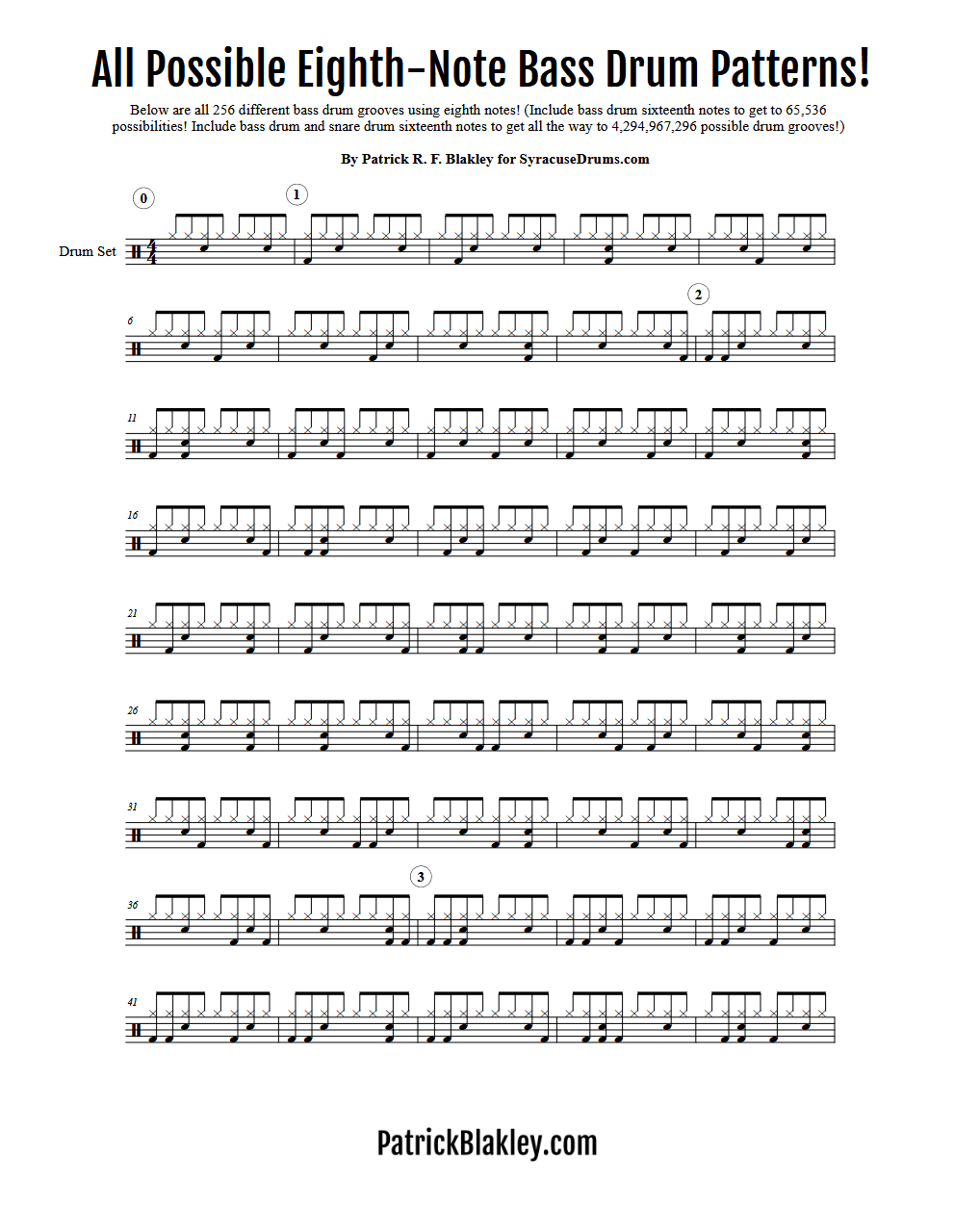
Every Possible Eighth-Note Bass Drum Groove in 4/4?
Yes. All 256 of Them!
If you have ever wondered how many drumset grooves actually exist within a simple framework, this answers it in a very direct way. These free drumset sheet music exercises map out every possible eighth-note bass drum placement in 4/4 under a standard hi-hat pattern and snare backbeat. No guessing, no skipping around. It is all there, systematically organized and ready to play.
Each collection contains 256 unique measures, and that number is not arbitrary. It comes directly from the basic mathematics of binary choices.
Consider a single measure of 4/4 written using eighth notes. There are eight possible positions in the measure where the bass drum could potentially play. At each position, there are only two choices: the bass drum either plays or it does not.
That means each position represents a binary choice. When you combine all eight positions, the total number of possible combinations is calculated as 2⁸ = 256.
In other words, there are 256 different ways to place or omit the bass drum across those eight eighth-note positions. Some patterns will be extremely simple, while others will contain bass drum notes on nearly every available position. Every combination is represented within the collection.
This is important because the number is not based on someone simply deciding that 256 patterns would make a convenient practice set. It represents the complete set of possible bass drum variations within that specific rhythmic framework. If you define the measure as four beats of 4/4 using eight eighth-note positions, and each position can independently contain either a bass drum note or a rest, 256 is the complete mathematical set of possibilities.
That makes these collections useful for systematic practice. Rather than selecting a handful of patterns that happen to be common or comfortable, you can explore the entire range of possibilities within the defined structure. The goal is not necessarily to memorize all 256 measures. Instead, working through the complete collection exposes you to rhythmic combinations that you might never think to create on your own.
Once you understand the basic math, it also becomes easy to see how quickly the number of possibilities grows when you add more subdivisions. Eight possible positions produce 256 combinations. Sixteenth notes double the number of positions to 16, which increases the theoretical number of bass drum combinations to 65,536.
That exponential growth is one of the reasons a systematic approach to drum groove generation can be so useful. Even a very simple rhythmic framework can contain far more possibilities than a drummer could reasonably discover through trial and error alone.
Within each collection, however, the math remains straightforward. Eight positions, two choices at each position, and 256 total possible measures. It is a simple concept, but it provides a surprisingly deep pool of material for drumset practice and exploration.
Standard Backbeat Grooves: 256 Complete Permutations
In the first exercise, the hi-hat plays steady eighth notes while the snare drum consistently lands on beats 2 and 4. Underneath that familiar backbeat, the bass drum cycles through every possible combination of eighth-note placements across the measure.
This creates a consistent musical framework while allowing the bass drum to change from measure to measure. Because the hi-hat and snare remain stable, you can focus your attention on what the bass drum is doing and how each different placement affects the overall groove. The familiar hi-hat and snare pattern essentially becomes a reference point while you explore the full range of bass drum possibilities.
One of the biggest benefits is developing greater control over bass drum independence. Instead of only practicing the handful of bass drum patterns that you already know, you are exposed to combinations that may require your foot to play in places that do not feel natural at first. As you work through the collection, those unfamiliar placements become increasingly comfortable and predictable.
This approach can also expose weaknesses that are easy to overlook during normal playing. A drummer may feel completely comfortable with common bass drum patterns but struggle when a note appears on a particular eighth-note position. Working systematically through every combination makes it much harder for those weak spots to hide. When something feels awkward, you can slow it down, isolate it, and work on it until the coordination becomes more reliable.
There is also a deeper musical benefit. By hearing the same hi-hat and snare framework remain consistent while the bass drum changes, you begin to develop a better understanding of how individual rhythmic components affect the construction of a groove. A single bass drum note can dramatically change the feel of a measure, even when everything else remains exactly the same.
Most importantly, these are not simply random exercises generated without any underlying structure. They are exhaustive within the defined framework. If a bass drum combination can exist within a single measure of 4/4 using those eight eighth-note positions, it is included.
That makes the collection fundamentally different from a traditional exercise list. You are not looking at someone's selection of the "most important" 20 or 30 patterns. You are working with the complete mathematical set of possibilities within the framework.
You do not necessarily need to play all of them every day, or even work through the entire collection in order. The value is knowing that the complete set is there. You can work systematically through the patterns, use them to target specific weaknesses, or select exercises randomly and see what the next combination has in store.
The result is a structured way to explore bass drum independence while developing a much deeper understanding of how individual rhythmic choices can shape a drumset groove.
The 32+ Standard Groove Patterns
Working through all 256 possible measures can be an effective way to develop bass drum independence, but it can also be more material than most drummers need for a practical practice session. For that reason, the complete collection is also distilled into a more focused set of 32 core grooves. These patterns provide a manageable starting point while still covering a wide range of useful bass drum combinations.
The 32 core grooves follow two simple rules. Every groove includes a bass drum note on beat 1, giving the pattern a clear starting point and strong connection to the underlying pulse. The second rule is that the bass drum does not overlap with the primary snare drum notes on beats 2 and 4. These restrictions remove many combinations that are less useful within a traditional backbeat while still leaving enough variation to create a substantial collection of grooves.
The result is a set of patterns that are immediately applicable to real drumset playing. The grooves generally feel natural and balanced because they are built around familiar musical conventions, but they still provide enough variation to challenge your coordination and expand your vocabulary. This makes the 32 core grooves much easier to incorporate into a normal practice routine than trying to work through every possible combination at once.
There are also 2 bonus grooves included in the collection. The first uses the bass drum on all four quarter notes, while the second places the bass drum on all eight eighth-note positions. Technically, these patterns fall outside the restrictions used to create the core collection, but they are so common in actual drumset playing that leaving them out would make the exercise less useful.
The purpose of the bonus grooves is to acknowledge the difference between mathematical rules and actual music. Rules are useful for creating a focused system, but real drummers regularly use patterns that do not fit neatly inside those boundaries. A good practice collection should account for that rather than pretending those patterns do not exist.
That is why the set is labeled 32+ grooves. You get 32 core patterns generated according to the defined rules, along with two familiar bonus patterns that are included because they have obvious practical value.
Together, these grooves provide a manageable collection for developing bass drum independence without sacrificing the variety that makes the larger system useful. You can start with the 32 core grooves, add the bonus patterns, and then expand into the complete 256-measure collection when you are ready for a more exhaustive challenge.
Download the free PDF version of this drumset exercise here!
Half-Time Grooves: 256 More Variations
The second major collection applies the same systematic approach to half-time drum grooves, where the primary snare drum backbeat moves from beats 2 and 4 to beat 3. That single change has a surprisingly significant effect on how the entire groove feels and how the bass drum interacts with the snare.
In a standard backbeat groove, the snare typically provides two major reference points within the measure, landing on beats 2 and 4. When the snare moves to beat 3, there is only one primary snare placement in the measure. This creates more space for the bass drum and gives the groove a noticeably different rhythmic character.
The same mathematical framework still applies. With eight possible eighth-note positions for the bass drum, there are still 256 possible bass drum combinations. The number of permutations has not changed, but the musical context has. Because the snare is now occupying only one position, the same bass drum pattern can interact with the backbeat in a completely different way.
This is an important concept when studying drumset independence. A rhythm does not exist in isolation. The way a bass drum pattern feels depends heavily on what the other parts of the drumset are doing around it. Moving the snare from beats 2 and 4 to beat 3 changes the framework, which means patterns that may feel familiar in a standard backbeat can suddenly feel completely different in a half-time setting.
The half-time collection therefore provides another opportunity to explore the same underlying bass drum possibilities from a different musical perspective. Instead of simply learning more patterns, you are learning how the same rhythmic vocabulary can behave differently when the surrounding structure changes.
This makes the collection useful for developing versatility as a drummer. Half-time grooves appear in many different styles of music and can create a heavier, more spacious, or more relaxed feel depending on the tempo and musical context. Working through a systematic collection gives you the opportunity to become comfortable with bass drum placements that might otherwise feel unfamiliar when the snare is centered on beat 3.
In the end, there are still 256 permutations, but they do not sound like the same 256 grooves you encountered in the standard backbeat collection. The mathematical possibilities may be identical, but the musical possibilities are different.
The 64+ Half-Time Groove Patterns
Because there is only one primary snare note to avoid in a half-time groove, more bass drum combinations fit naturally within the framework. In the standard backbeat collection, the bass drum has to avoid the snare on both beats 2 and 4. With the snare moved to beat 3, there is only one primary snare placement to consider. That leaves more available space for the bass drum and allows a larger number of combinations to qualify as practical, standard grooves.
That is why the half-time collection expands to 64 core grooves. The same basic rules are still applied. Every groove includes a bass drum on beat 1, and the bass drum does not overlap with the primary snare drum note on beat 3. Within those constraints, the system produces a larger selection of grooves that can be played and applied in a musical context.
The additional patterns are not simply extra variations for the sake of making the collection bigger. They represent the increased rhythmic freedom created by the half-time snare placement. With less interaction between the bass drum and snare, the bass drum has more opportunities to fill different parts of the measure while still maintaining the basic structure of the groove.
As with the standard backbeat collection, 2 bonus grooves are included as well. These patterns technically fall outside the core rules but are common enough in real drumset playing that excluding them would not make much musical sense. Including them keeps the collection connected to the way drummers actually play rather than treating the mathematical rules as absolute musical laws.
Together, the 64 core grooves and 2 bonus grooves create a practical library of 66 half-time patterns. You can work through them systematically, use them as coordination exercises, or combine them with the random groove generator to make your practice sessions less predictable.
The result is another complete collection built around the same basic philosophy: use simple rules to organize a large number of rhythmic possibilities, then turn those possibilities into practical material for developing real drumset skills.
Why This Matters for Real Playing
Most drummers learn grooves through imitation. They hear a beat they like, watch someone play it, learn the pattern, and eventually add it to their own vocabulary. This is an important part of learning the drumset, and imitation is one of the ways musicians have always learned. The limitation is that it can leave gaps in your playing. You may become very comfortable with the grooves you have been taught without ever exploring the many rhythmic possibilities that exist between them.
Working systematically through different groove permutations helps expose those gaps. Instead of practicing only the patterns you already know, you encounter a much wider range of bass drum placements and coordination challenges. Some will feel familiar, while others will immediately reveal areas where your independence or timing could be stronger.
One of the biggest benefits is developing genuine independence rather than simply memorizing a collection of patterns. When you encounter a groove you have never played before, you cannot rely entirely on muscle memory. You have to understand what each limb is doing, how the parts line up, and how the different subdivisions fit together. That process develops your ability to control each part of the drumset rather than simply reproducing a memorized sequence.
These exercises can also strengthen your timing in uncomfortable rhythmic placements. A note that lands in a familiar location may feel effortless, while moving that same note to a different sixteenth-note or eighth-note position can suddenly make the groove much harder. Those uncomfortable placements are often where useful practice happens. By repeatedly encountering them, you can gradually make them feel as natural as the patterns you already know.
Systematic practice also helps build consistency across different subdivisions. Instead of becoming comfortable only with the rhythmic placements you encounter most frequently, you can deliberately work through the entire framework and make sure your coordination is not dependent on a small number of familiar patterns.
Perhaps most importantly, this process teaches you how small changes can dramatically affect the feel of a groove. Moving a single bass drum note by one subdivision can make a pattern feel completely different even when the hi-hat and snare remain unchanged. By comparing these patterns side by side, you begin to develop a much better understanding of groove construction and why certain rhythmic choices create particular feels.
That understanding can carry directly into songwriting and drum part creation. When you have experience with a wider range of possibilities, your musical choices become more intentional. Instead of automatically playing the first familiar groove that comes to mind, you have a larger vocabulary to draw from and a better understanding of what each rhythmic choice can accomplish.
You do not have to use every possibility. In fact, you probably will not. The point is to know that those possibilities exist and develop enough control to choose between them when the music calls for it.
The more you understand the available options, the more deliberate your choices can become. That is where systematic groove practice moves beyond coordination exercises and starts becoming a tool for developing your voice as a drummer.
The Challenge: Switch Hands
Here is where the exercise gets uncomfortable. Once you are comfortable working through the grooves normally, try playing them with your non-dominant hand leading on the hi-hat. For right-handed players, that means leading the hi-hat with the left hand. For left-handed players, it means leading with the right hand.
This simple change can reveal coordination problems very quickly. A pattern that feels relatively easy when played with your dominant hand can suddenly feel much more difficult when you reverse the lead. Your hands may feel less comfortable, your timing may become less consistent, and certain bass drum combinations may suddenly require much more concentration.
That discomfort is exactly what makes this such a useful exercise. The goal is not simply to make a familiar groove harder for the sake of making it harder. You are training your ability to maintain a steady rhythmic framework while your body is operating outside its normal habits. This can expose weaknesses that remain hidden when you always play in the same way.
For right-handed drummers, leading the hi-hat with the left hand can be particularly revealing because many players have spent years allowing the right hand to dominate their eighth-note and sixteenth-note patterns. Reversing the lead forces the left hand to take responsibility for maintaining the pulse while the other limbs continue playing their assigned parts.
The long-term benefit is greater control and flexibility around the drumset. The objective is not necessarily to become perfectly ambidextrous or to make your hands completely interchangeable. Instead, you are developing the ability to maintain consistent time and coordination even when your normal technique is disrupted.
Working through all 256 measures this way provides a particularly demanding challenge because you are not practicing one difficult pattern repeatedly. You are exposing your non-dominant hand to the entire range of bass drum combinations within the collection. That gives you a much broader test of independence than simply mastering one or two reversed exercises.
Start slowly and prioritize clean execution over speed. If a particular combination falls apart, isolate it and work on it until the coordination becomes reliable. Over time, patterns that initially feel awkward should begin to feel much more natural.
If you can work your way through all 256 measures cleanly with your non-dominant hand leading the hi-hat, you will have developed a level of coordination and independence that can have a noticeable impact on your overall drumset playing.
Drumline Players: You Are Not Left Out!
The same concept applies directly to rudimental playing.
A separate set of exercises called Two to the Eight Power takes the exact same permutation idea and applies it to sticking patterns using:
(Use those 3 links above to dive into each version of the exercise!)
Each subdivision again has two possibilities. That creates the same total:
2⁸ = 256 rudimental permutations
These are ideal for:
Snare drummers building control
Tenor players who want to create their own around patterns across drums
Front ensemble players improving rhythmic precision
It is the same math, just applied to different textures.
Download those drumline and snare drum PDF exercises for free above, or download EVEN MORE drumline music here!
Free Drumset and Drumline Sheet Music Downloads
All of these exercises are available as free drumset sheet music PDFs and free drumline exercises, giving drummers and percussionists access to structured practice material without having to purchase another method book or build a practice routine from scratch. You can work through the complete 256-measure systems if you want an exhaustive challenge, or use the condensed groove libraries when you want something more practical for a shorter practice session.
The different collections are designed to serve different purposes. The full 256-measure systems allow you to systematically explore every possible combination within the defined framework, making them useful for serious work on coordination, independence, and rhythmic control. The smaller groove libraries provide a more manageable selection of patterns that can be incorporated into regular drum practice without feeling like you have been assigned 256 pages of homework.
The material can also be useful for teachers looking for additional drumset exercises or percussion practice material for their students. Because the patterns are organized systematically, an instructor can assign specific sections based on a student's ability level or use the material as a way to identify and address coordination weaknesses. Students can also use the exercises independently between lessons as a structured practice resource.
If you are specifically searching for free drumset sheet music, these collections provide a large amount of material to explore. They can be useful for students learning to read drum notation, experienced drummers looking for new challenges, or teachers who want additional exercises to supplement their existing curriculum.
The collection also includes drum groove exercises in PDF format, including patterns designed to develop bass drum independence and explore half-time drum grooves. These exercises can be approached slowly for coordination development, gradually increased in tempo for technical practice, or played in a musical context to explore how the patterns actually function as grooves.
For percussionists looking for drumline rudiment exercises and other free percussion practice resources, the broader collection provides additional material beyond drumset grooves. The goal is to make useful, structured percussion education resources easier to access, whether you are practicing at home, preparing for an ensemble, teaching private lessons, or simply looking for something new to put on the music stand.
You do not need to work through everything. Pick the material that matches your current goals, start at a manageable tempo, and gradually work toward more challenging patterns. The important thing is having enough quality material available that you can continue developing without constantly searching for the next exercise.
Whether you need free drumset sheet music, bass drum independence exercises, half-time drum grooves, drum groove PDFs, drumline exercises, or general percussion practice material, these resources are designed to give you plenty of material to work with.
This collection is designed to cover all of it in one place.
You might also be interested in the 8,200+ 16th Note Bass Drum Groove Worksheet, or the Ultimate Groove Generator with over 4 billion drumset grooves!!
About the Author
Patrick Blakley is a percussion educator, author, adjudicator, and entrepreneur specializing in marching percussion and drumline education. He is the creator of DrumPacket.com, DrumlineWarmups.com, DrumAudit.com, DrumsetGrooves.com, and SyracuseDrums.com. His educational materials and performance audio edits through CompetitiveMusic.com are used by hundreds of schools and programs across the United States and beyond. He is the author of Quadratics: The Tenor Drum Equation, The Field Percussion User Manual, and other instructional music books. Read more about him by clicking here!
