
Every 16th Note Drum Groove: 8,195 Bass Drum Patterns in 4/4 + Free Worksheet
8,195 Drum Grooves in 4/4: The Complete 16th Note Bass Drum Worksheet!
This worksheet is designed to let you explore every possible sixteenth-note bass drum rhythm combination within a specific set of rules. Rather than giving you a handful of predetermined bass drum patterns, it provides a structured way to work through the full range of combinations that fit the parameters.
The system is built around two primary rules. First, the bass drum does not normally play underneath the designated snare drum notes, although there are some exceptions that allow for additional variations. Second, the bass drum always plays on count 1. Keeping these rules consistent provides a musical framework while still leaving plenty of room for different rhythmic combinations.
The result is a systematic approach to exploring bass drum rhythms instead of simply choosing patterns at random. You can work through the worksheet methodically, playing each combination at the drumset and listening to how the placement of the bass drum changes the feel of the groove. Some combinations may sound immediately familiar, while others may create syncopations or accents that you would not normally think to play.
This makes the worksheet useful for developing bass drum control, coordination, groove vocabulary, and rhythmic awareness. It can also be used as a starting point for creating your own drumset grooves. Once you become comfortable with the combinations, you can begin experimenting with different hi-hat patterns, snare placements, tempos, and musical styles.
Rather than asking yourself what bass drum pattern you should practice next, you can use the worksheet as a roadmap and systematically explore the available possibilities. The goal is not simply to complete a worksheet. It is to become familiar with the rhythmic options available to you so that more of those possibilities become part of your natural drumset vocabulary.
One of the most interesting things about drumset practice is just how many rhythmic possibilities exist within even a very small musical framework. A single bar of 4/4 music might look simple on paper, but once you start considering all of the possible ways the different parts of the drumset can be combined, the number of potential grooves grows incredibly quickly.
Start with just the bass drum. If you limit yourself to bass drum placements on sixteenth notes in a single bar of 4/4, there are 16 possible positions in the measure. At each position, you have two basic choices: the bass drum can either play or it can remain silent.
When you consider every possible combination of those choices, you get 65,536 possible bass drum combinations. That is already a surprisingly large number of possibilities for a single instrument playing within a single measure. No drummer is realistically going to sit down and practice all of them, and writing every combination out by hand would be an equally ambitious way to spend your afternoon.
But the numbers become much more interesting when you allow all of the basic drumset voices to vary independently. Imagine that the bass drum, snare drum, and hi-hat can each change at every sixteenth-note position. At each subdivision, there are now four possible states based on the combination of those voices. Across all 16 subdivisions, that produces 4,294,967,296 possible grooves.
That is more than 4.2 billion possible drum grooves, and this calculation is still extremely limited. We are only looking at one bar of 4/4 using sixteenth notes. There are no triplets, no different note values, no additional percussion instruments, no orchestration choices, no dynamics, no accents, no ghost notes, no open hi-hat variations, and no changes in phrasing or articulation.
Once you start adding those musical variables, the number of possible combinations becomes enormous.
This is one reason a systematic drum groove generator can be so useful. A human drummer can only create, remember, and consciously explore a limited number of patterns at any given time. A computer can quickly generate combinations that would be impractical to enumerate manually, giving you a way to explore a much larger portion of the rhythmic possibilities available on the drumset.
Of course, not every mathematically possible combination will sound good. Some will be awkward, redundant, or simply not useful in a particular musical context. That is where musical judgment comes into play. The goal is not to assume that every possible combination is automatically a great groove. The goal is to explore the enormous space of possibilities and find the combinations that are actually interesting, playable, and musical.
And that leads to a fun possibility. If there are billions of potential combinations within something as simple as one bar of sixteenth-note drumset patterns, it is entirely possible to encounter a groove that you have never played before.
It is even possible that nobody has ever played that exact combination before.
That is the real potential of algorithmic drum groove generation. You are not limited to the patterns that happen to be sitting in a book or the grooves that you already know. You can explore combinations that would be extremely difficult to discover through traditional practice alone.
Why 8,195 Grooves Instead of 65,536?
The enormous number of mathematically possible drum patterns is interesting, but simply generating every possible combination would not necessarily produce a useful practice system. Many combinations would be awkward, repetitive, or unlikely to be useful in a musical setting. The goal of this system is to narrow that enormous pool down into something that a drummer can actually use.
Instead of including all 65,536 possible bass drum combinations, these grooves are generated using two practical rules. First, every groove includes a bass drum note on beat 1. Second, bass drum notes do not normally land on beats 2 or 4 where the primary snare drum notes occur. These restrictions provide a basic musical framework while still leaving a large number of rhythmic possibilities available.
Those two constraints eliminate a significant amount of unnecessary variation without reducing the system to a small collection of predictable patterns. The result is a much more focused group of grooves that are generally easier to understand, play, and apply to real drumset playing.
After applying these rules, the system produces 8,195 unique sixteenth-note bass drum grooves.
That is still an enormous amount of material. Even if you practiced one completely different groove every day, it would take more than 22 years to work through all 8,195 patterns. And that is only the bass drum component of the groove.
There is another interesting detail. Some bass drum patterns are extremely common in actual drumset playing even though they technically violate the rules used to generate the main collection. Rather than excluding these familiar patterns simply because they do not fit the mathematical restrictions, a small group of intentionally selected bonus grooves is included.
These additional patterns bring the total collection to 8,217 grooves.
The bonus grooves are important because music does not always follow perfectly clean rules. A system can use rules to create a useful framework while still recognizing that real drummers regularly play patterns that fall outside those boundaries. Including these common exceptions makes the collection more practical without allowing the entire system to become an unrestricted list of every possible combination.
The result is a balance between mathematics and musicality. The rules reduce the enormous number of possible combinations into a manageable and useful collection, while the bonus grooves make sure some familiar and practical patterns are not left out simply because they technically break the rules.
In other words, the system is not trying to generate every possible pattern. It is trying to generate a very large number of patterns that are actually worth playing.
Not Sheet Music. A Better System.
Writing out more than 8,000 measures of drumset sheet music would be technically possible, but it would not be particularly practical. You would end up with an enormous collection of pages that would be difficult to organize, difficult to search, and even more difficult to use during an actual practice session. At some point, having more exercises becomes less useful if finding the exercise you want takes longer than actually playing it.
Instead, the entire system is built into a spreadsheet, which turns out to be a much more powerful format for this type of drum practice tool. Rather than treating the grooves as a static book, the spreadsheet makes the entire collection interactive and easy to navigate.
Because the grooves are organized digitally, you can scroll through the collection and explore patterns at your own pace. You can also search through the available material instead of manually flipping through hundreds or thousands of pages looking for a particular pattern. This makes it much easier to use the system during a lesson, at home, or while working on a specific aspect of your drumset playing.
The spreadsheet format also makes it possible to do something a traditional book cannot do nearly as easily: generate a groove for you. Instead of choosing the next pattern yourself, you can use the randomized groove generator to select something from the available collection. This introduces an element of unpredictability into your practice session and helps prevent you from automatically choosing the patterns that look easiest or most familiar.
That randomness can be valuable. If you always choose your own exercises, you will naturally tend to gravitate toward things you already understand or enjoy playing. A randomized groove generator takes some of that decision-making out of your hands and gives you a pattern that you might not have selected yourself. You then have to read it, play it, and figure out how to make it work.
The spreadsheet is therefore more than just a digital list of drum grooves. It functions as a searchable practice library and an interactive groove generation system. You can browse through thousands of patterns when you want to explore systematically, or let the generator choose something for you when you want to add some unpredictability to your practice.
With thousands of grooves available, the goal is not to practice everything. The goal is to have enough material that you never run out of something new to explore.
How to Read the Drum Groove Spreadsheet
The layout is simple once you understand what you are looking at.
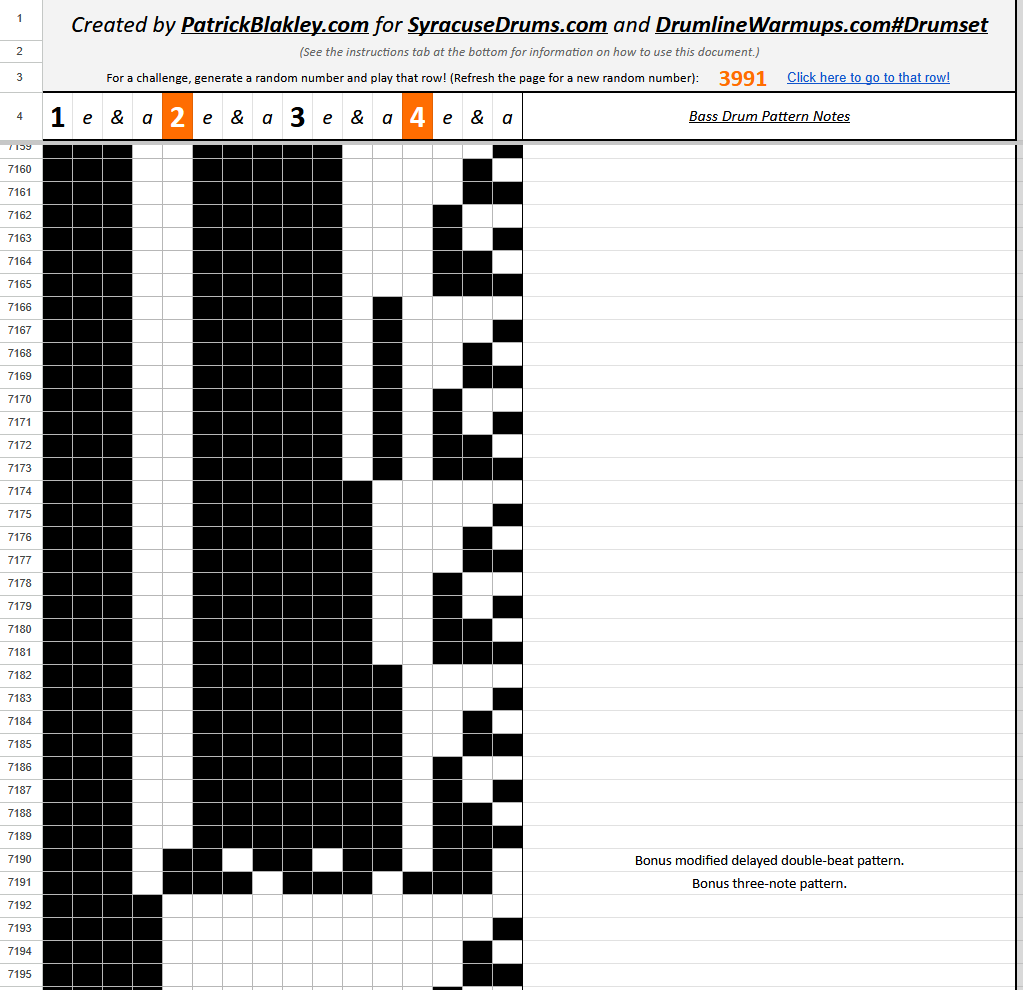
Each row represents one complete groove.
Across each row are 16 cells, one for each 16th note in the measure.
White cell = no bass drum
Black cell = bass drum note
At the top, the counts are labeled so you can track where you are in the measure. The beats are clearly marked, and beats 2 and 4 are highlighted in orange to show where the snare drum belongs.
Because of the rules used to generate the system, most grooves avoid placing bass drum notes directly under those snare hits. This keeps everything feeling clean and playable.
To the right of each row:
Some grooves include a short description
Some have recognizable pattern names
Some are marked with actual song names that use that groove
That last column is an ongoing project. If you recognize a groove in a song, you can contribute and help expand the list.
The Random Groove Generator
At the top of the spreadsheet, there is a random number generator that gives you a quick way to jump into the collection without having to choose a groove yourself. With a click, the generator selects a completely random groove and takes you directly to it. Instead of scrolling through thousands of possibilities and trying to decide which one looks interesting, you can let the system make the decision for you.
This is where the system becomes particularly useful as a practice tool. When you choose your own exercises, it is very easy to fall into familiar patterns. Most drummers naturally gravitate toward grooves they already know how to play, patterns that feel comfortable, or exercises that they simply enjoy. There is nothing wrong with that, but comfortable playing does not always provide the kind of challenge that leads to growth.
A random groove removes some of that predictability. You might land on a pattern that feels immediately natural, or you might get something that feels awkward and requires some work to coordinate. You may encounter a combination that sounds surprisingly musical once you play it at the kit. Every once in a while, you may even land on a groove that you would never have thought to create on your own.
That unpredictability is the point. You are giving yourself a reason to react rather than simply repeat.
This can be particularly useful when you are writing music. Sometimes the hardest part of creating a drum part is coming up with the initial idea. You may know that the song needs something different, but you keep playing the same familiar grooves because those are the ideas that naturally come to mind. Instead of waiting for inspiration to arrive, you can use the generator as a creative starting point.
Click the generator, find the groove, and play it.
The generated pattern does not have to become the final drum part. It might inspire a completely different groove, suggest a new rhythmic accent, or give you an idea for how the drums could interact with another instrument. Even a groove that does not work for the song can be useful because it gets you away from the blank page and into the process of experimenting.
The same principle applies to practice. You can use the random generator to start a practice session, select a new groove whenever you get stuck, or challenge yourself to play a certain number of randomly selected patterns. The system turns the question of "What should I practice?" into something much simpler.
Just click the generator and start playing.
How to Practice These Drum Grooves:
There are a few ways to approach this system depending on your goal.
1. Random Challenge Mode
Use the generator and commit to learning whatever shows up. No skipping.
2. Scroll and Discover
Jump to a random section and work through a handful of grooves in that range.
3. Density Training
As you scroll further down, the number of bass drum notes gradually increases. Early rows are sparse. Later rows become dense and physically demanding.
This creates a natural progression from simple to advanced without needing separate exercises.
4. Composition Mode
Use the spreadsheet as a writing tool. If you are stuck, grab a random groove and build a beat or song around it.
You will end up with ideas that do not sound recycled.
Why This Works
Most drummers naturally rely on familiar shapes and patterns when they play. Over time, certain combinations of bass drum, snare, and hi-hat become comfortable and automatic. That is not necessarily a bad thing. Developing a reliable vocabulary of grooves is an important part of becoming a better drummer. The problem occurs when those familiar patterns become the only patterns you can comfortably access.
A system built around thousands of possible groove combinations can help push you outside that familiar territory. Instead of always choosing the patterns you already know, you are regularly exposed to combinations that you may never have encountered before. Some will immediately make sense, while others may initially feel awkward or require more concentration. That process is valuable because it forces you to adapt rather than simply relying on muscle memory.
Working through different sixteenth-note placements can also strengthen drumset independence. Each position in a measure presents a different coordination challenge, and practicing those placements gives you more experience controlling where and when each limb plays. Over time, this can make unfamiliar rhythmic combinations feel less foreign and give you greater control over the individual voices within a groove.
Timing is another important part of the process. Some rhythmic placements feel completely natural because you have played them thousands of times. Other placements can feel surprisingly uncomfortable, particularly when a note lands in a space where you would not normally expect to play. Working through those uncomfortable spots can help develop a stronger internal sense of time and a better understanding of how different subdivisions feel within the pulse.
Perhaps the biggest long-term benefit is expanding your internal vocabulary of grooves. The goal is not to memorize thousands of patterns. Instead, you are exposing yourself to enough different rhythmic combinations that you begin to recognize and understand a much broader range of possibilities. Eventually, some of those ideas become part of your natural playing vocabulary, even if you never consciously remember where you first encountered them.
That makes the system useful for two different but closely related purposes. It is a practice system because it gives you structured material that can challenge your coordination, timing, reading, and independence. At the same time, it is a creative engine because it can provide unfamiliar ideas that you can use as starting points for writing, improvising, arranging, or developing new grooves.
The important distinction is that the system does not tell you exactly how you should play. It gives you possibilities you might not have discovered on your own and lets you decide what to do with them.
The Bigger Picture
Even with 8,217 unique drum grooves mapped out in the system, we are still only scratching the surface of what is possible on the drumset. The collection may seem enormous when you look at thousands of individual patterns, but the number of possible rhythmic combinations is vastly larger.
As discussed earlier, there are 65,536 possible bass drum combinations when you consider every possible bass drum placement across the 16 sixteenth-note positions in a single bar of 4/4. The current system intentionally narrows that enormous number down using practical musical rules, resulting in a more focused collection of grooves that are useful for practice and exploration.
The possibilities become even more extreme when you consider the entire drumset. If the bass drum, snare drum, and hi-hat are all allowed to vary across those same 16 sixteenth-note positions, there are more than 4.2 billion possible combinations. That calculation still represents an extremely simplified version of what can actually happen on a drumset.
Those numbers do not account for triplets or other subdivisions. They do not account for dynamics, accents, ghost notes, open hi-hats, cymbal choices, tom orchestration, sticking patterns, articulation, tempo, phrasing, or the countless ways a drummer can interpret the same written rhythm. They also do not account for what happens when a drummer takes a basic groove and changes it over multiple measures.
Once those variables enter the picture, the number of possible drumset ideas becomes effectively enormous.
That is why 8,217 grooves should not be viewed as a finite list that you are expected to complete. It is a starting point for exploration. The collection gives you a structured environment in which to work on a specific set of rhythmic possibilities while leaving an enormous amount of room to expand beyond them.
If your goal is to develop a larger vocabulary, improve your independence, find new songwriting ideas, or simply avoid playing the same grooves over and over, you are not going to run out of possibilities anytime soon.
In fact, you are barely getting started.
Free Drum Groove Worksheet
This entire system is available as a free drum groove spreadsheet.
If you are searching for new drum grooves in 4/4, exercises to improve bass drum independence, or challenging 16th-note drum patterns, this groove system gives you a structured way to explore all of them. Rather than relying on the same collection of exercises found in traditional drum books, you can work through a large library of patterns and use the random generator to discover combinations you might not normally choose yourself.
It can also be useful for more advanced drumset coordination workouts. The constantly changing bass drum placements can challenge your ability to maintain a steady hi-hat and snare pattern while controlling the bass drum independently. As the patterns become less familiar, you have to pay closer attention to subdivision, timing, coordination, and the relationship between the different limbs.
For drummers who are looking for unique drum groove ideas, the system can also function as a creative resource. A generated pattern can become the starting point for a new beat, a songwriting idea, a rehearsal exercise, or simply an interesting groove to explore at the kit. You do not have to use the pattern exactly as generated. Sometimes the most useful result is simply discovering a rhythmic idea that leads somewhere else.
It can also serve as a collection of drum practice challenges. Choose a random groove and see if you can play it cleanly. Start slowly, work it up to tempo, and then experiment with the pattern in different musical contexts. You can make the challenge as simple or as demanding as you want.
Whether you are a beginner looking for new 4/4 drum grooves, an experienced drummer working on independence, or a songwriter looking for something different, the system gives you a large collection of material to explore without requiring you to come up with every idea yourself.
This free drumset music worksheet gives you a structured way to explore all of it! And, if you want even more, there are TONS more free drumset music PDF exercises here!
Final Thought
Somewhere within these 8,000+ drum grooves is a pattern you have never played before. There may be hundreds of them. There may be thousands. With so many different combinations of sixteenth-note bass drum placements, it is nearly impossible to know what you will discover until you actually start exploring.
That is one of the most interesting aspects of the system. Most drummers develop a relatively small collection of go-to grooves that they can play comfortably and confidently. Those familiar patterns become part of our musical vocabulary, and there is nothing wrong with having reliable grooves in your toolkit. The problem is that familiarity can also become a creative limitation when you automatically reach for the same patterns every time you sit down at the drums.
The groove generator gives you a way to break that cycle. Instead of always playing what you already know, you can deliberately expose yourself to patterns that fall outside your normal habits. Some may become new favorites. Others may challenge your coordination or timing. A few may sound strange at first but become surprisingly useful once you experiment with them in a musical context.
You do not have to assume that every generated groove is going to become part of your permanent vocabulary. That is not the point. The value comes from exploring the possibilities and discovering what works for you. A pattern might inspire a completely different groove, give you an idea for a song, or reveal a rhythmic combination that you had never considered before.
So the real question is not whether there are enough drum grooves to keep you practicing. There are.
The question is whether you want to keep playing the same patterns you already know, or start digging into the thousands of possibilities that are waiting to be explored.
You might also be interested in the 256 Eight-Note Bass Drum Groove worksheet, as well as the Ultimate Drumset Groove Generator with 4 billion+ grooves!!
About the Author
Patrick Blakley is a percussion educator, author, adjudicator, and entrepreneur specializing in marching percussion and drumline education. He is the creator of DrumPacket.com, DrumlineWarmups.com, DrumAudit.com, DrumsetGrooves.com, and SyracuseDrums.com. His educational materials and performance audio edits through CompetitiveMusic.com are used by hundreds of schools and programs across the United States and beyond. He is the author of Quadratics: The Tenor Drum Equation, The Field Percussion User Manual, and other instructional music books. Read more about him by clicking here!
