
Tempo to Note Value Conversion Guide: How to Change Rhythm Using BPM - Math for Musicians!
Changing tempo is usually thought of as changing the speed of a piece. If a song moves from 120 BPM to 140 BPM, for example, most musicians simply think of the music as getting faster. However, tempo can also be used as a precise mathematical tool for changing the notated value of a beat while keeping the perceived rhythm essentially identical.
This is particularly useful when working with different note values, subdivisions, arrangements, and transcriptions. A rhythmic pattern written in eighth notes at one tempo can sometimes be expressed using quarter notes, sixteenth notes, or another subdivision at a different tempo. By choosing the correct tempo relationship, the actual spacing of the musical events can remain the same even though the notation has changed.
The important idea is that the tempo marking and the note value work together. BPM by itself does not completely describe how fast every individual note occurs. A tempo of 120 BPM can represent quarter notes, eighth notes, half notes, or other values depending on what the tempo marking is attached to. When you change both the tempo and the note value in the correct proportion, you can change the way a rhythm is written without necessarily changing how that rhythm sounds.
This can be especially useful for drummers. Percussionists frequently encounter situations where the same musical idea needs to be represented in different ways. A marching percussion exercise might be written with one subdivision while a drumset transcription uses another. A practice exercise might be easier to read or count when expressed using a different primary note value. Understanding the relationship between tempo and note duration gives you a way to make these conversions deliberately rather than relying on trial and error.
The concept can initially seem more complicated than it actually is because musicians tend to associate BPM with overall speed. Once you start thinking about the duration of each note rather than just the number displayed on the metronome, the relationship becomes much easier to understand. You are essentially keeping the amount of real time between musical events consistent while changing the way those events are represented on the page.
This is one of those concepts that feels complicated until it suddenly becomes obvious. Once you understand the underlying relationship, it becomes a practical tool that you can use when arranging music, transcribing rhythms, creating drum exercises, teaching students, or adapting material from one notation system to another. Instead of simply changing the speed of a piece, you can use tempo as a controlled way to manipulate the relationship between note values and perceived rhythm.
The Core Idea
If two rhythmic patterns place their musical events at the same points in time, they can sound identical to the listener even when the notation used to represent them is different. The notation tells the musician how the rhythm is organized on the page, but the actual sound is determined by when each note occurs. This distinction is important when using tempo changes to convert one note value into another.
That means you can take a passage written using one primary note value and represent it using a different note value by adjusting the tempo accordingly. The rhythm does not necessarily need to be rewritten from scratch. Instead, the relationship between the original note duration and the new note duration can be used to calculate a new tempo that preserves the timing of the musical events.
For example, you can use tempo relationships to convert:
Quarter notes into eighth notes
Eighth notes into sixteenth notes
Sixteenth notes into triplet subdivisions
Eighth notes into eighth-note triplets
The important detail is that the tempo has to change by the correct mathematical ratio. Simply changing the notation while leaving the BPM unchanged will change the actual timing. Likewise, changing the BPM by an arbitrary amount will produce a different rhythm. The conversion works when the new tempo compensates for the difference between the old and new note values.
Consider a simple example. Suppose a passage consists of continuous quarter notes at 60 BPM. Each quarter note lasts one second. If you want to represent those same musical events as eighth notes, the new eighth-note tempo needs to be 30 BPM. At that tempo, each eighth note also lasts one second. The notation has changed, and the metronome marking has changed, but the actual spacing between the notes remains identical.
The same principle works in the opposite direction. If eighth notes are being played at 120 BPM and you want to represent those exact same events as quarter notes, the quarter-note tempo would be 60 BPM. Each quarter note at 60 BPM occupies the same amount of time as each eighth note at 120 BPM.
Triplets work the same way, although the ratios become slightly more involved. An eighth-note triplet divides a beat into three equal parts, while two ordinary eighth notes divide the same beat into two parts. To preserve the actual duration between events when moving between those systems, the tempo must be adjusted so that the individual note durations remain equivalent.
This is why it is more accurate to think about time between notes rather than simply thinking about BPM. BPM describes how quickly a particular note value occurs, but the note value attached to that BPM determines the actual duration represented by each beat. Change the note value and you may need to change the BPM to compensate.
The listener ultimately does not hear the notation. The listener hears the timing. If every musical event occurs at the same point in time, changing the way those events are notated does not necessarily change what the listener perceives. Only the written representation and the tempo marking have changed.
For drummers, this provides a useful way to understand rhythmic equivalence. Once you start calculating these relationships, you can move between different note values and subdivision systems while preserving the underlying timing. This can be useful when transcribing music, adapting exercises, creating practice materials, or teaching students how different rhythmic values relate to one another.
Simple Example: Eighth Notes to Triplets
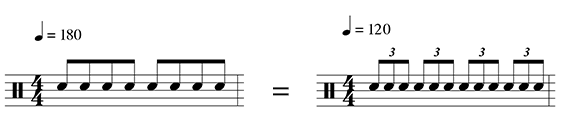
Let’s say you have continuous eighth notes at 180 BPM and you want those same attacks to be written as eighth-note triplets. The goal is to change the notation without changing the actual spacing between the attacks. To accomplish that, the tempo has to be adjusted to account for the difference between two subdivisions per beat and three subdivisions per beat.
At 180 BPM, the quarter-note beat lasts one-third of a second. Because there are two eighth notes in each beat, each eighth note occurs every one-sixth of a second. That gives you six attacks per second.
Now consider eighth-note triplets. There are three triplet notes in each quarter-note beat. To produce the same six attacks per second, the quarter-note tempo needs to be reduced to 120 BPM, not 90 BPM. At 120 BPM, each quarter-note beat lasts one-half of a second. Dividing that beat into three equal triplet subdivisions gives you one-sixth of a second between each attack.
So the conversion is:
Eighth notes at 180 BPM
Eighth-note triplets at 120 BPM
Both produce the same six attacks per second. The individual notes occur at the same points in time, even though the notation divides the beat differently.
This is a particularly useful example because it shows why the tempo marking cannot be considered separately from the subdivision. At 180 BPM, two eighth notes fit into every beat. At 120 BPM, three triplet subdivisions fit into every beat. The number of notes per beat changes, but the actual amount of time between attacks stays the same.
The listener therefore hears the same sequence of attacks. What changes is the musical framework used to describe those attacks. In the first version, the attacks are organized as pairs of eighth notes. In the second version, they are organized as groups of three. The underlying pulse density remains constant.
This principle can be expressed mathematically. When converting between two different subdivisions while preserving the actual note spacing, you adjust the tempo in the opposite direction of the change in subdivision density. Moving from two subdivisions per beat to three subdivisions per beat requires the tempo to become two-thirds as fast. In this example, 180 BPM becomes 120 BPM.
This is the key idea: tempo and rhythmic subdivision work together as a multiplier of rhythmic density. BPM tells you how quickly the underlying beat moves, while the subdivision tells you how many musical events occur within each beat. By changing both in the correct proportion, you can represent the same sequence of attacks using completely different rhythmic notation.
Once you understand this relationship, tempo becomes more than a way to make music faster or slower. It becomes a practical tool for converting rhythmic values, comparing different notational systems, and finding equivalent ways to represent the same musical timing.
A Cleaner Way to Think About It
Instead of memorizing long lists of tempo conversions, it is easier to think of note values as relative divisions of a measure. This turns rhythm into a proportional system rather than a collection of unrelated note values that have to be memorized individually.
In 4/4 time, a measure contains four quarter-note beats. If we describe the number of equal note divisions that can occupy that measure, the basic note values can be represented like this:
Whole notes = 1 per measure
Half notes = 2 per measure
Quarter notes = 4 per measure
Eighth notes = 8 per measure
Sixteenth notes = 16 per measure
The same idea can be applied to triplets. Because triplets divide a beat into three equal parts instead of two, their density increases accordingly:
Quarter-note triplets = 6 per measure
Eighth-note triplets = 12 per measure
Sixteenth-note triplets = 24 per measure
These numbers are not new note values. They simply describe how many equal events of each type can fit into a 4/4 measure. Thinking about them this way makes it much easier to compare different rhythmic subdivisions.
For example, ordinary eighth notes produce eight equally spaced attacks per 4/4 measure. Eighth-note triplets produce twelve. That means eighth-note triplets have 50 percent greater event density when the underlying quarter-note tempo is the same. If you want those two systems to produce the same number of attacks per second, the tempo has to change to compensate for that difference.
This is where the proportional relationship becomes useful. Rather than memorizing a separate conversion for every possible combination of note values and triplets, you can compare their relative densities. If one rhythmic system contains eight events per measure and another contains twelve, the ratio between them tells you how the tempo needs to change to preserve the same actual timing.
For example, the ratio between eighth notes and eighth-note triplets is 8:12, which simplifies to 2:3. That means the tempo relationship required to preserve the same attack spacing is also based on that 2:3 ratio. A passage of eighth notes at 180 BPM can therefore be represented as eighth-note triplets at 120 BPM while keeping the actual spacing between attacks identical.
The same approach works with many other conversions. You do not need to memorize every possible tempo relationship. Instead, determine how many events each rhythmic system produces within the same amount of musical time, compare those numbers, and use the resulting ratio to calculate the new tempo.
This way of thinking turns tempo conversion into simple ratio math. Instead of treating quarter notes, eighth notes, sixteenth notes, and triplets as completely separate categories, you can see them as different subdivisions within the same proportional system.
Once you understand rhythmic density this way, tempo conversions become much easier to calculate. You are no longer trying to remember a chart of isolated BPM relationships. You are simply asking one question: How does the number of rhythmic events change, and what tempo adjustment keeps the actual time between those events the same?
The Real Formula
To convert between note values while preserving the actual spacing between musical events, you can use a simple proportional formula:
New tempo = Old tempo × (Old subdivision value ÷ New subdivision value)
The key is understanding what the subdivision values represent. In the system above, the values describe how many equal events fit into a 4/4 measure. A quarter note has a value of 4 because four quarter notes fit into a measure. An eighth note has a value of 8 because eight eighth notes fit into the same measure.
For example, suppose you have quarter notes at 120 BPM and want to represent the exact same attacks as eighth notes. The subdivision values are:
Quarter note = 4
Eighth note = 8
Plug those values into the formula:
New tempo = 120 × (4 ÷ 8)
First calculate the ratio:
4 ÷ 8 = 0.5
Then multiply the original tempo:
120 × 0.5 = 60 BPM
Therefore:
Quarter notes at 120 BPM = eighth notes at 60 BPM
The two versions produce the same amount of time between attacks. The notation has changed, but the actual duration of each event has not.
The same principle works in reverse. If you have eighth notes at 60 BPM and want to express those same attacks as quarter notes, the calculation becomes:
New tempo = 60 × (8 ÷ 4)
The ratio is 2, so:
60 × 2 = 120 BPM
Therefore:
Eighth notes at 60 BPM = quarter notes at 120 BPM
This is why doubling and halving tempo works so cleanly in simple cases. Moving from quarter notes to eighth notes doubles the number of possible events within the measure, so the tempo must be cut in half to preserve the actual time between events. Moving back from eighth notes to quarter notes cuts the subdivision density in half, so the tempo doubles.
The same formula can be applied to smaller subdivisions. For example, converting eighth notes to sixteenth notes changes the subdivision value from 8 to 16. The ratio is 8 ÷ 16, or 0.5, so the new tempo is half the original tempo. Converting sixteenth notes back to eighth notes reverses the relationship and doubles the tempo.
The advantage of using a formula is that it removes the need to memorize every possible conversion. Once you know the relative subdivision values, you can calculate the appropriate tempo for the new notation.
The important thing to remember is that this calculation is designed to preserve the actual time between attacks. It does not simply make the written music look different. The tempo and subdivision are being changed together so that the listener hears the same underlying rhythmic spacing.
Once you understand that relationship, tempo conversion becomes a straightforward mathematical process rather than a collection of memorized rules.
Why This Works Musically
Music is ultimately organized around the spacing of events in time. Every note, rest, accent, and subdivision occupies a specific position within a musical timeline. Written notation gives us a way to describe those positions, but the notation itself is not the sound. What the listener actually experiences is the timing and relationship between the musical events.
If two rhythmic patterns produce identical spacing between their note attacks, they can be functionally equivalent even if they are labeled or notated differently. The notation may divide the underlying time grid into different groupings, but if the attacks occur at the same moments, the listener can hear the same rhythmic sequence.
This is why quarter notes at one tempo can equal eighth notes at another. The note value changes, but the tempo can be adjusted so that each individual attack still occupies the same amount of time. The written rhythm looks different, yet the actual timing remains unchanged.
The same principle can apply when straight rhythms are converted into triplets through tempo adjustment. Straight eighth notes divide a beat into two equal parts, while eighth-note triplets divide it into three. Because the subdivisions are different, the tempo has to change by the appropriate ratio if the goal is to preserve the exact spacing between attacks. When that calculation is correct, the notation changes without changing the underlying event timing.
This also means that complex subdivisions can sometimes be reframed as simpler note values. A rhythm that looks complicated in one notation system may become easier to understand when viewed through another set of note values and a corresponding tempo. This can be useful when transcribing music, arranging parts, creating exercises, or explaining rhythmic concepts to students.
The easiest way to visualize this is to imagine a time grid. Think of the grid as a fixed timeline containing all of the possible positions where a musical event could occur. Changing the notation does not necessarily change the grid. Instead, it changes how we label and group the positions on that grid.
For example, imagine a sequence of evenly spaced drum hits. You could describe those hits using one set of note values, then change the tempo and describe the exact same sequence using another set of note values. The written music would look different, but the underlying timeline would remain the same.
This is why tempo should not be thought of simply as a speed setting. Tempo establishes the relationship between the written beat and real time. Subdivision determines how many events are placed within that beat. Change one without properly accounting for the other and the rhythm changes. Change them together using the correct ratio and you can preserve the timing.
It is essentially the same time grid viewed from a different zoom level. At one zoom level, you might describe the music with quarter notes. Zoom in and you might describe the same timeline using eighth notes or sixteenth notes. Change the grouping again and you might use triplets. The labels change, but the underlying concept remains the same: where do the musical events occur in time?
Once you start thinking about rhythm this way, tempo conversion becomes much more intuitive. Instead of memorizing dozens of individual conversion rules, you can look at the relationship between note values, determine the necessary ratio, and calculate the tempo that preserves the desired spacing. The mathematics simply gives you a precise way to move between different views of the same rhythmic timeline.
Practical Applications
Understanding the relationship between tempo and rhythmic subdivision is useful in many real-world musical situations. Once you understand how to preserve the actual spacing between attacks while changing the written note values, the concept becomes useful for arranging, teaching, transcription, composition, and percussion writing.
One practical application is arranging percussion parts across different tempos. An arranger may want to move a musical idea from one section of a composition to another without changing its underlying rhythmic density. Instead of manually rebuilding every rhythm, the arranger can use the relationship between tempo and subdivision to determine an equivalent representation. This can make the process of adapting existing material much faster and reduce the chance of introducing accidental timing changes.
The concept can also be useful when simplifying complex rhythmic notation for students. A rhythm that is technically correct is not always the easiest rhythm for a student to read. Sometimes a different combination of note values and tempo markings can represent the same underlying timing in a way that is easier to understand. This can be particularly useful when introducing students to subdivisions, polyrhythmic concepts, or unfamiliar rhythmic groupings.
Another application is converting between triplet and straight feels. Straight subdivisions and triplet subdivisions organize time differently, so changing between them requires careful attention to the tempo relationship. Understanding the mathematical relationship makes it possible to create equivalent rhythmic exercises and examples without relying entirely on trial and error. This can be useful when teaching students how different subdivisions relate to one another.
The technique is also valuable for matching pre-recorded audio spacing during transcription. When transcribing a recording, you may encounter a passage that is easier to notate using a different subdivision than the one that initially seems obvious. By analyzing the actual spacing between attacks, you can determine which note values and tempo relationship best represent the performance. This can result in cleaner notation while maintaining the timing of the original recording.
It can also help when designing consistent rhythmic layers in ensemble writing. Percussion parts often contain multiple layers moving at different subdivision levels. Understanding rhythmic density makes it easier to determine how those layers relate to the underlying pulse. This becomes particularly important when writing parts that need to lock together precisely across multiple instruments.
Marching percussion and drum corps writing especially benefit from this way of thinking. Marching percussion often combines complex rhythmic material with visual demands, ensemble timing, and a need for extremely clear notation. The most complicated possible notation is not necessarily the best notation. Players need to be able to read the music quickly, understand the subdivision, and execute it consistently while also managing movement and other performance responsibilities.
Visual clarity can therefore be just as important as rhythmic complexity. An arranger may choose one notation system over another because it communicates the intended rhythm more clearly to the performers. If two approaches produce the same attack spacing, the better choice may simply be the one that is easier for the ensemble to read and understand.
This is particularly relevant when writing for large percussion sections. Snare drums, tenors, bass drums, and front ensemble instruments may all be performing related rhythmic material at the same time. A clear understanding of the underlying time grid allows the arranger to build those layers intentionally while maintaining a consistent relationship to the ensemble pulse.
Ultimately, tempo conversion is not just a theoretical music math trick. It is a practical tool for arranging, teaching, transcription, composition, and percussion writing. Once you understand the relationship between tempo and rhythmic density, you have more control over how musical ideas are represented without necessarily changing the timing that the listener hears.
A Mental Shortcut
If you only remember one idea from this article, remember this: tempo and rhythmic subdivision are directly connected. If you change the subdivision while keeping the tempo unchanged, the spacing between musical events changes. If you want to preserve that spacing, you can adjust the tempo by the appropriate ratio based on the subdivision sizes.
In practical terms, if a rhythm would feel faster or slower after changing its note values, the solution is not necessarily to rewrite the rhythm again. Instead, look at the relationship between the original subdivision and the new subdivision, calculate the ratio, and adjust the tempo accordingly. This allows you to move between different forms of notation while preserving the underlying timing.
The more you work with this concept, the less you need to memorize specific conversions. You can simply compare the rhythmic densities, determine how much the subdivision has changed, and use that relationship to calculate the appropriate tempo. What initially looks like a collection of unrelated music theory rules becomes a simple proportional system.
This way of thinking is particularly useful for drummers because percussionists deal with subdivisions constantly. Whether you are reading marching percussion music, transcribing a drum part, writing an exercise, teaching a student, or arranging an ensemble, understanding the relationship between tempo and subdivision gives you another way to solve rhythmic problems.
The written note value is essentially a way of describing how events are organized within the musical pulse. Change the subdivision, adjust the tempo by the correct ratio, and you can preserve the actual time between those events.
Or, more bluntly:
Tempo is just rhythm in disguise.
Final Thought
This is one of those music theory topics where the math looks intimidating until you realize that it is really just proportional scaling. The numbers may seem complicated when you first encounter different note values, subdivisions, and tempo relationships, but the underlying idea is straightforward. You are comparing how many rhythmic events occur within a given amount of time and adjusting the tempo when necessary to preserve that timing.
Once you internalize the concept, you can stop thinking exclusively in terms of isolated note values and start thinking in terms of time grids. Instead of asking whether a rhythm is written as eighth notes, sixteenth notes, or triplets, you can ask where the attacks actually occur within the timeline. That shift in perspective makes it much easier to understand why different notational systems can sometimes represent the same underlying rhythmic spacing.
This way of thinking can make rhythm writing much more flexible. You are no longer limited to the first notation that comes to mind. You can experiment with different note values, subdivision systems, and tempo relationships to find the version that communicates the musical idea most clearly. For percussionists and arrangers, that flexibility can be especially useful when creating exercises, adapting parts, teaching students, or writing music for an ensemble.
And honestly, once you start seeing rhythm as a time grid, it becomes much more fun. The math stops being something you have to memorize and becomes a tool you can use to manipulate and understand rhythm.
This article is also the opposite of my Rare Time Signatures article, in a way. They are almost mirror images of one another while ultimately trying to accomplish a similar goal. One explores how changing the organization of the musical grid can create unusual rhythmic possibilities, while this article looks at how changing tempo and subdivision can give you different ways to represent that grid.
If you found this concept useful, check out the Rare Time Signatures article next. Looking at both ideas together can give you a much broader understanding of how rhythm can be organized, notated, and manipulated.
A Quick Cheat Sheet
whole-note to half-note: multiply tempo by 0.5
whole-note to quarter-note: multiply by 0.25
whole-note to quarter-note-triplet: multiply by 0.1666
whole-note to eighth-note: multiply by 0.125
whole-note to eighth-note-triplet: multiply by 0.8333
whole-note to sixteenth-note: multiply by 0.0625
half-note to whole-note: multiply tempo by 2
half-note to quarter-note: multiply by 0.5
half-note to quarter-note-triplet: multiply by 0.333
half-note to eighth-note: multiply by 0.25
half-note to eighth-note-triplet: multiply by 0.1666
half-note to sixteenth-note: multiply by 0.125
quarter-note to whole-note: multiply tempo by 4
quarter-note to half-note: multiply by 2
quarter-note to quarter-note-triplet: multiply by 0.666
quarter-note to eighth-note: multiply by 0.5
quarter-note to eighth-note-triplet: multiply by 0.333
quarter-note to sixteenth-note: multiply by 0.25
eighth-note to whole-note: multiply tempo by 8
eighth-note to half-note: multiply by 4
eighth-note to quarter-note: multiply by 2
eighth-note to quarter-note-triplet: multiply by 1.333
eighth-note to eighth-note-triplet: multiply by 0.666
eighth-note to sixteenth-note: multiply by 0.5
eighth-note to sixteenth-note-triplet: multiply by 0.333
sixteenth-note to whole note: multiply tempo by 16
sixteenth-note to half-note: multiply by 8
sixteenth-note to quarter-note: multiply by 4
sixteenth-note to quarter-note-triplets: multiply by 2.666
sixteenth-note to eighth-note: multiply by 2
sixteenth-note to eighth-note-triplets: multiply by 1.333
sixteenth-note to sixteenth-note-triplets: multiply by 0.666
sixteenth-note to thirty-second-note: multiply by 0.5
And to go the opposite direction, just simply divide!
About the Author
Patrick Blakley is a percussion educator, author, adjudicator, and entrepreneur specializing in marching percussion and drumline education. He is the creator of DrumPacket.com, DrumlineWarmups.com, DrumAudit.com, DrumsetGrooves.com, and SyracuseDrums.com. His educational materials and performance audio edits through CompetitiveMusic.com are used by hundreds of schools and programs across the United States and beyond. He is the author of Quadratics: The Tenor Drum Equation, The Field Percussion User Manual, and other instructional music books. Read more about him by clicking here!
