
How to Build a Drumline Warm Up Routine That Actually Works
Drumline Warm Ups Guide: Build an Effective Practice Routine for Any Ensemble
How to Build a Drumline Warm Up Routine That Actually Works
If you are teaching drumline for the first time or trying to improve your ensemble, the biggest question is usually this: where do you even start? A drumline warm up can seem simple from the outside, but an effective warm up routine does much more than give players something to play before rehearsal. It establishes the technical, musical, and physical standards that the ensemble will use for the rest of the season. The warm up is where players learn how the group is expected to sound, how notes should be produced, how rhythms should feel, and how individual parts fit together as an ensemble.
A strong drumline does not begin with show music. It starts with a structured warm up routine, clear technique standards, and consistent daily exercises. Before players are expected to perform complicated show music, they need a reliable foundation for playing basic rhythms, controlling dynamics, maintaining consistent sound quality, and staying synchronized with the rest of the battery. Without that foundation, even talented players can struggle with timing, consistency, endurance, and overall ensemble sound. A difficult production cannot fix fundamental problems that were never addressed during rehearsal.
A good drumline warm up should also have a clear purpose. Each exercise should help develop a specific skill rather than simply filling time at the beginning of rehearsal. Rudiments can develop hand control and coordination. Timing exercises can improve internal pulse and ensemble accuracy. Accent patterns can develop dynamic control and articulation. Longer exercises can help players build endurance and learn how to maintain consistent technique as they become tired. When these elements are organized into a repeatable system, the warm up becomes one of the most valuable teaching tools available to a drumline instructor.
Consistency is particularly important. Players should not have to relearn the expectations of the ensemble every rehearsal. Using the same basic warm up structure allows students to focus on improving their execution instead of figuring out what they are supposed to do. Over time, familiar exercises also make it easier for an instructor to identify problems. If the same exercise sounds different from one rehearsal to the next, the instructor can determine whether the issue is related to technique, timing, dynamics, fatigue, or concentration.
This guide breaks down what an effective drumline warm up system looks like and how you can implement one quickly, even if you are starting from scratch. Whether you are working with a brand-new high school drumline, an experienced marching percussion section, or a smaller ensemble with limited rehearsal time, the basic principles remain the same. Start with the fundamentals, establish clear expectations, and use the warm up as a consistent opportunity to develop the players before asking them to perform more demanding music.
Why Drumline Warm Ups Matter More Than You Think
Drumline warm ups are not just a routine. They are the system that shapes your entire ensemble. A well-designed warm up packet gives instructors a consistent framework for teaching technique, developing musicianship, and establishing expectations from the beginning of the season. Instead of treating the first few minutes of rehearsal as something players simply need to get through before working on show music, a strong warm up makes those minutes an important part of the instructional process.
A good warm up packet helps establish consistent technique across the battery and pit. Every player may arrive with a different background, different habits, and different levels of experience. Some students may have played snare drum for years while others are picking up marching percussion for the first time. A structured warm up gives the entire ensemble a common starting point. The instructor can define things such as grip, posture, stroke types, heights, accents, dynamics, releases, and playing position, then reinforce those standards every day.
Warm ups also provide a controlled environment for developing timing, control, and sound quality. Players can concentrate on one musical concept at a time without also having to worry about learning choreography, memorizing show music, moving around the field, or managing complicated transitions. This makes the warm up an ideal place to isolate problems and develop better playing habits. When players eventually encounter those same challenges in the show, they already have experience handling them.
Another important function of a drumline warm up is creating a shared understanding of expectations. An instructor should not have to explain from scratch what a clean unison note sounds like every time the ensemble rehearses. The warm up provides repeated opportunities to demonstrate and reinforce the standard. Over time, students begin to recognize what the ensemble should sound and look like, which allows them to become more independent musicians instead of relying on the instructor to identify every problem.
A consistent warm up can also make rehearsals more efficient. Because the exercises are familiar, instructors can quickly identify problems and determine where additional attention is needed. If the ensemble is struggling with a particular rudiment, dynamic level, subdivision, or sticking pattern, that issue can be addressed directly through the warm up before it becomes a larger problem in the show music. This makes the warm up both a teaching tool and a diagnostic tool.
Groups that skip this step often end up dealing with the same problems repeatedly. Technique can become inconsistent from player to player, students may receive conflicting instructions, and valuable rehearsal time can be spent correcting basic issues that should have been addressed earlier. The result is usually slower progress and a less unified ensemble sound. A strong warm up does not guarantee a great drumline by itself, but it gives the instructor and students a repeatable system for building one.
The most effective warm up systems therefore serve several purposes at once:
Establish consistent technique across the battery and pit so players share common physical and musical standards.
Improve timing, control, and sound quality by giving players focused exercises that isolate specific skills.
Create a shared understanding of expectations so students know what the ensemble is working toward.
Diagnose and fix problems faster by providing a familiar set of exercises that can reveal weaknesses before they appear in show music.
The important distinction is that a warm up should not simply be a collection of exercises. It should be an organized teaching system. Every exercise should have a reason for being included, and the instructor should understand what skill it is designed to develop. When the warm up is built this way, the packet becomes much more than something players perform at the beginning of rehearsal. It becomes the technical foundation for the entire drumline.
What Should Be Included in a Drumline Warm Up Packet
An effective drumline warm up packet should go beyond a few basic exercises. It should function as a complete teaching system.
Technique Guidelines
Before players even start playing, they need a clear understanding of:
Stick grip and fulcrum
Playing zones
Stroke types and heights
Dynamics and sound quality
Set position and playing position
Without this, every player develops their own version of technique, which creates inconsistency across the line.
Communication System
Rehearsals are loud. Verbal instruction alone is not enough.
Many instructors use simple visual cues or hand signals to communicate timing, resets, and corrections quickly. This keeps rehearsals efficient and reduces downtime.
Structured Warm Ups and Exercises
A complete system should include a progression of exercises that build skills over time, such as:
Timing and rhythm control exercises
Accent patterns and stick control
Diddle and roll development
Grid variations
Ensemble timing exercises
These should scale across multiple difficulty levels so both beginners and advanced players can improve together.
Full Ensemble Integration
Your warm ups should apply to:
Snare drum
Tenors
Bass drum
Front ensemble
A unified approach ensures the entire ensemble develops together instead of in isolated sections.
The Challenge: Building This From Scratch
Creating a full drumline warm up packet from nothing takes a significant amount of time.
Creating an effective drumline warm up system requires more than finding a few exercises online and putting them into a packet. The exercises need to match the ability level of the students, the notation needs to be easy to understand, and the material needs to progress in a way that develops skills over time. Most importantly, the exercises need to work in an actual rehearsal environment. An exercise that looks good on paper is not necessarily an exercise that will produce better playing when a group of students is standing in a gym, parking lot, or football field trying to perform it together.
You need to design exercises for multiple skill levels. A beginning drumline may need to spend significant time developing basic stroke control, counting, subdivisions, rudiments, and dynamic awareness. An experienced ensemble may need more challenging material involving complex sticking patterns, odd groupings, layered rhythms, independence, endurance, and advanced dynamic control. Using the same material for every group can create problems in both directions. Beginners can become overwhelmed, while advanced players can become bored. A useful warm up system should give instructors material that can be adjusted to the actual ability of the ensemble.
You also need to write clean, readable notation. Marching percussion notation has to communicate information quickly because players are often reading music while moving through a fast-paced rehearsal. Sticking, accents, dynamics, rests, subdivisions, and other performance instructions need to be presented consistently. Poorly formatted notation can create unnecessary confusion and take valuable rehearsal time away from actually playing. Good notation should make the intended performance clear without forcing students or instructors to decode what the writer meant.
The material also needs a logical progression. Exercises should build on one another instead of existing as a random collection of patterns. A simple exercise might introduce a particular sticking or rhythmic concept, while a later exercise combines that concept with accents, dynamics, faster tempos, or more complicated subdivisions. This approach gives students a clear path forward. They are not simply learning more difficult exercises. They are applying skills they have already developed in increasingly demanding situations.
Finally, you need to test what actually works in rehearsal. This is one of the most important and often overlooked parts of creating a drumline warm up. An exercise can look excellent in a notation program and still be awkward to teach, difficult to hear, or ineffective at developing the intended skill. Rehearsal testing reveals those problems. You may discover that an exercise needs to be simplified, that a tempo marking is unrealistic, that the notation needs clarification, or that a particular pattern does not accomplish what you originally intended.
For many instructors, especially those teaching drumline for the first time, this process can become overwhelming quickly. You are already responsible for teaching students, planning rehearsals, learning show music, managing equipment, communicating with staff, and preparing the ensemble for performances. Building an entire warm up system from scratch adds another substantial project to an already busy schedule.
That is why having a structured starting point can be so valuable. Instead of spending hours creating every exercise from nothing, an instructor can begin with an organized system and adapt it to the needs of the ensemble. The goal is not to eliminate the instructor's role. It is to give the instructor better tools to spend more time teaching and less time reinventing the same materials every season.
A Faster Way to Get Your Drumline Set Up
If you want a complete system without spending weeks building one from scratch, there is an easier option. A ready-made drumline warm up and technique packet can give instructors a structured starting point while still leaving room to adapt the material to the needs of their own ensemble. This can be particularly useful for new instructors who are still developing their teaching approach or for experienced instructors who simply do not have the time to write, format, organize, and test an entire packet themselves.
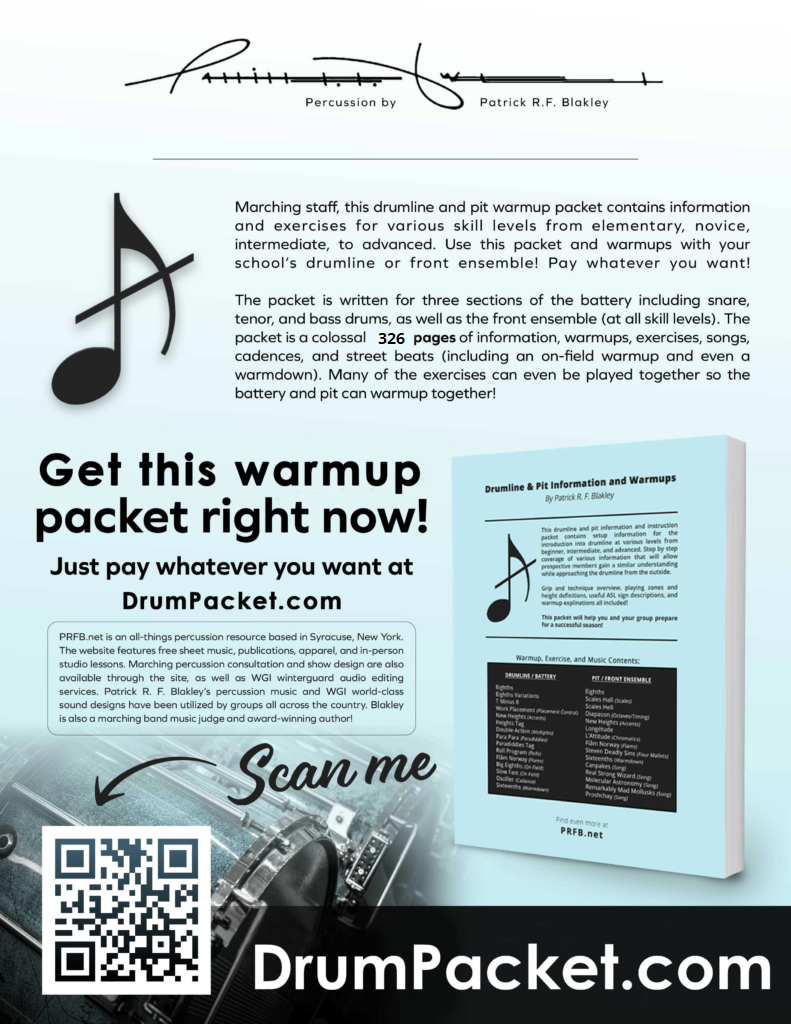
I put together a full drumline warm up and technique packet designed to give instructors the materials they need to get started immediately. The goal is to provide more than a collection of random exercises. The packet is organized around the fundamental skills that a marching percussion ensemble needs to develop, giving instructors a framework they can use during regular rehearsals and throughout the season.
Instead of guessing what to teach each day, you have a structured approach that has already been used with real ensembles. That means you can spend less time figuring out what exercise should come next and more time listening to your students, identifying problems, and helping them improve. The material can also serve as a starting point for instructors who want to eventually develop their own warm up system. Once you understand how exercises are organized and what skills they are designed to develop, it becomes much easier to modify the material for different players and ensembles.
A structured packet is not meant to replace good instruction. The instructor still has to listen, demonstrate, correct technique, adjust tempos, and determine when the group is ready to move forward. The purpose is to provide a reliable framework for doing that work. With the right materials already in place, rehearsal time can be focused on developing musicians rather than constantly creating new worksheets and exercises.
What Is Included in the Drumline Warm Up Packet
This packet includes over 300 pages of material designed for drumlines at a wide range of experience levels. The goal is to give instructors a complete resource that can be used with beginning players, developing ensembles, and more advanced performers. Rather than requiring an instructor to piece together separate technique exercises, warm ups, communication tools, and repertoire from multiple sources, the packet brings those materials together into one organized system.
What Is Included in the Drumline Packet?
The packet includes a full technique section covering fundamental concepts such as grip, posture, playing zones, stroke types, and dynamics. These concepts provide the physical foundation for consistent playing. Establishing common technique early is especially important when working with a group because students often arrive with different playing backgrounds and habits. Having clearly defined standards gives the instructor a reference point for teaching and correcting those differences.
There are also visual guides for clear instruction. Demonstrating a technique is often more effective when students can see exactly what they are being asked to do. Visual references give instructors another way to explain concepts and give students something they can review outside of rehearsal. This can be particularly useful when teaching younger players or introducing a technique that requires specific physical positioning.
The packet also includes communication tools designed to improve rehearsal efficiency. Drumline rehearsals involve a significant amount of information, and clear communication can make a major difference in how quickly an ensemble learns. Having consistent terminology and communication methods helps instructors give directions more efficiently and helps students understand exactly what is expected without repeatedly stopping to explain the same concepts.
At the center of the packet are 130 pit and drumline warm ups, exercises, and variations, along with drumline cadences and pit songs. This provides instructors with a substantial collection of material that can be used throughout the season rather than a small group of exercises that becomes repetitive after a few rehearsals. Variations also allow instructors to adjust familiar material by changing tempos, dynamics, sticking patterns, or other musical elements as students develop.
The material covers snare drum, tenors, bass drum, and front ensemble. This makes the packet useful for the entire percussion section rather than focusing exclusively on the snare line. Each section of the battery has different technical and musical demands, while the front ensemble has its own approach to technique, rhythm, sound production, and ensemble playing. A complete drumline curriculum needs to account for those differences while still maintaining a unified musical approach.
Exercises are included for beginner through advanced levels. This allows instructors to introduce fundamental concepts to new players while continuing to challenge more experienced performers. Not every student needs to perform every exercise at the same tempo or difficulty level. Instructors can select appropriate material based on the ability of the group and gradually increase the demands as players become more comfortable.
The packet also includes a cadence and warm down sequence. Cadences provide an opportunity for students to apply their skills in a more performance-oriented setting, while a structured warm down gives the rehearsal a defined conclusion. Ending rehearsal with focused, controlled playing can also reinforce the same technique and musical standards established during the warm up.
Audio examples are also available so students can play along with the exercises and develop stronger timing and consistency. Audio references give students another way to practice when an instructor is not directly in front of them. They can also help students hear the intended tempo and musical feel of an exercise, making them a useful supplement to the written notation.
Together, these materials are designed to give drumline instructors a practical system they can use from the first rehearsal through the rest of the season. The emphasis is on having enough material to teach fundamentals, develop technique, improve ensemble timing, and keep students progressing as their skills improve.
Built for All Skill Levels
Whether your group is a middle school drumline, a high school ensemble, or a more advanced competitive group, the material can be adapted to match the needs of your players. Not every ensemble starts at the same technical level, and even players within the same group can have very different levels of experience. A useful drumline curriculum needs to account for those differences rather than assuming every student is ready for the same material.
For a middle school drumline or beginning ensemble, instructors can start with fundamental exercises that focus on basic technique, rhythm, coordination, dynamics, and ensemble awareness. The goal at this stage is to establish good playing habits and help students become comfortable reading and performing percussion notation. Building these skills gradually gives younger players a foundation they can continue developing as they gain experience.
A high school drumline may have a wider range of ability levels. Some students may be participating in marching percussion for the first time, while others may have several years of experience. In this situation, instructors can use easier material to establish common standards across the ensemble and then introduce more challenging exercises as players demonstrate that they are ready. This also makes it easier to maintain a consistent rehearsal structure when students are progressing at different rates.
More advanced competitive groups can use the material as a foundation for refining technique, developing endurance, improving timing, and working on more demanding musical concepts. Advanced players do not necessarily need completely different fundamentals. In many cases, the same basic concepts become more important as the demands of the music increase. The difference is in how precisely and consistently those concepts must be performed.
The important idea is that you can start simple and gradually increase the difficulty as your players improve. An exercise does not have to be difficult to be useful. In fact, simple exercises can be some of the most effective teaching tools when they are performed with a high standard of accuracy and consistency. As students improve, the instructor can increase tempo, add dynamics, introduce more complicated rhythms, or move into more advanced variations.
This approach also gives the warm up a natural progression throughout the season. Early rehearsals can focus heavily on establishing technique and basic ensemble skills. As the players become more comfortable, the instructor can shift more attention toward speed, endurance, musical interpretation, and advanced coordination. The warm up remains familiar, but the expectations continue to increase.
That flexibility makes the system useful for different types of programs. The same overall framework can support a beginning middle school group, a developing high school drumline, or an experienced competitive ensemble without requiring every group to move through the material at the same pace.
Digital Download and Super Flexible Pricing
The digital version of the drumline warm up packet is available as a pay what you want download. This pricing model is intended to make the material accessible to instructors and programs with different budgets. Not every drumline has the same level of financial support, and the cost of instructional materials can become a significant consideration for smaller music programs.
A digital packet also gives instructors immediate access to the material without waiting for a physical book to be shipped. This can be especially useful when preparing for a new season or taking over a drumline with little existing curriculum. The files can be kept with other teaching resources and referenced during rehearsal, while individual exercises can be printed when a physical copy is more convenient.
The pay what you want format makes the packet particularly accessible for new instructors, smaller programs, and anyone working with a limited budget. A new instructor may already be purchasing equipment, music, sticks, mallets, and other supplies for the ensemble. Smaller programs may have limited funding available for instructional materials. Providing a flexible pricing option allows those instructors to access the same core material without making the cost of the packet a barrier.
The packet can also be useful for instructors who have an existing curriculum but want additional exercises and resources. There is no requirement to replace everything a program is already doing. Individual warm ups, technique exercises, communication tools, or supplemental materials can be incorporated into an existing rehearsal system as needed.
If you prefer working from a printed book, a physical version is also available online. A printed copy can be useful for instructors who want to keep the packet on a music stand or rehearsal table and make notes directly on the pages. Some instructors also find that having a physical reference makes it easier to quickly move between exercises during a rehearsal.
Whether you use the digital version, the physical version, or a combination of both, the goal is the same: provide drumline instructors with a practical collection of material they can use to teach technique, structure rehearsals, and help their players improve throughout the season.
How to Use It With Your Ensemble
The drumline warm up packet is designed to be flexible rather than requiring every instructor to follow one specific rehearsal format. Every program has different goals, rehearsal schedules, student ability levels, and teaching styles. The material can therefore be used as a complete curriculum or as a collection of supplemental resources that can be incorporated into a system you already use.
You can use it as your full warm up system if you are looking for a structured starting point. The exercises can provide a consistent framework for regular rehearsals, allowing you to establish common technique standards and gradually introduce more advanced material as the season progresses. This can be particularly helpful for instructors who are building a drumline program from the ground up and want a complete collection of material rather than having to assemble one exercise at a time.
You can also pull individual exercises into your current routine. If your program already has a successful warm up, there is no reason to throw it away. You can use individual exercises to address specific technical or musical needs. For example, you might use a particular exercise to work on subdivision accuracy, another to develop dynamic control, and another to challenge the ensemble's ability to maintain consistency at faster tempos.
The material can also be used to assign exercises for individual practice. Students do not improve only during rehearsal. Regular individual practice is an important part of developing the physical coordination, timing, endurance, and consistency required for marching percussion. Assigning specific exercises gives students a clear idea of what they should work on between rehearsals instead of simply telling them to practice more.
Instructors can also share materials directly with their students. This gives players access to the same notation and reference material being used during rehearsal. Students can review an exercise at home, prepare upcoming material, and use the written resources alongside the audio examples when practicing independently.
The system is intentionally flexible so you can adapt it to your teaching style. An experienced instructor may use the packet as a source of supplemental material, while a new instructor may rely on it as the foundation of an entire warm up program. The important thing is that the material serves the needs of the ensemble rather than forcing every drumline into exactly the same routine.
Final Thoughts
Building a great drumline starts with a clear system. Without a consistent approach to technique, timing, musical development, and rehearsal, progress can become slow and inconsistent. Players may practice the same material but develop different habits, and instructors can find themselves repeatedly stopping rehearsal to address problems that should have been established earlier. A structured teaching system gives both the instructor and the students a clear direction.
A well-designed warm up packet provides a foundation for everything your group does, from daily rehearsal to performance. The skills developed during warm ups carry directly into show music, cadences, exercises, and ensemble performance. When students regularly work on consistent strokes, accurate rhythms, controlled dynamics, proper technique, and ensemble timing, they are developing skills that can be applied to virtually every piece of music they perform.
The warm up also provides an opportunity to establish expectations before the ensemble begins working on more complicated material. If players understand how notes should sound, how dynamics should be performed, how rhythms should line up, and what the instructor expects from their technique, those standards can become part of the group's normal playing habits. This makes it easier to identify problems later because the ensemble already has a defined standard to compare its performance against.
A structured system can also make rehearsal time more efficient. Rather than spending every rehearsal deciding what the group should work on, an instructor can follow a progression and make adjustments based on what the players need. If timing is inconsistent, the warm up can emphasize timing exercises. If technique is breaking down at faster tempos, the instructor can return to slower material and rebuild the necessary control. If the group is sounding inconsistent dynamically, exercises can be selected that focus specifically on volume and articulation.
If you are looking for a way to improve your drumline efficiently, having a complete set of exercises, technique guidelines, and teaching tools in one place can make a significant difference. It gives you more options when planning rehearsals and gives your students a consistent set of materials to reference when practicing on their own.
Ultimately, the goal of a drumline warm up is not simply to make the first few minutes of rehearsal sound good. It is to build the skills that allow the ensemble to perform more difficult music with greater accuracy, consistency, confidence, and musical control. When the warm up is treated as part of the teaching system rather than as a routine that players simply have to get through, it becomes one of the most useful tools an instructor can have.

About the Author
Patrick Blakley is a percussion educator, author, adjudicator, and entrepreneur specializing in marching percussion and drumline education. He is the creator of DrumPacket.com, DrumlineWarmups.com, DrumAudit.com, DrumsetGrooves.com, and SyracuseDrums.com. His educational materials and performance audio edits through CompetitiveMusic.com are used by hundreds of schools and programs across the United States and beyond. He is the author of Quadratics: The Tenor Drum Equation, The Field Percussion User Manual, and other instructional music books. Read more about him by clicking here!
