
How to Use a Tachymeter to Find Tempo (BPM) Without a Metronome
How to Use a Tachymeter to Find Tempo Without a Metronome
If you have ever noticed the numbers around the edge of your watch and wondered what they do, you are not alone. That scale is called a tachymeter, and while it is most commonly associated with measuring speed and distance, the same scale can also be used as a practical tempo reference for musicians. For drummers, percussionists, and marching band performers, a tachymeter can provide a surprisingly useful way to estimate beats per minute when a traditional metronome is not available.
A tachymeter is typically found on watches with a chronograph and is designed to calculate the rate of an event over a known period of time. In its traditional use, it can help determine how many units of something occur within an hour. When the "something" is a musical beat, the same basic principle can be applied to tempo. By timing a specific number of beats and reading the corresponding value on the tachymeter scale, you can estimate the tempo of the music in beats per minute, or BPM.
This can be particularly useful during drumline rehearsals, marching band practices, percussion lessons, and performances where you need a quick tempo reference. You may not always have a metronome, phone, or other timing device immediately available, but you may have a watch with a tachymeter on your wrist. Once you understand how the scale works, you can use it to make a quick BPM estimate without needing any additional equipment.
In this guide, we will look at how a tachymeter works, how to use one to measure musical tempo, and why the method is useful for drummers and other musicians. The technique is not intended to replace a precision metronome for detailed practice, but it can be a convenient way to check tempo when you need a fast and practical estimate.
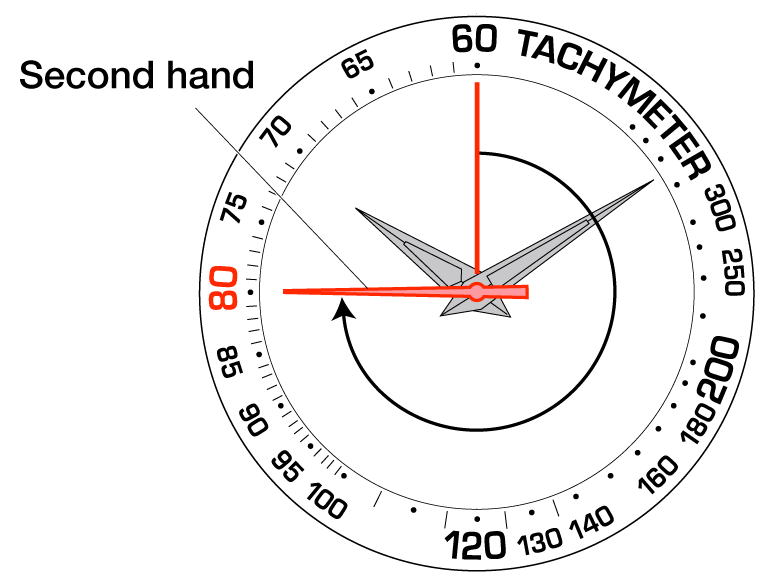
What Is a Tachymeter?
A tachymeter is a numbered scale printed on the bezel or face of certain analog watches. It is designed to measure a rate over a specific period of time, most commonly the speed of a moving object. By combining the watch's chronograph function with the tachymeter scale, the wearer can determine how many units of an activity occur within one hour.
The same basic principle can be applied to music because tempo is a rate. Instead of measuring miles per hour or another physical quantity, a musician can use the tachymeter to estimate the number of beats that occur in one minute. Since musical tempo is expressed as beats per minute, or BPM, the tachymeter's numerical scale can serve as a quick reference for determining tempo.
For drummers and percussionists, this creates an interesting secondary use for a watch that was not specifically designed as a musical tool. A tachymeter can function as a quick tempo calculator when a metronome is not available. With a chronograph watch and a little practice, you can time a set number of beats and use the tachymeter reading to estimate the BPM of the music.
The method is particularly useful for situations where you need a fast tempo check rather than laboratory-level precision. A drummer might use it during rehearsal to determine approximately how fast an ensemble is playing, while a drumline instructor could use it to check whether a group is close to its intended marching tempo. It is a simple example of applying a tool designed for one purpose to another practical musical problem.
Why Use a Tachymeter for Tempo?
Using a tachymeter to measure tempo can be useful when you need a quick BPM estimate but do not have immediate access to a metronome or electronic tempo tool. It provides a simple analog method that can be used with a watch you may already be wearing. While it is not intended to replace a precision metronome, it can provide a practical reference when you need to determine the approximate tempo of music quickly.
A tachymeter can be especially convenient during rehearsal. If an ensemble is working through a section and the intended tempo is not immediately known, an instructor can time a series of beats and use the tachymeter scale to estimate the BPM. This can provide enough information to determine whether the group is playing close to the desired tempo or needs to adjust its pacing.
The technique can also be useful on the marching field or in a live performance setting. Instructors, judges, and performers may occasionally need to verify an approximate tempo without interrupting an event or relying on electronic equipment. In a competition environment, where maintaining consistent timing is important, having a quick analog reference can be useful for checking tempo relationships and confirming that an ensemble is performing within the expected range.
This method is particularly relevant to marching band and drum corps environments, where tempo consistency affects everything from individual technique to ensemble coordination and movement. A small change in tempo can influence how performers approach a phrase, how visual elements line up with the music, and how the ensemble maintains synchronization over the course of a performance.
A tachymeter is therefore best viewed as a quick BPM estimation tool rather than a replacement for a metronome. When precision is required during practice, a reliable metronome remains the better choice. When you need a fast, convenient, and reasonably accurate tempo estimate in the field or during a live setting, a tachymeter can be surprisingly useful.
How to Find Tempo Using a Tachymeter
Step 1: Start the Timer
Begin by starting the timing hand on your watch.
If your watch has a chronograph function, press the start button
If not, use the second hand as it passes the 12 o’clock position
Step 2: Count the Music
The goal is to measure exactly 60 beats of music.
In most cases, this means counting quarter notes.
If the music is in 4/4 time, an easy method is to count 15 measures. Since each measure contains 4 beats, 15 measures equals 60 beats.
Step 3: Stop at Beat 61
When you reach the next downbeat after your 60th beat (in other words, when you say “61”), stop the timer.
The position of the timing hand on the tachymeter scale will now indicate the tempo in BPM.
Example: 120 BPM
Suppose a piece of music is being performed at 120 BPM and you want to verify the tempo using a tachymeter. Since 120 BPM means that 120 beats occur every minute, you can measure a smaller number of beats and use the elapsed time to determine the same rate. For this example, counting 60 beats is useful because it represents exactly half of the beats that would occur in one minute.
At 120 BPM, 60 beats will take 30 seconds to occur. Start the chronograph at the beginning of a beat and count 60 consecutive beats at the same pulse. When you reach the final beat, stop the chronograph and look at the tachymeter scale. The elapsed time of 30 seconds corresponds to a rate of 120 events per hour, so the chronograph hand will point to approximately 120 on the tachymeter scale.
The important idea is that you are using the watch to measure the rate of the beats rather than measuring an entire minute. The tachymeter converts the measured time interval into a rate, allowing you to determine the approximate tempo from the position of the chronograph hand. This makes it possible to check a 120 BPM tempo relatively quickly without having to count beats for a full 60 seconds.
The same principle can be applied to other tempos by changing the number of beats you count. The key is understanding the relationship between the number of beats, the amount of elapsed time, and the BPM indicated by the tachymeter. Once that relationship becomes familiar, measuring tempo with a tachymeter becomes a straightforward process.
How to Use a Tachymeter in Different Time Signatures
4/4 Time
Count 15 measures (60 beats total), then stop the timer on the next downbeat.
Other Time Signatures
When using a tachymeter to estimate musical tempo, it is generally easier to count individual quarter notes rather than counting measures. The tachymeter is measuring the rate of the musical pulse, so the number of beats contained in each measure is not important as long as you consistently identify the quarter note as the beat being measured.
For example, you can use this approach with music written in 3/4, 5/4, 7/8, or mixed meter. The time signature changes how the beats are organized into measures, but it does not prevent you from measuring a consistent quarter note pulse. Rather than trying to calculate how many measures have passed, simply count 60 quarter-note beats while maintaining a steady tempo.
This is particularly useful with music that changes time signatures or uses unusual meters. If you counted measures instead of beats, you would need to account for the different number of beats in each measure. Counting quarter notes eliminates much of that complication. You are measuring the actual musical pulse directly, regardless of how the composer groups those beats into measures.
The key is maintaining a steady quarter-note pulse throughout the measurement. Start the chronograph precisely with the beginning of the first beat, count the designated number of quarter notes, and stop the timer consistently at the end of the count. The more accurately you maintain the pulse and operate the chronograph, the more useful your tachymeter reading will be as an estimate of the actual BPM.
For drummers and percussionists, this approach is especially practical because maintaining a steady pulse is already a fundamental part of playing. Once you understand that you are measuring beats rather than measures, the technique can be applied to a wide range of musical meters without changing the basic process.
Compound Time (6/8 and 12/8)
Compound time signatures such as 6/8 and 12/8 require a slightly different approach because the musical pulse is often felt as a dotted quarter note rather than an individual eighth note. In 6/8, for example, the six eighth notes are commonly grouped into two larger beats. In 12/8, the twelve eighth notes are commonly organized into four larger beats. When musicians feel those larger groupings as the primary pulse, the dotted quarter note becomes the more natural unit for measuring tempo.
If you use a tachymeter while counting dotted quarter notes, the tachymeter will measure the rate of those dotted quarter-note pulses. The resulting number therefore represents dotted quarter notes per minute, not standard quarter-note BPM. This distinction is important because the two tempo values describe different rhythmic units even though they refer to the same piece of music.
For example, a tempo of 80 dotted quarter notes per minute in 6/8 is not the same as 80 quarter notes per minute. A dotted quarter note contains one and a half quarter notes, so the equivalent quarter-note tempo would be 120 BPM. The tachymeter is simply reporting the unit you chose to count. It does not automatically know whether you are counting quarter notes, dotted quarter notes, or another rhythmic value.
When using this technique, identify the primary pulse of the music before starting the measurement. If the ensemble is clearly feeling 6/8 or 12/8 in larger dotted quarter-note groupings, count those pulses consistently rather than switching between eighth notes and dotted quarter notes. This keeps the measurement internally consistent and gives you a useful tempo reference for the way the music is actually being performed.
For drummers, this distinction is especially important when working with marching music, drumline arrangements, and other music that may use compound meters. Knowing exactly which rhythmic value you are measuring prevents confusion when comparing a tachymeter reading with a metronome setting or a written tempo marking.
Using a Tachymeter in Odd Meter
For time signatures such as 5/8 and 7/8, the musical feel can shift depending on how the beats are grouped. Unlike a simple meter such as 4/4, where the quarter-note pulse is usually straightforward, odd meters can divide their eighth notes into different groupings. For example, 7/8 might be felt as 2+2+3, 3+2+2, or another combination depending on the music. Those groupings can change the way the rhythm feels without necessarily changing the underlying tempo.
When using a tachymeter, the most important thing is to establish a consistent pulse before you begin counting. One approach is to interpret the odd meter against a larger quarter-note-based pulse. For example, if the music in 7/8 is being felt with a steady underlying pulse, you can use that pulse as your reference rather than trying to treat each measure as a separate unit. The goal is to measure a consistent rhythmic value, not the number of measures that pass.
Once you have established the pulse, count 60 quarter-note beats while keeping the tempo as steady as possible. Starting and stopping the chronograph consistently is just as important as maintaining the musical pulse. The tachymeter reading is based on the elapsed time between the beginning and end of your count, so inconsistent counting or timing will reduce the accuracy of the result.
The same principle applies to mixed meter. A passage might alternate between 5/8, 7/8, 3/4, and other time signatures, but the underlying pulse can remain consistent throughout. The time signature determines how the beats are organized, while the pulse determines how quickly those beats occur. If you maintain that pulse while measuring, the tachymeter can provide a useful tempo reading even when the meter changes from measure to measure.
For drummers and percussionists, this is an important distinction. Do not use the number of beats in a measure as your tempo reference unless that is specifically the rhythmic unit you intend to measure. Instead, identify the consistent pulse, count that pulse accurately, and let the tachymeter calculate the rate. This makes the technique much more reliable when working with odd meters, mixed meter, and rhythmically complex music.
When This Method Works Best
Using a tachymeter to estimate musical tempo is most effective when the music has a steady tempo and a clearly identifiable pulse. The technique depends on measuring a consistent rate over a specific period of time, so the more stable the underlying pulse is, the more useful the resulting BPM reading will be. This makes the method particularly well suited to marching band, drumline, drum corps, and other ensemble settings where maintaining a consistent tempo is an important part of performance.
You should also be able to clearly identify the rhythmic pulse you are measuring. Before starting the chronograph, determine whether you are counting quarter notes, dotted quarter notes, or another consistent rhythmic value. Once you begin counting, that unit should remain unchanged for the duration of the measurement. If the music is performed with a strong and consistent pulse, this can produce a useful approximation of the current tempo.
Accurate counting is equally important. Losing your place, accidentally skipping a beat, adding an extra beat, or starting the chronograph late can all affect the final reading. For that reason, it is often helpful to count a manageable number of beats that you can track comfortably while also operating the watch. With practice, musicians can become comfortable using the technique without disrupting their normal focus on the performance or rehearsal.
The method becomes less reliable when the music contains significant tempo changes, accelerando, ritardando, or rubato. In these situations, the tempo is intentionally changing, so there is no single BPM value that accurately describes the entire passage. The tachymeter can still measure the average rate over the period you time, but that number may not represent the tempo at every individual beat.
For the most accurate results, use the tachymeter during a section where the tempo is stable and the pulse is easy to follow. When precise BPM information is required for practice, programming, or detailed musical analysis, a digital metronome or other dedicated tempo tool remains the better choice.
Final Thoughts
A tachymeter is more than just a design feature on an analog watch. For musicians, it can also serve as a practical tool for estimating tempo when a metronome is not available. By combining the watch's chronograph with the tachymeter scale, you can measure a consistent musical pulse and use the resulting reading to estimate the tempo in beats per minute.
This can be particularly useful when teaching a drumline, rehearsing with a marching band, working with a drum corps, or checking tempo in a live performance setting. A watch is considerably easier to carry onto a marching field than a full set of electronic equipment, and the tachymeter provides an analog alternative when you need a quick reference. It can be especially convenient for instructors who need to verify the approximate tempo of an ensemble without stopping rehearsal to set up a metronome.
Once you become comfortable identifying the pulse, counting consistently, and operating the chronograph, the process becomes relatively quick. In many cases, you can determine an approximate tempo in well under a minute. The exact amount of time required depends on the number of beats you choose to count and the tempo being measured, but the basic principle remains the same: measure a known number of musical pulses and use the tachymeter to determine the corresponding rate.
The method is most useful as a practical tempo estimation technique rather than as a replacement for a precision metronome. For detailed practice, recording sessions, or situations where exact BPM accuracy is required, dedicated electronic tempo equipment is still the better choice. However, when you need a fast and convenient way to check tempo in a rehearsal, on the marching field, or during a performance, a tachymeter can be surprisingly effective.
Once you understand how the scale works, your watch becomes another tool in your percussion toolkit. Instead of simply telling you what time it is, it can also give you a quick answer to another question musicians ask constantly: What tempo are we playing?
About the Author
Patrick Blakley is a percussion educator, author, adjudicator, and entrepreneur specializing in marching percussion and drumline education. He is the creator of DrumPacket.com, DrumlineWarmups.com, DrumAudit.com, DrumsetGrooves.com, and SyracuseDrums.com. His educational materials and performance audio edits through CompetitiveMusic.com are used by hundreds of schools and programs across the United States and beyond. He is the author of Quadratics: The Tenor Drum Equation, The Field Percussion User Manual, and other instructional music books. Read more about him by clicking here!
