
Star Spangled Banner Snare Drum Solo Free Sheet Music and Performance Idea
⭐ This post focuses on a snare drum solo using the rhythms of the Star Spangled Banner. ⭐
If you’re looking for the ACTUAL percussion parts for the song, CLICK HERE!
Star Spangled Banner Snare Drum Solo Free Sheet Music and Performance Idea
The United States National Anthem is one of the most recognizable pieces of music in the country. The Star-Spangled Banner is performed before sporting events, military ceremonies, civic events, school functions, and other public gatherings, most often by a solo vocalist. Even when the performance is relatively simple, the melody is so familiar that audiences generally recognize it within the first few phrases.
The song also presents some interesting musical challenges. The melody contains wide leaps, sustained notes, changes in intensity, and phrases that require careful control of musical tension and release. A strong vocal performance has to balance those elements while also dealing with the unusually large range of the melody.
Occasionally, you will hear a full ensemble version featuring a concert band, orchestra, brass ensemble, or other instrumentation. Percussion may also be included, with instruments such as snare drum and crash cymbals providing accents and helping establish the ceremonial character of the performance.
But here is a version you probably have not heard before.
This is a snare drum solo arrangement of The Star-Spangled Banner.
Yes, the entire anthem. No singer. No brass. No orchestra. Just one drummer holding the entire musical concept together and hoping nobody accidentally starts saluting in 7/8.
At first, arranging a national anthem for solo snare drum sounds like a deliberately ridiculous idea. The original melody depends heavily on pitch, and a snare drum does not have a traditional system of pitched notes. That means the arrangement has to communicate the identity of the melody through other musical elements.
The solution is to translate the rhythmic contour, phrasing, accents, dynamics, and articulation of the melody into percussion language. Instead of literally reproducing every pitch, the solo uses rhythmic patterns and musical gestures that correspond to the movement of the original tune.
This is what makes the arrangement more than simply a novelty transcription. A good percussion arrangement has to preserve enough of the original musical structure that the listener can recognize the source material. The performer is essentially creating a melodic illusion using an instrument that is primarily associated with rhythm.
The arrangement follows the natural phrasing of The Star-Spangled Banner while translating those phrases into a playable and musical snare drum feature. Long melodic ideas can become sustained rolls or controlled rhythmic textures. Strong points in the melody can become accents. Climactic moments can be represented through dynamic growth, increased density, or more aggressive articulation.
Dynamics are particularly important.
Without pitch to provide much of the original melody, the performer has to use volume, articulation, spacing, and phrasing to create musical direction. A completely flat performance would quickly become nothing more than a sequence of notes. The arrangement works much better when the drummer treats each phrase as though they are actually singing it.
That means thinking beyond the individual sticking pattern.
Where does the phrase begin? Where is it going? Where does the musical tension increase? Where does it relax? Which notes are important, and which ones simply connect one idea to another?
Those questions are just as relevant to a snare drum solo as they are to a vocalist.
The result is written to be both fun and slightly ridiculous, but it is also surprisingly effective when performed with strong musical interpretation and dynamic contrast. The humor gets the audience's attention, but the musicality is what makes the arrangement worth performing.
It also makes the piece an interesting challenge for percussionists. A performer has to balance the novelty of the concept with the responsibility of treating the music seriously. Playing every note as loudly and aggressively as possible might technically get through the arrangement, but it misses the point. The goal is to make the audience hear the anthem hiding inside the snare drum.
And that is where the real challenge begins.
Can one percussionist take a melody normally carried by a human voice and an entire ensemble and make it recognizable using nothing but a snare drum?
There is only one way to find out.
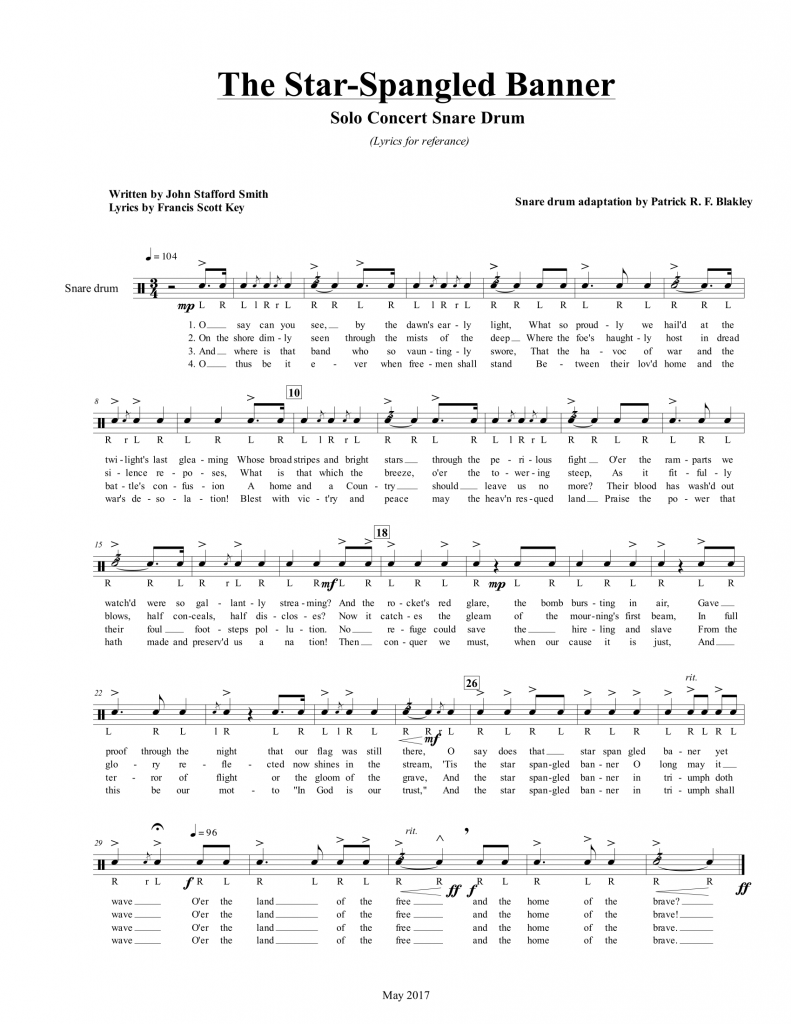
Why This Works
There is something inherently entertaining about taking a melody everyone knows and removing the melody entirely. The audience still hears The Star-Spangled Banner in their head while you are playing rudiments, rolls, accents, and rhythmic figures across a single snare drum. The listener supplies the missing pitches from memory, which creates a strange but surprisingly effective musical illusion.
That is part of what makes the arrangement work. The audience does not need to hear every pitch to recognize the musical idea. They already know the melody, so their brains fill in some of the information that the instrument cannot provide. The drummer is essentially giving the listener enough rhythmic and structural information to trigger the original melody in their memory.
The result is a strange effect where people recognize what is happening while simultaneously wondering how a national anthem ended up being performed as a snare drum solo.
That contrast between familiarity and absurdity is where much of the entertainment comes from. Everyone knows the source material, but almost nobody expects to hear it translated into rudimental percussion. The familiar musical phrases are still present, but they have been converted into something completely different.
From a percussion standpoint, however, the arrangement is more than a joke. It provides a useful exercise in several important performance skills.
Musical Phrasing on Snare Drum
A snare drum is often associated with precision, articulation, and rhythmic clarity. Those qualities are important, but they can sometimes lead performers to focus too heavily on individual notes. This arrangement encourages the player to think about the entire musical phrase instead.
The performer has to shape each phrase as though it were being sung. Notes need direction, accents need purpose, and transitions need to lead naturally into the next musical idea. The goal is to make the listener feel the shape of the melody even though there are no pitched notes reproducing it.
Dynamic Shaping Without Pitch
When an instrument does not provide a conventional melody, dynamics become even more important. Changes in volume can create contrast, establish hierarchy, and give a phrase somewhere to go.
A soft roll can function as a musical buildup. A strong accent can represent a point of arrival. A gradual crescendo can create the same feeling of increasing intensity that a vocalist or brass section might create through pitch and volume.
This makes the arrangement a useful reminder that musical expression does not depend entirely on pitch. Rhythm, dynamics, articulation, and tone can all contribute to the perception of musical direction.
Rudimental Interpretation of Melody
For percussionists, the arrangement provides an opportunity to think about rudiments differently. Instead of treating rolls, diddles, flams, accents, and other rudimental vocabulary as isolated technical exercises, the performer can use them as tools for musical interpretation.
The rudiments become the vocabulary of the arrangement.
A roll is not simply a roll. It can represent a sustained musical idea. An accent is not merely a louder note. It can identify an important point in a phrase. A sticking pattern can create motion that corresponds to the movement of the original melody.
This approach can help performers make the transition from playing exercises to making music. Technical vocabulary becomes much more useful when the performer understands why it is being used.
Performance Creativity
Finally, the arrangement encourages creativity. There is no obvious standard way to perform a national anthem on solo snare drum, which means the performer has room to develop an interpretation. Choices involving dynamics, articulation, tempo, stick height, roll quality, and stage presence can all affect the result.
That makes this kind of arrangement particularly useful for percussionists who are interested in performance beyond traditional concert literature. A familiar melody can become the starting point for experimentation rather than simply something that has to be reproduced exactly.
The joke gets the audience's attention.
The musical interpretation is what keeps them listening.
And that is ultimately the challenge of the arrangement. The performer has to make the audience hear a melody that is not actually being played.
Download the Snare Drum Solo
You can download the full Star-Spangled Banner snare drum solo sheet music below and use it however you like. The arrangement is designed to work as a standalone percussion feature, so you do not need an accompanying ensemble, backing track, or vocalist to make the concept work. All you need is a snare drum, a pair of sticks, and enough confidence to commit completely to the bit.
Because the source material is so familiar, this solo can work particularly well in situations where an audience is not expecting it. The recognition factor does much of the work for you. As soon as listeners realize what melody is being represented, the performance takes on an entirely different character.
It is perfect for:
A humorous recital piece that gives a traditional percussion performance an unexpected twist
A creative encore that leaves the audience with something memorable
A "this might actually work" performance moment where the novelty gradually turns into genuine musicality
Confusing your band director in the best possible way while still demonstrating legitimate percussion technique
The solo can also be useful as a short demonstration of how percussion instruments can communicate musical ideas without directly reproducing pitch. If you perform it for students, it provides an opportunity to discuss rhythm, phrasing, dynamics, rudiments, musical interpretation, and the role of the listener's memory.
For performers, the biggest challenge is resisting the temptation to treat the piece entirely as a joke. The concept is funny, but the performance becomes much more effective when you actually play it well. Clean technique, controlled dynamics, deliberate phrasing, and confident stage presence make the difference between a funny idea and a successful musical performance.
The audience should eventually reach a point where they realize that the ridiculous thing happening in front of them actually works.
That is the sweet spot.
So download the Star-Spangled Banner snare drum solo sheet music, grab your sticks, and see what happens when one of the most recognizable melodies in American music gets handed to a single snare drummer.
At minimum, you will have a story for the next rehearsal.
Performance Tips
If you actually plan to perform this, commit to it fully. The concept works best when the performer treats the arrangement as legitimate musical literature rather than constantly signaling to the audience that it is supposed to be funny. The humor comes from the contrast between the seriousness of the performance and the ridiculousness of hearing a national anthem represented entirely on a snare drum.
Start by shaping every phrase like a singer would. Think about where the melody breathes, where the musical line builds, and where it naturally releases. Even though the snare drum cannot reproduce the original pitches, you can still communicate the contour of the melody through dynamics, articulation, spacing, and rhythmic emphasis.
Use dynamics aggressively. A snare drum solo does not need to exist at one volume from beginning to end. Quiet passages can create anticipation, while larger accents and crescendos can provide the dramatic moments the audience expects from the original anthem. Dynamic contrast also helps the listener understand the structure of the piece.
Do not rush the opening.
This is particularly important because the audience may need a moment to figure out what they are hearing. If you immediately launch into an enormous drumline-style performance, the joke can disappear before the audience has time to recognize the melody. Let the opening breathe. Give the listener enough information to start making the connection.
Then let the performance build.
Once the audience realizes what is happening, you can lean into the percussion side of the arrangement. Stronger accents, larger dynamics, more aggressive rudimental vocabulary, and increased intensity can create the payoff. The transition works because the audience has already identified the source material.
And most importantly, play it seriously.
Do not smirk after every phrase. Do not stop to acknowledge the joke. Do not make exaggerated faces to tell everyone that you know how ridiculous the concept is. The more sincerely you perform it, the funnier the situation becomes.
That is the fundamental rule of this kind of performance:
The performer should take the music seriously so the audience can enjoy the absurdity.
If you treat the piece like a throwaway joke, the audience gets the joke immediately and it is over. If you perform it with the same concentration, discipline, and musicality you would bring to a serious snare drum solo, the audience has time to discover what is happening for themselves.
That discovery is the payoff.
The best version of this performance is the one where the audience goes from, "What is this?" to "Wait a minute..." to "Oh my gosh, that's The Star-Spangled Banner."
Then you just keep playing like nothing unusual is happening.
Final Thoughts
This started as a joke, but like many good percussion ideas, it accidentally turned into something useful. What began as an unusual way to present The Star-Spangled Banner became an exercise in phrasing, dynamics, rudimental technique, musical interpretation, and performance creativity.
That is part of what makes unusual arrangements worthwhile. A strange idea can force you to approach familiar musical concepts from a completely different direction. When the normal tools are removed, you have to find new ways to communicate the same musical information. In this case, taking away the melody created an opportunity to explore how much of a familiar song can still be communicated through rhythm, dynamics, articulation, and phrasing.
If you enjoy creative snare drum solos, unusual percussion arrangements, or simply want something different to add to your practice routine, give this one a shot. It can work as a recital piece, an encore, a classroom demonstration, or simply a ridiculous challenge to see whether you can make a familiar melody recognizable on one snare drum.
It is also a good reminder that percussion does not always have to take itself so seriously. There is plenty of value in traditional repertoire and disciplined technical study, but musicians also benefit from occasionally doing something completely unexpected. A strange arrangement can challenge your playing, entertain an audience, and give you a reason to think differently about your instrument.
And if you perform this live, there is a non-zero chance someone in the audience will try to sing along.
They may not even realize they are doing it at first. Their brain recognizes the rhythmic and structural information, supplies the missing pitches, and suddenly someone in the audience is quietly singing a national anthem while one person plays a snare drum.
That alone makes it worth it.
You can also check out some free drumline warmups and exercises on the warmups page too!
The Actual Snare Drum & Percussion Sheet Music for The Star-Spangled Banner
If you came to this page looking for the actual snare drum sheet music for The Star-Spangled Banner, rather than the slightly ridiculous solo arrangement above, you are in luck.
The traditional snare drum version is considerably simpler. This is my take on a practical percussion arrangement that allows the drums and cymbals to support the brass, woodwinds, and vocals without getting in the way.
One of the most common mistakes percussionists make when performing The Star-Spangled Banner is simply playing too loudly. A loud drum roll or crashing cymbal can quickly distract from the melody and lyrics. The drummer's job, as it is in practically every musical setting, is to complement the music happening around them. Percussionists are not always the stars of the show, and mature musicians understand when their role is to support rather than stand out.
This arrangement is designed with that philosophy in mind. The percussion provides a foundation for the anthem while remaining underneath the ensemble. The cymbals become more prominent toward the end, making their impact greater because they have remained relatively subdued until that moment.
The snare drum roll creates a sustained texture without demanding attention, then subtly reminds us of its importance when it returns after moments of silence. The bass drum serves as a quiet heartbeat throughout the piece before taking on the role of a distant cannon shot at the climax.
Every percussion part has a purpose. By understanding their individual roles and playing with musical maturity, percussionists can support The Star-Spangled Banner rather than compete with it. This arrangement gives each player a clear role while creating a percussion accompaniment that complements the music as a whole.
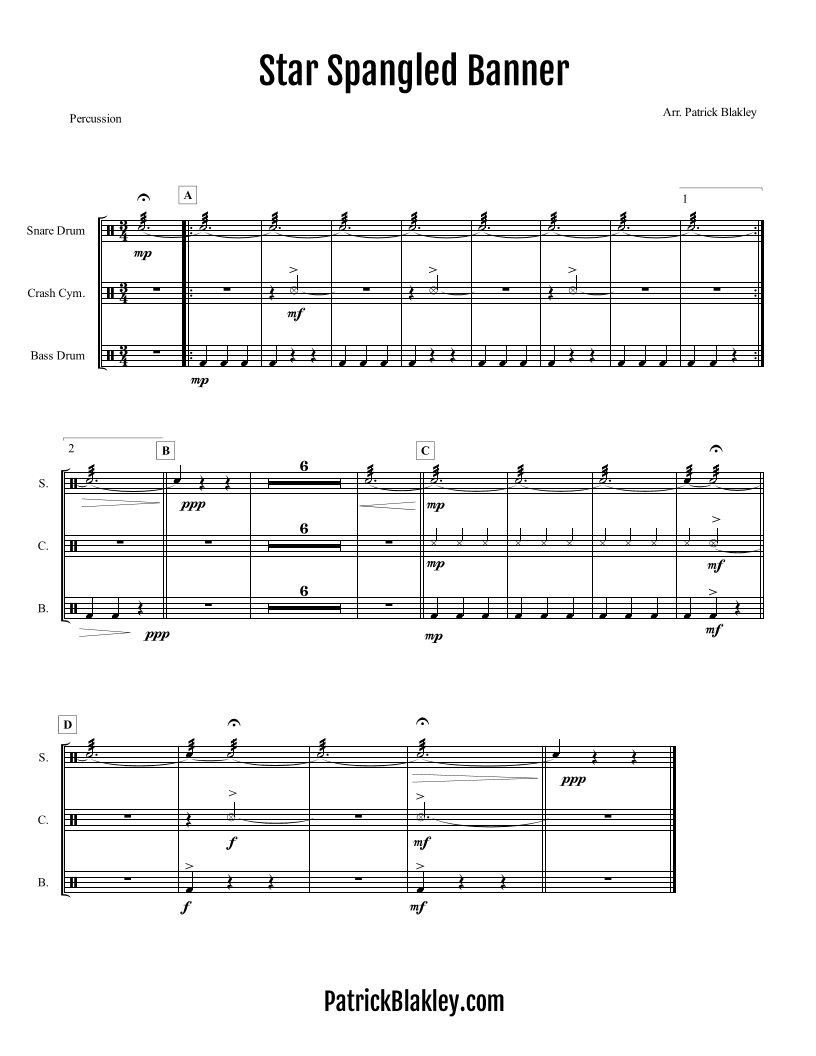
In many ceremonial performances, the snare drum part is essentially a long roll that accompanies the anthem. Instead of attempting to reproduce the melody through rudimental patterns, the drummer provides a sustained roll that supports the musical performance without competing with the vocalist or ensemble.
That makes sense from a traditional ceremonial percussion standpoint. The snare drum is not there to play the melody. Its role is to provide a controlled, sustained texture and reinforce the formal character of the performance. A well-executed roll can sit underneath the anthem without distracting from the primary musical material.
The challenge is that a long roll is deceptively simple. Playing one for an extended period requires consistent stick control, evenness, dynamic control, and endurance. The drummer has to maintain a continuous sound while avoiding unwanted accents, changes in volume, or breaks in the roll. At a soft dynamic, this can be considerably more difficult than simply playing loud.
So if you were actually searching for Star-Spangled Banner snare drum sheet music, this is probably the version you had in mind.
You can download the traditional snare drum part below as well. It is useful for ceremonial performances, patriotic events, demonstrations, or anyone who simply needs the straightforward percussion part rather than the full snare drum solo arrangement.
And yes, it is basically a long roll.
Sometimes the correct answer really is the least complicated one.
Then again, if you would rather play the entire national anthem as a rudimental snare drum solo, that option is available too.
Download the real snare drum sheet music for the Star Spangled Banner here!
About the Author
Patrick Blakley is a percussion educator, author, adjudicator, and entrepreneur specializing in marching percussion and drumline education. He is the creator of DrumPacket.com, DrumlineWarmups.com, DrumAudit.com, DrumsetGrooves.com, and SyracuseDrums.com. His educational materials and performance audio edits through CompetitiveMusic.com are used by hundreds of schools and programs across the United States and beyond. He is the author of Quadratics: The Tenor Drum Equation, The Field Percussion User Manual, and other instructional music books. Read more about him by clicking here!
