
Drumline Warmups Versus Exercises (And How To Effectively Use Them Both)
Drumline Warmups vs. Exercises: What’s the Difference, and When Should You Use Each?
If you’ve ever been handed a packet of drumline music labeled “EXERCISES,” only to find another packet labeled “WARMUPS,” you might be wondering: aren’t they the same thing? Spoiler alert, they’re not. While both are important parts of a drumline’s musical development, they serve different purposes during rehearsal and should be approached differently by performers and instructors.
A drumline warmup is generally designed to prepare players for the physical and musical demands of rehearsal. Warmups help establish sound quality, stick technique, timing, balance, articulation, and basic ensemble coordination before the group moves into more demanding material. A good warmup can also give performers a consistent way to focus their hands and ears at the beginning of every rehearsal. It is less about learning a complicated musical idea and more about getting the players ready to perform at their best.
A drumline exercise, on the other hand, is usually designed to develop a specific skill or challenge a particular aspect of playing. An exercise might focus on subdivisions, accent patterns, dynamic control, timing, endurance, hand-to-hand coordination, rolls, diddles, flams, or transitions between different techniques. Exercises can certainly be used as warmups, but their primary purpose is usually skill development rather than simply preparing the players to play.
That distinction becomes especially important when planning an efficient drumline rehearsal. If every piece of music is treated as a warmup, players may spend valuable rehearsal time working on material that requires much more concentration than they actually need at that point in the rehearsal. Likewise, if a warmup is treated like a performance exercise, players may focus too heavily on playing everything perfectly instead of using the material to establish proper technique, sound, and timing.
The easiest way to think about it is this: warmups prepare you to play, while exercises teach you how to play better. There is plenty of overlap between the two, and some pieces of drumline music can serve both purposes. The important thing is understanding what each piece is intended to accomplish and using it accordingly.
Let’s break down the differences between drumline warmups and exercises, when you should use each one, and how they can work together to make your rehearsal time more productive.
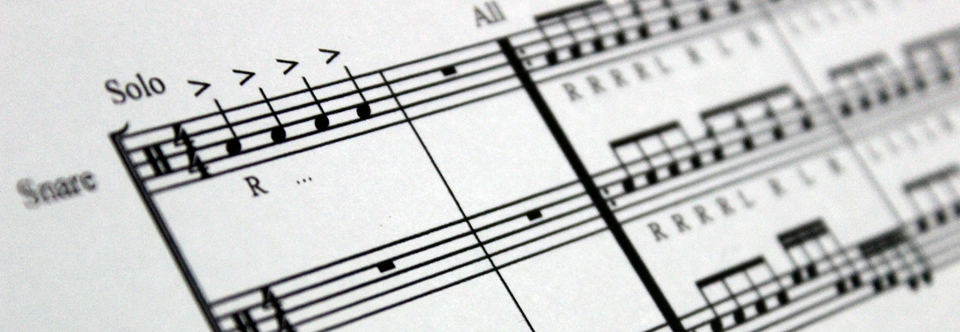
What Is a Drumline Exercise?
A drumline exercise is a detailed, focused breakdown of a specific skill or musical concept. Think of it as a deep dive into one particular area of playing, such as timing, diddles, rolls, flams, stick heights, hand speed, articulation, dynamic control, or endurance. Rather than trying to cover everything at once, a well-designed exercise gives the performers an opportunity to concentrate on one skill and develop it through repetition.
Exercises are especially useful because they can isolate and exaggerate a technique. If a drumline is struggling with consistent diddle quality, for example, an exercise can focus almost entirely on diddles without introducing a lot of other musical information. The same concept can be applied to rolls, flams, accents, tap heights, subdivisions, or transitions. By removing unnecessary distractions, the performers can hear and feel exactly what they are supposed to be doing.
A good exercise also gives the brain and body a more complete understanding of a concept. Players are not simply repeating a pattern because someone told them to. They are learning how a technique works, what it should sound like, what it should feel like, and how it changes when the tempo or dynamic changes. This is particularly valuable for developing consistency across an ensemble. When every player approaches the same technique in a similar way, the entire drumline becomes more unified.
Exercises are not necessarily short, either. Some drumline exercises may only be a few measures long, while others can fill an entire page or more. The length of an exercise does not determine its value. What matters is whether the material gives the players enough useful repetition to develop the skill without becoming unnecessarily complicated. A short exercise can be extremely effective if it targets the right problem.
Memorization is also optional. Some programs memorize their entire warmup and exercise packet, while others read from music throughout rehearsal. There is no universal rule that says a drumline exercise has to be memorized. The decision depends on the group's workflow, rehearsal schedule, educational goals, and the amount of material in the packet. If memorization allows the performers to focus more closely on technique and listening, it can be useful. If memorizing dozens of pages would take time away from more important rehearsal priorities, keeping the music in front of the players may make more sense.
Exercises are particularly valuable during early-season camps and the first weeks of a drumline season. This is when instructors are establishing the fundamentals that performers will rely on for the rest of the year. Players are learning the program's approach to grip, stroke types, stick heights, dynamics, sound quality, timing, releases, and ensemble awareness. Spending time on focused exercises during this period can prevent small inconsistencies from becoming major problems later in the season.
This is also where exercises become more than just practice material. They become a common language for the ensemble. An instructor can refer back to a particular exercise when a problem appears in show music, giving players a familiar musical framework for correcting it. If a certain roll exercise has already established the desired sound and technique, for example, the instructor can use that exercise as a reference when working on a difficult roll passage in the production book.
In short, exercises teach the how and why behind your drumming. They take an individual skill, break it down into manageable pieces, and give the performers enough focused repetition to understand and eventually apply that skill in more complicated music. A good exercise does not just give players something to play. It gives them a specific reason to play it.
What Is a Drumline Warmup?
A warmup is not the same as an exercise. It is better understood as a summary of skills you have already developed. While an exercise is designed to teach, isolate, and develop a specific concept, a warmup takes those concepts and puts them back into motion. The goal is not necessarily to introduce a new technique. The goal is to remind the performers what good technique feels and sounds like before they move into more demanding rehearsal material.
A good drumline warmup helps get the blood flowing while also reconnecting the brain with familiar mechanics. Players are physically preparing their hands and arms, but they are also shifting their attention into performance mode. The first few minutes of playing can establish grip, posture, stick heights, sound quality, timing, articulation, and ensemble awareness. Rather than spending valuable rehearsal time rediscovering those fundamentals every day, a consistent warmup gives the performers a familiar path back to them.
Warmups also tend to be shorter and faster-paced than exercises. A drumline might spend several minutes working through a detailed exercise that isolates one specific skill, while a warmup may move through several techniques in a relatively short amount of time. The intent is efficiency. You want enough repetition to activate the necessary skills without spending the entire rehearsal reviewing material the players already understand.
Another important characteristic of a good warmup is that it can connect basic technique to the kind of music the ensemble will actually perform. Many drumline warmups incorporate phrasing, accents, dynamic changes, rolls, diddles, transitions, and other musical ideas that resemble show material. This creates a bridge between technical preparation and musical performance. Instead of going directly from isolated technique work into the production book, the players gradually transition from fundamentals into the style and vocabulary they will need during rehearsal.
This is one reason warmups are often memorized. If the same material is used at nearly every rehearsal, memorization allows the players to focus less on reading notes and more on listening, technique, sound quality, and ensemble awareness. Once everyone knows the material, the instructor can make adjustments quickly without having to stop and explain where everyone is in the music. A familiar warmup becomes almost like a daily checklist for the hands and ears.
That does not mean every warmup needs to be memorized, however. A program with a large packet may choose to keep some material on the stand, especially if the warmup contains a lot of variations or if the group is still learning it. Memorization is a tool, not a requirement. The important thing is that the warmup accomplishes its purpose efficiently.
The relationship between exercises and warmups is therefore pretty straightforward. Exercises build the skill. Warmups reactivate the skill. An exercise might spend an entire session teaching players how to produce a consistent diddle. A warmup might then include a short diddle passage that reminds them to use that technique correctly before rehearsal begins.
Think of warmups as SparkNotes for your hands. They are quick reminders of bigger lessons that have already been taught. They refresh familiar skills, get the performers physically and mentally prepared, and establish a consistent starting point for rehearsal. When designed well, a warmup does not waste time teaching yesterday's lesson again. It makes sure yesterday's lesson is still in your hands today.
What Actually Happens When You Warm Up?
Physically, warming up prepares the hands and arms for the demands of drumming. Gentle movement increases blood flow and raises the temperature of the working muscles and surrounding tissues. As the body gets moving, performers can gradually transition from larger, slower motions into the precise movements required for controlled strokes, diddles, rolls, flams, and other drumline techniques.
Playing cold can make everything feel harder than it needs to. The hands may feel stiff, fine motor control can be less precise, and the first few reps can sound noticeably different from what the player produces later in rehearsal. This is particularly important for drumline performers because many of the techniques we use depend on extremely small and controlled movements. A warmup gives the body an opportunity to transition into those movements gradually instead of asking the hands to immediately perform at full speed and intensity.
There is also a practical injury-prevention component. A proper warmup does not make a player immune to injury, and it should never be used as an excuse to ignore pain or overwork the hands. However, gradually increasing the physical demands of playing is generally a better approach than going from sitting around for an hour directly into aggressive full-tempo playing. The goal is to start with controlled, comfortable movements and progressively increase the speed, volume, and complexity.
The mental component of a drumline warmup is just as important. Walking into rehearsal and immediately playing difficult music requires performers to switch from whatever they were doing before rehearsal into a highly focused musical environment. A consistent warmup provides that transition. It tells your brain that it is time to listen closely, watch for instructions, control your technique, and pay attention to what everyone around you is doing.
This is especially important in an ensemble because drumline performance is not simply a collection of individual players playing the correct notes. Everyone has to agree on timing, sound quality, dynamics, stick heights, articulation, and phrasing. A warmup gives the entire group an opportunity to synchronize those elements before they start working on production music. By the time the show music comes out, the performers should already be thinking and listening like an ensemble.
A familiar warmup can almost function as a mental switch. The first few exercises reconnect the hands with established mechanics. The next few passages get the ears focused on timing and sound. As the warmup progresses, the performers become increasingly engaged with the people around them. Eventually, the line is no longer simply playing notes from a page. It is listening, reacting, and functioning as a single musical unit.
That is why a good drumline warmup accomplishes much more than simply getting your hands moving. It prepares the body to play and prepares the brain to listen. The physical preparation helps performers transition safely into demanding technique, while the mental preparation gets everyone focused on the same musical task. By the time rehearsal officially begins, the drumline should already feel like it has started.
How to Use Exercises and Warmups Throughout the Season
Early Season (Camps, First Months)
Early in the season, drumline rehearsals should lean heavily toward exercises. This is where the technical foundation gets built, tested, and refined. Think of it as laying bricks. You do not rush that part of the construction because everything you build later depends on having a solid foundation underneath it.
During camps and the first rehearsals, exercises give instructors the opportunity to teach the fundamentals in a controlled environment. Players can learn proper grip, stroke types, stick heights, rebound, articulation, dynamics, releases, rolls, diddles, flams, and timing without also having to worry about difficult show music. If something sounds wrong, you can isolate the problem and address it directly instead of trying to fix it while everyone is also learning choreography, memorizing music, or navigating complicated transitions.
This is also the time to establish a common technical language for the entire ensemble. Different players may arrive with completely different backgrounds and habits. One performer might have years of marching experience while another may be relatively new to the activity. Exercises allow the staff to establish a consistent approach so that everyone understands what terms such as tap, accent, diddle, roll, release, height, and subdivision actually mean within the context of that particular drumline.
Warmups still have a place during this part of the season, but they should support the exercises rather than replace them. A short warmup can introduce familiar movements and get everyone playing together, but the more detailed teaching should happen through focused exercises. If a player does not understand a technique, simply repeating it every day in a warmup is unlikely to solve the problem. The player needs instruction, feedback, and focused repetition.
Most importantly, early-season training should teach players how to think about playing, not simply how to play the notes on the page. They should learn to recognize whether their sound is too open or too choked, whether their timing is ahead or behind, whether their stick heights are consistent, and whether their technique is creating unnecessary tension. These are skills that allow performers to diagnose their own playing later in the season instead of depending on an instructor to identify every problem.
Mid to Late Season (Closer to Performances)
As the season progresses and performances get closer, the balance should begin to shift. Ideally, the major technical concepts have already been taught and players understand the expectations. The focus now becomes consistency. The question is no longer simply whether the performers know how to execute a technique. The question is whether they can execute it consistently at different tempos, dynamics, and levels of performance pressure.
This is where warmups become increasingly valuable. Instead of spending a large portion of every rehearsal reteaching individual techniques, the drumline can use familiar warmups to activate the skills that were developed through exercises. The warmup becomes a daily reminder of the technical standards established earlier in the season.
A strong late-season warmup should also help transition the players directly into show music. If the production contains fast diddles, accented 16th notes, controlled rolls, extreme dynamics, or specific phrasing concepts, the warmup can include those same ideas. This creates a logical progression from technical preparation into the actual performance material. The hands are already doing something familiar when the show music begins, rather than suddenly being asked to switch into an entirely different vocabulary.
Shorter and more intentional warmups can also save valuable rehearsal time. As performances approach, every minute becomes more important. The goal is not to spend 30 minutes proving that everyone remembers how to play a basic exercise. The goal is to get the ensemble physically and mentally prepared, establish the expected sound and timing, and move into the material that actually needs attention.
That does not mean exercises disappear completely. Revisit them when the technique starts to fray. If rolls become inconsistent, pull out the roll exercise. If diddles are getting sloppy, return to the diddle exercise. If stick heights are drifting, use an exercise that exposes the problem. Exercises become diagnostic tools that you can bring back whenever the ensemble needs a technical reset.
By the middle and end of the season, warmups become the workhorse of the rehearsal rather than the encyclopedia. The encyclopedia contains all of the information you taught throughout the season. The workhorse is what you use every day to keep that information active, consistent, and ready to perform. Exercises build the vocabulary. Warmups keep that vocabulary fluent.
Analogy Time: The Three-Part System
Think of your drumline season like learning a language. At the beginning, you are not expected to immediately have a deep conversation. You start by learning the basic rules, vocabulary, and structures that allow you to communicate effectively. Drumming works much the same way. Players first learn the mechanics and concepts, then practice using them fluently, and eventually apply everything in the context of actual performance music.
Exercises are like grammar lessons. They are slow, detailed, repetitive, and occasionally boring. That is not necessarily a bad thing. Grammar exercises are valuable because they isolate the rules of a language and give you a chance to understand how those rules work. Drumline exercises do the same thing with musical technique. They can isolate a roll, diddle, flam, accent pattern, subdivision, dynamic concept, or timing challenge and give performers the repetition necessary to understand it.
The important part is that you eventually move beyond simply studying the rules. A person can understand every grammar rule in a language and still struggle to have a conversation. Likewise, a percussionist can understand how a diddle is supposed to work but still struggle to execute one consistently in a fast musical passage. Knowing the concept is only the beginning. The skill has to become automatic.
Warmups are your daily conversation practice. They are faster, more fluid, and built around concepts you have already learned. Instead of stopping to analyze every individual technique, you use familiar material to keep those skills active. A good warmup forces your brain and hands to recall the fundamentals without requiring you to consciously think through every step.
This is one of the reasons repetition is so important in drumline training. When a warmup is performed regularly, the performers become increasingly comfortable with the musical language of the ensemble. They know the patterns. They understand the terminology. They recognize the expected sound. They can listen to the other players and make adjustments without having to consciously calculate every movement.
Show music is the full novel. It combines everything the players have learned and puts those skills into a musical context. The show may contain difficult rhythms, demanding techniques, unusual phrasing, extreme dynamics, and complex ensemble moments. Unlike an isolated exercise, however, the purpose is not simply to demonstrate a particular technique. The technique is now being used to communicate something musically.
That distinction matters. A drumline does not perform a show so the audience can admire how well everyone understands paradiddles. The technical work exists to make the performance possible. Once the performers have developed the necessary skills, those skills should become tools for creating sound, emotion, movement, and musical expression.
By the end of the season, you should not still be diagramming sentences every time you play. You should be speaking fluently. The exercises gave you the rules and vocabulary. The warmups kept those skills active and consistent. The show is where everything comes together.
That is ultimately the relationship between exercises, warmups, and show music. Exercises teach the language. Warmups keep you fluent. Show music gives you something worth saying.
What If You’re Teaching Beginners?
For younger or less experienced groups, you may not need a complicated system of separate exercises, warmups, and show music. In fact, introducing too much material too quickly can make it harder for developing players to understand what they are actually supposed to be learning. A two-part system can often be more effective: use exercises as the primary warmup material, then write show music that directly builds on the skills those exercises develop.
Using exercises as warmups allows one piece of music to serve multiple purposes. Instead of teaching a technique in one packet, warming up with another packet, and then asking players to apply completely different ideas in the show, the same exercises can gradually introduce and reinforce the skills the group needs. A simple exercise can be played slowly while the instructor teaches the concept, then gradually increased in tempo as the players become more comfortable.
This approach is particularly useful for beginning percussionists because it reduces the amount of information they have to keep track of. A new player is already trying to understand grip, stick control, rhythm, reading music, listening to other performers, and basic ensemble timing. Giving that player several different packets of music with overlapping concepts can create unnecessary confusion. A smaller collection of carefully designed exercises provides a more manageable path from learning to performance.
The exercises can also become a consistent reference point throughout the season. If the group is learning a basic accent pattern, for example, that pattern can first be taught in an exercise. Once the players understand it, the same concept can appear in the show music. When the show passage becomes difficult, the instructor can return to the original exercise and use it to reinforce the technique. The players are not learning a completely new solution to every problem. They are learning how to apply something they already understand.
The show music should then become a musical extension of those exercises. For a developing group, that usually means writing material that is simple, clean, and attainable. The goal is not to make the music look difficult on the page. The goal is to create music the performers can execute confidently while still developing their technique.
This can actually produce better performances than giving a young group music that is technically beyond its current ability. Difficult notes do not automatically create a difficult or impressive performance. If the performers are struggling just to survive the rhythms, the ensemble may lose timing, sound quality, dynamics, and musical expression. A simpler passage played with excellent consistency will usually be much more effective than a complicated passage played poorly.
As the group improves, the system can grow with them. Exercises can become more sophisticated, the warmup material can become more varied, and the show music can gradually introduce more demanding techniques. Eventually, the group may benefit from separating exercises and warmups into distinct categories. There is no need to start there.
For a developing drumline, simple and connected is often better than complicated and fragmented. Teach a concept through an exercise, reinforce it through repetition, and then give the players an opportunity to use it in the show. That creates a clear progression from learning to practicing to performing without overwhelming the players along the way.
Writing Warmups That Reflect Your Show Music
By midseason, your warmups shouldn’t just keep hands moving, they should bridge directly into the show. That means your warmups need to start sounding and feeling like the music your line is actually performing. If you’re still doing symmetrical double-beat reps in late October, you’re leaving progress on the table.
Here’s how to write warmups that mimic show performance without turning into full-on etudes:
1. Use Subdivision Counts (“Duts”) Instead of a Tap-Off
Your show doesn’t start with a click or a loud tap. It starts with awareness, internal pulse, and subdivision, so your warmups should too. Duts help the line hear and feel the timing before playing. Plus, it’s a great chance to reinforce ensemble listening and count structure in a way that directly connects to the show rep.
2. Sticks In = Better Habits Between Reps
Drumlines don’t typically hang out with their sticks out between phrases in a show. Yet somehow, every warmup rep ends with players freezing like mannequins. Instead, bring sticks in or down to the sides after each rep, just like you would in performance. It’s a small visual habit, but it reinforces show discipline and transitions.
3. Don’t Always End on Count 1
Show phrases rarely end cleanly on downbeats. Neither should all your warmups. Mix it up:
End some warmups on the upbeat before count 1.
Let others flow through count 1 to mimic push-through moments.
That unpredictability helps your players develop awareness beyond blocky rep phrasing, because real music breathes, pushes, and pulls.
4. Build in Asymmetry, Especially for the Left Hand
Show music isn’t symmetrical. You rarely get perfect right/left balance. In fact, your weakest hands usually get exposed. So:
Start some warmups on the left hand.
Include uneven groupings where one hand gets more mileage than the other.
Design certain reps to favor the left to build it up without calling attention to it.
This trains a more performance-ready sound and hand balance, not just a symmetrical practice muscle memory that vanishes in the show.
5. Don’t Turn Your Warmup Into an Etude
Tempting as it is to get musical and clever with your warmups, resist the urge to write a mini-concert piece. If your warmup starts to sound like a movement from a percussion ensemble show, you’ve missed the mark. A warmup should reinforce one or two ideas in a quasi-musical, abbreviated context.
That means:
Don’t chase variety just for the sake of it.
Stay laser-focused on technique reinforcement.
Use show-style phrasing, not show-level complexity.
If your warmup teaches, activates, and echoes the feel of the show, without stealing time or turning into art, you’re doing it right.
Read more about the Performance-Ready Method here!
Final Thoughts
Exercises and warmups each serve a distinct purpose, and understanding that difference can make a significant impact on how efficiently a drumline learns and rehearses. Exercises are your teaching tools. Warmups are your maintenance tools. Show music is your artistic expression. These three categories overlap, but they should not be treated as interchangeable.
Exercises give you the opportunity to slow things down and focus on the details. They are where players learn new techniques, correct inefficient habits, develop consistency, and understand the mechanics behind what they are playing. They give instructors a controlled environment for identifying problems and providing specific feedback. When a performer struggles with something in the show, the solution can often be traced back to a fundamental skill that needs more focused work.
Warmups take those established skills and keep them active. They are not meant to replace detailed instruction, especially when a group is learning something for the first time. Instead, they provide a daily opportunity to reconnect with familiar techniques, establish the ensemble sound, reinforce timing, and prepare the performers for rehearsal. A consistent warmup also creates a predictable starting point for the group, which can be particularly useful during long rehearsal days.
Then there is show music, which takes everything the players have learned and puts it to work. The purpose of show music is not simply to demonstrate technical ability. It is where technique becomes musical expression. Rhythm, dynamics, phrasing, sound quality, timing, and articulation all become tools for communicating the ideas behind the production.
The three should work together as a system. If a show passage contains a difficult technique, an exercise can be used to teach that technique. Once the players understand it, a warmup can keep the skill active throughout the season. The show then gives them an opportunity to apply that skill in a meaningful musical context. When the technique starts to deteriorate, you can return to the exercise, address the problem, and then bring the players back into the normal warmup routine.
The timing of that process matters, too. Early in the season, exercises may take up a larger portion of rehearsal because the players are still building their technical foundation. As the season progresses, warmups can take over more of the daily maintenance work while rehearsal time shifts toward show music, cleaning, musical interpretation, and performance preparation.
The goal is not to choose between exercises and warmups. The goal is to use both intentionally. Give each piece of music a job, use it for the purpose it was designed to accomplish, and adjust your approach as the season develops.
Exercises teach. Warmups maintain. Show music expresses. When those three pieces work together, your drumline can spend less time fixing problems and more time making music. Your hands, your ears, your performers, and your staff will all benefit from having a clear purpose behind the rehearsal material.
About the Author
Patrick Blakley is a percussion educator, author, adjudicator, and entrepreneur specializing in marching percussion and drumline education. He is the creator of DrumPacket.com, DrumlineWarmups.com, DrumAudit.com, DrumsetGrooves.com, and SyracuseDrums.com. His educational materials and performance audio edits through CompetitiveMusic.com are used by hundreds of schools and programs across the United States and beyond. He is the author of Quadratics: The Tenor Drum Equation, The Field Percussion User Manual, and other instructional music books. Read more about him by clicking here!
