
Drumr App Review: Best Drum Practice App for Drumline and Drumset
Drumr App: The Best Drum Practice App for Drumline and Drumset to Improve Your Drumming!

The Drumr App is the Best Drum Practice App to Improve your Drumming for Drumline and Drumset!
If you are serious about improving your drumming, practice is not simply about putting in more hours. How you practice matters just as much as how long you practice. A productive practice session should give you something specific to work on, a way to repeat it correctly, and some indication of whether you are actually improving. That is where the Drumr app stands out as a useful tool for structured drum practice.
In this Drumr app review, I will look at how the platform approaches practice for different types of drummers, including drumline players, drumset players, electronic drummers, and beginners. Drumr combines a library of exercises and lessons with tools such as tempo control, looping, performance tracking, and real-time feedback. The result is a practice environment designed to give you more structure than simply opening a metronome and deciding what to play.
I recently joined Drumr as a contributor, which has given me firsthand experience with the platform and an opportunity to see how its practice tools work from the perspective of a percussion educator. I have also created material for the app, including marching percussion exercises, drumline material, drumset grooves, and fills that apply rudimental concepts to the drum kit. That gives me a different perspective than someone simply reviewing the app from the outside. I can evaluate not only how the app works as a user, but also how the material translates into actual percussion practice.
One of the things I find particularly useful about Drumr is that it does not limit itself to a single type of drummer. A beginner can use guided material to establish fundamental skills, while a more experienced player can work through specific rudiments, marching exercises, grooves, fills, or timing exercises. Players using electronic drums can also take advantage of the app's analysis features to receive feedback on their timing and note accuracy.
That range matters because drumming is not one skill. A drummer may need to develop coordination, timing, technique, reading, musicality, consistency, and the ability to apply technical concepts in different musical situations. A good practice system should give you a way to work on those areas deliberately rather than simply encouraging you to play more.
Whether you are learning your first rudiments, preparing for a drumline audition, developing your drumset technique, practicing on an electronic drum kit, or looking for a better way to organize your daily practice, Drumr provides a structured approach that is worth examining.
In the sections below, I will break down the features that make Drumr useful, where it fits into a drummer's practice routine, and why the combination of drumline, drumset, and electronic drum practice makes it different from many other drum practice apps.
What Is the Drumr App
Drumr is a drum practice app designed for drummers at a wide range of skill levels. Whether you are learning your first beats, building basic coordination, preparing for a drumline audition, or working on advanced technique, the app provides structured material and practice tools designed to make your time behind the drums more productive.
The content covers several areas of percussion, including drumline exercises, drumset grooves, rudiments, fills, and guided lessons. That variety is useful because drummers do not all practice the same way. A beginner may need step-by-step instruction and repetition, while an experienced player may want to focus on a particular rudiment, increase tempo, work on timing, or apply a technical concept to the drumset. Having different types of material available makes it possible to use the same platform as your playing develops.
Drumr also includes tools that address some of the practical problems that come with practicing. Tempo control allows you to work at a speed that matches your current ability rather than trying to play an exercise at full tempo immediately. Looping makes it easier to isolate a difficult measure, pattern, groove, or transition and repeat it without constantly restarting the entire exercise. Performance tracking gives you a way to monitor your practice activity and consistency over time.
That distinction is important. Simply having access to hundreds of drum exercises does not necessarily make practice more effective. In fact, having too much material can sometimes make it harder to decide what to practice. A structured practice system can help narrow your focus so that you spend more time actually working on a skill and less time searching for something to play.
Drumr also takes a broader approach to percussion than many practice platforms. The combination of drumset and marching percussion material makes it useful for players who participate in multiple areas of drumming. A student might work on rudiments and marching exercises one day, then use related technical concepts in drumset grooves and fills the next. That crossover can help develop a more complete understanding of how technique applies in different musical settings.
The overall goal is simple: help drummers practice with more purpose and get better results from the time they spend practicing. The app does not eliminate the need for focused repetition, good instruction, or consistent work. What it does provide is a collection of material and tools that can make that work more organized, measurable, and productive.
My Drumline and Drumset Content in Drumr
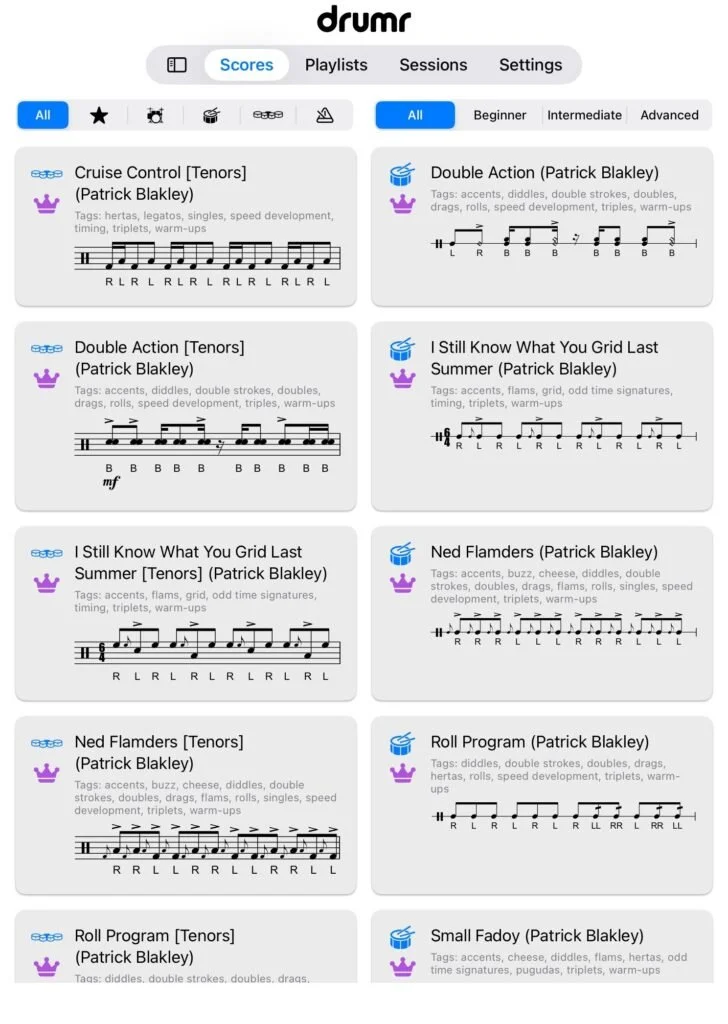
As of Version 5.11, I have added 30 marching snare warmups and marching tenor exercises to the Drumr app. These include:
Accentual Healing
Cruise Control
I Still Know What You Grid Last Summer
Ned Flamders
Small Fadoy
Roll Program
Triplet Diddle Patterns
and many more.
I have also created drumset grooves and fills that apply rudimental concepts directly to the drum kit. This approach helps bridge the gap between drumline and drumset playing, allowing you to take the technical skills developed through rudimental practice and apply them in a musical context.
The goal is not just to develop better chops. It is to help you understand how those skills translate to the drumset so you can become a more complete, versatile, and adaptable drummer.
Why Drumr Is One of the Best Drum Practice Apps
Accurate Drum Notation and Realistic Sound
Every exercise includes clear musical notation and high-quality audio playback, making it easier to understand exactly what you are supposed to play.
Whether you are working through drumline grids, rudiments, drumset grooves, or fills, you can follow the notation while listening to the corresponding performance. This makes it easier to learn unfamiliar exercises, check your interpretation, and practice with a clear musical reference.
Advanced Practice Tools
Drumr gives you full control over your practice session with features like:
Looping specific sections
Adjusting tempo
Skipping measures
Repeating difficult passages
These tools make it easier to isolate problem areas and improve faster.
Beginner to Advanced Learning
The app includes guided drum lessons for beginners as well as structured exercises for more advanced players. Beginners can use the guided material to build fundamental skills, while experienced drummers can use targeted exercises to work on technique, coordination, speed, and musical application.
This range makes Drumr one of the more flexible drum practice apps for drummers at different stages of development.
Progress Tracking That Keeps You Consistent
Drumr tracks your practice activity, streaks, and improvement over time, giving you a clear way to monitor your consistency. Instead of relying on memory or simply assuming you are getting better, you can use your practice history to see how regularly you are working and how your performance develops over time.
That progress tracking can also help make practice more consistent. Building a regular practice habit is easier when you can see the work you have already put in and identify where you need to improve.
Smart Practice Recommendations
The app can also suggest what to practice next based on your activity. Instead of spending part of every practice session deciding what to work on, you have a clear direction for your next exercise.
This helps turn practice into a more structured process. You can work through targeted material, build consistency, and keep moving forward without constantly having to figure out what comes next.
Drumline and Drumset Practice in One App
Many drum practice apps are built around one particular type of drummer. Some focus almost entirely on drumset playing, while others are designed specifically for marching percussion and rudimental training. Drumr takes a broader approach by bringing drumset practice and marching percussion practice together on the same platform. That makes it particularly useful for drummers who play more than one style or want to develop skills that transfer between different areas of percussion.
For drumset players, Drumr includes grooves, fills, and musical styles such as rock, funk, jazz, Latin, and metal. This gives you opportunities to work on more than just technical exercises. You can practice playing within different musical feels, develop coordination, work on fills, and apply your technique in actual groove-based situations. Having material across multiple styles is useful because good drumset playing requires more than speed or coordination. It also requires learning how different musical styles feel and how your playing needs to adapt to them.
The marching percussion material takes a different approach. Drumline players can work on grids, hybrid rudiments, marching snare warmups, and tenor exercises based on advanced marching percussion teaching approaches. These types of exercises can be used to develop hand technique, consistency, rhythmic accuracy, control, and coordination. For students preparing for auditions or working toward higher levels of marching percussion performance, having structured material available for regular practice can make it easier to build a routine.
The combination becomes especially useful for hybrid drummers. Many percussionists move between drumline and drumset, but the skills developed in one environment do not always get applied to the other. Rudimental patterns can become drumset fills. Hand technique can contribute to faster and cleaner playing around the kit. Grid exercises can improve rhythmic control. Conversely, learning grooves and musical application on the drumset can help a rudimental player understand how technical patterns can function within actual music.
That crossover is one of the more interesting aspects of Drumr. Instead of treating drumline and drumset as completely separate disciplines, you can use the app to explore how skills from one area can strengthen your playing in another. This is particularly valuable for younger drummers who are still figuring out which areas of percussion they enjoy, as well as experienced players who want to become more versatile.
For someone looking specifically for a drumline practice app, Drumr provides dedicated marching percussion material. For someone searching for a drumset practice app, it provides grooves, fills, and multiple musical styles. For drummers who want both, having the two approaches available in one practice environment eliminates the need to constantly switch between different resources.
The result is a practice platform that can support a broader range of percussion development, from basic drumset skills and beginner rudiments to advanced marching exercises and musical application. For drummers who want their technical skills to transfer across different styles of playing, that flexibility can be a significant advantage.
E Drum Analysis and Real Time Feedback
One of the most useful features in Drumr is its electronic drum analysis. When you connect a compatible electronic drum kit through MIDI or USB, the app can analyze your playing and provide real-time information about your timing. Instead of simply listening back and deciding whether a passage felt accurate, you can see how closely your notes line up with the exercise. The system can identify notes that are early, late, or missed, giving you specific information about where your timing needs work.
This type of feedback is particularly valuable because timing problems are not always obvious to the person playing. A drummer can feel like they are playing consistently while still rushing certain patterns, dragging during transitions, or repeatedly missing specific notes. Those problems can be difficult to identify without an outside reference. E-drum analysis gives you another way to evaluate your playing by turning timing accuracy into something you can actually observe and work on.
That makes the feature especially useful for timing practice and consistency. You can slow an exercise down, work through it repeatedly, and use the feedback to determine whether your accuracy is improving. As your playing becomes more consistent, the analysis provides a way to see that progress rather than relying entirely on memory or perception.
For drumline players, this can be useful when working on precise rhythmic patterns, grids, rudiments, and other exercises where small timing inconsistencies can become obvious in an ensemble. For drumset players, it can be applied to grooves, fills, and coordination exercises where maintaining a steady pulse is essential. Electronic drum users also get the advantage of being able to practice this type of material without needing another person to provide constant feedback.
It is important to remember that technology does not replace listening. A drummer still needs to develop the ability to hear timing, feel the pulse, control dynamics, and make musical decisions. The value of Drumr's e-drum analysis is that it gives you an additional source of information. You can combine what you hear and feel with objective timing data to get a more complete picture of your playing.
For drummers who want to improve timing, precision, consistency, and rhythmic accuracy, electronic drum analysis is one of the features that makes Drumr more than a basic library of drum exercises. It turns an electronic drum kit into an interactive practice tool that can give you immediate information about how accurately you are actually playing.
Who Created Drumr
Drumr was developed by Scott Gardner and Geoff Fry, who built the platform around the idea that drummers need more than a collection of exercises. Effective practice requires structure, useful feedback, and a way to measure progress over time. Drumr brings those elements together in a single practice environment designed for drummers at different skill levels and from different playing backgrounds.
The platform is particularly interesting because it addresses both drumset and marching percussion practice rather than treating them as completely separate disciplines. That makes it useful for players who move between drumset, drumline, rudimental percussion, and other areas of drumming. Instead of simply providing another library of drum exercises, Drumr is designed to help players turn those exercises into a more organized and measurable practice routine.
That approach is also what separates a dedicated practice app from simply watching drum videos or downloading sheet music. Those resources can be useful, but they do not necessarily provide a structured way to practice, receive feedback, and monitor improvement. Drumr attempts to bring those parts of the process together so that the technology supports the practice itself rather than simply delivering more material to play.
Why I’m On Board
As someone who has spent decades performing, teaching, and writing about percussion, I have spent a lot of time thinking about what actually makes practice productive. There is no shortage of exercises, play-along tracks, method books, and instructional videos available to drummers. The harder part is creating a practice process that keeps you focused, gives you useful feedback, and makes it clear whether you are actually improving.
That is one of the things I appreciate about Drumr. The platform is built around the practice process rather than simply providing another collection of material. Whether you are drilling marching snare warmups, working through drumline exercises, developing rudimental technique, or applying those concepts to drumset grooves and fills, the material can become part of a more structured practice routine.
I also find the combination of different percussion disciplines particularly useful. A drummer should not have to think of drumline technique and drumset playing as completely separate skill sets. Rudiments, coordination, timing, touch, consistency, and control can all transfer between different forms of percussion when they are practiced with that goal in mind.
That is where Drumr has the most value for me as a percussion educator. It gives drummers a way to practice specific skills while also providing tools for repetition, tempo control, feedback, and progress tracking. The technology does not replace good instruction or deliberate practice, but it can make those practice sessions more organized and measurable.
If you are willing to put in the work, Drumr gives you a better framework for making that work count.
Final Thoughts on the Drumr App
If you are looking for a drum practice app for drumline, drumset, or electronic drums, Drumr is one of the more comprehensive options worth considering. Its biggest advantage is that it brings several parts of effective practice together in one place instead of requiring you to piece everything together from separate apps, videos, method books, and practice tools.
The combination of structured exercises, real-time feedback, tempo control, looping, and progress tracking gives you more information about your practice than simply playing through an exercise and moving on. For electronic drummers, the e-drum analysis adds another layer by providing objective feedback about timing accuracy. For drumline players, the marching percussion material provides exercises that can be practiced systematically. Drumset players can work on grooves, fills, styles, and the application of rudimental concepts around the kit.
That does not mean an app can replace a good teacher, focused practice, or years of playing experience. Technology is only useful when the drummer actually puts in the work. What Drumr does well is provide a framework that makes that work more organized and measurable.
Whether you are preparing for a drumline audition, developing your drumset technique, improving timing on an electronic kit, or simply trying to become more consistent in the practice room, having a clear practice structure can make a significant difference.
For drummers who want to spend less time wondering what should I practice? and more time actually practicing, Drumr provides a practical path forward.

Drumr: Learn Faster. Drum Better.
The reps are on you. The tools are here.
Download Drumr and start leveling up today.
If you’re looking for even more ways to level up your drumming, check out my full library of marching snare, tenor, bass drum, and pit exercises, drumset grooves, and full warmups. There’s something for every skill level, whether you’re sharpening rudiments, exploring new grooves, or just warming up before a rehearsal. Download the sheet music for free, then let the Drumr app put you through your paces! Your chops will thank you.
About the Author
Patrick Blakley is a percussion educator, author, adjudicator, and entrepreneur specializing in marching percussion and drumline education. He is the creator of DrumPacket.com, DrumlineWarmups.com, DrumAudit.com, DrumsetGrooves.com, and SyracuseDrums.com. His educational materials and performance audio edits through CompetitiveMusic.com are used by hundreds of schools and programs across the United States and beyond. He is the author of Quadratics: The Tenor Drum Equation, The Field Percussion User Manual, and other instructional music books. Read more about him by clicking here!
