FREE Drum Sight-Reading Quick Assessment Booklet!
This booklet can be enhanced with the Drumset Groove Generator System!
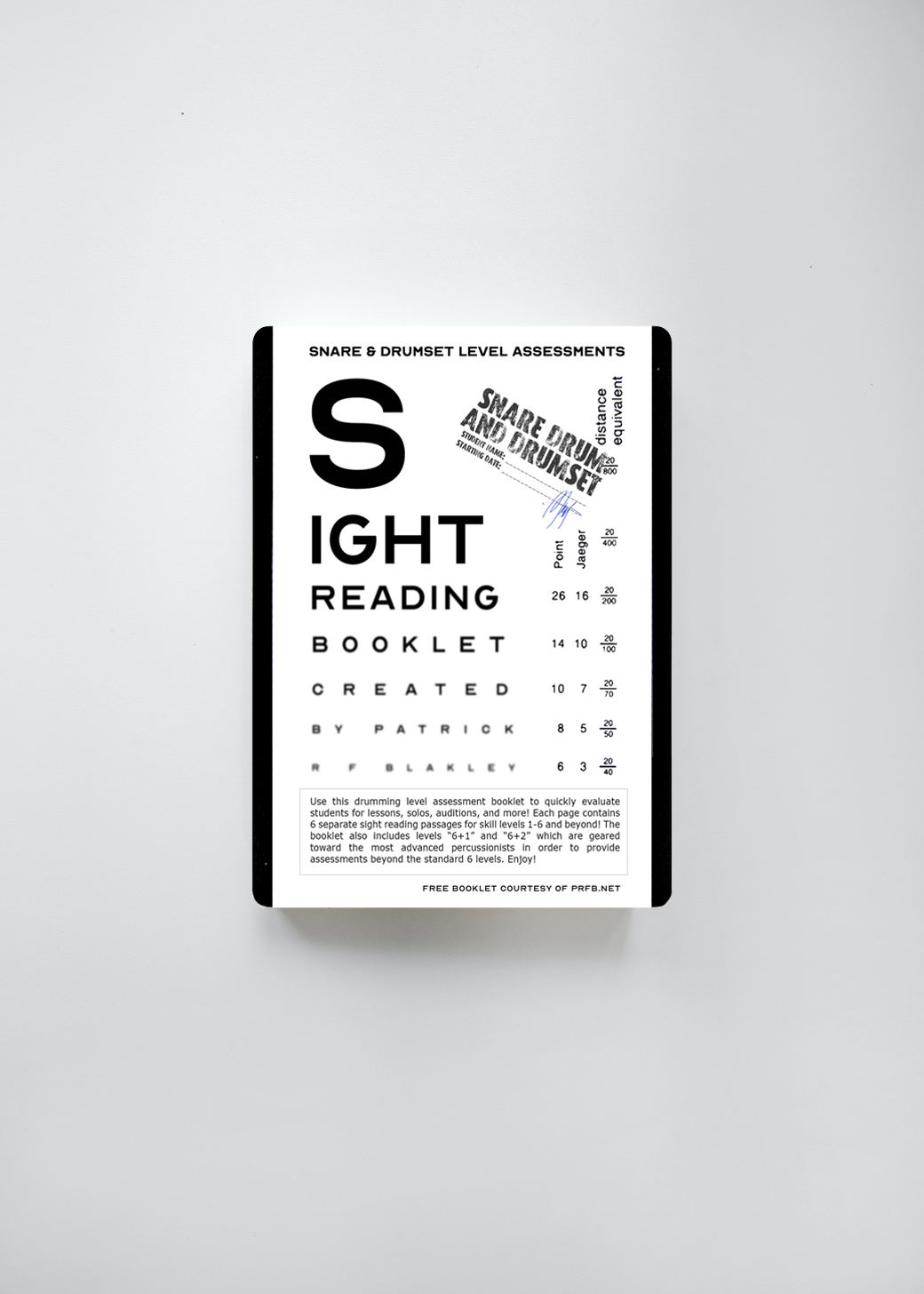
My FREE drumming sight-reading assessment booklet helps teachers and parents evaluate a percussionist’s ability level and determine an appropriate starting point for lessons or solo selection. It can also be used during auditions to help place performers within an ensemble.
Each 14-page booklet includes six sight-reading passages for each level from 1 through 6. Two additional advanced sections, labeled 6+1 and 6+2, provide extra challenges for highly advanced percussionists who have surpassed the standard levels.
In total, each booklet contains 48 drum sight-reading assessments, all available to download completely free.
Note: A combined physical copy of the booklet is available for purchase on Amazon.com!
Assessing a drummer’s skill level is an important step in building a strong percussion section. This free booklet provides a structured way to evaluate snare drum ability, one of the core foundations of drumming. The assessments focus on key skills such as timing accuracy, rhythmic flexibility, dynamic control, and rudimental proficiency.
By using these exercises, teachers and ensembles can better understand a performer’s current ability level and make more informed decisions about placement, instruction, and repertoire. The booklet offers a practical tool for developing stronger percussionists and creating a more cohesive ensemble sound.
General Overview of Drumming Skill Levels:
Foundational Level (Level 1): Drummers grasp basic rhythmic concepts, note values, and simple drum notation in common time signatures (e.g., 4/4, and sometimes 2/4). They can read straightforward rhythms with quarter notes, eighth notes, and basic rests.
Elementary Level (Level 2): At this stage, drummers expand their understanding to include more varied rhythms, incorporating eighth-note combinations, rests, and basic syncopation. They can navigate through simple time signature changes and natural sticking patterns.
Intermediate Level (Level 3): Drummers demonstrate proficiency in interpreting more complex rhythms, including triplets, sixteenth notes, and syncopated patterns. They can read in various time signatures (e.g., 3/4, and sometimes 6/8) and handle moderate tempo changes. They are also starting to incorporate basic rudiments in musical phrases.
Proficient Level (Level 4): At this stage, drummers exhibit a strong command of notation, comfortably reading challenging rhythmic patterns, dotted notes, and more intricate syncopation. They can navigate through irregular time signatures and moderate tempo fluctuations with ease. They are also able to perform many more rudiments as incorporated into musical phrases.
Advanced Level (Level 5): Drummers showcase an advanced understanding of complex rhythmic structures, polyrhythms, odd time signatures (e.g., 5/4, 7/8), and intricate musical phrases. They handle rapid tempo changes and execute challenging notation with precision. Most rudiments are understood and can be utilized in a musical phrase. Drummers also utilize sticking patterns to pronounce the way a phrase feels as opposed to just notes on a page.
Expert Level (Level 6+): Drummers at this pinnacle possess a mastery of the musical phrase, effortlessly interpreting highly intricate rhythms, complex polyrhythms, irregular subdivisions, and challenging notation. They adapt seamlessly to rapid tempo fluctuations and execute demanding musical compositions with exceptional precision and musicality. All rudiments can be incorporated into a musical phrase, and the feel of the music becomes of utmost importance.
Beyond Level 6 mastery, drummers creatively blend rhythms and patterns in new ways that may never have been done before. They fuse diverse time signatures and cultural influences, crafting captivating soundscapes that transcend traditional boundaries. Their exploration extends beyond drumming, incorporating unconventional instruments and experimental techniques to redefine percussion’s potential. In this uncharted realm, drummers are sonic pioneers, constantly innovating and reshaping the language of rhythm to evoke emotions and captivate audiences, pushing the boundaries of what percussion can achieve in music. Beyond level 6 is where the pure art of drumming exists, and percussion is pushed to new boundaries!
Learn about each of the standard drum levels from 1 through 6, then way beyond!
Tips and Strategies for Sight-Reading Drum Music
Understanding Rhythmic Patterns: Familiarize yourself with common rhythmic patterns and subdivisions. Practice counting aloud while tapping or playing these patterns to internalize their feel. This helps in recognizing and interpreting rhythms accurately when sight-reading.
Focus on Key Notation Elements: Prioritize understanding key notation elements like time signatures, note values, rests, and dynamic markings. This foundation enables you to decode music swiftly, making it easier to follow the music sheet.
Gradual Difficulty Progression: Start with simpler pieces and gradually progress to more complex ones. Begin by focusing on basic rhythms and gradually introduce syncopation, odd time signatures, and intricate patterns. This step-by-step approach enhances your sight-reading skills steadily.
Practice with Various Styles: Explore diverse musical styles such as jazz, rock, Latin, and classical. Each style presents unique rhythmic structures and patterns. Familiarizing yourself with different genres expands your sight-reading capabilities across various musical contexts.
Consistent Practice Routine: Devote regular practice sessions specifically dedicated to sight reading. Set aside time to work on new pieces or exercises daily to improve your reading speed, accuracy, and overall proficiency.
Use a Metronome and Play Along with Music: Incorporate a metronome into your practice sessions to develop a strong sense of timing. Additionally, playing along with recordings or backing tracks enhances your ability to stay in sync with other musicians while sight-reading.
Focus on Phrasing and Musicality: Sight-reading isn’t solely about hitting the right notes. Emphasize phrasing, dynamics, and musical expression as you read. This brings life to the music and helps you connect more deeply with the piece.
Practice Sight Singing Rhythms: Develop your ability to sight sing rhythms without your drum set. This exercise enhances your internalization of rhythms, making it easier to replicate them on the drums.
Mastering drum sight-reading demands a strategic approach. Consistent dedication to these strategies will enhance your drum sight-reading proficiency, making you adept in diverse musical contexts.
The FREE Sight-Reading Booklet Download Form!
Download the FREE Sight-Reading Booklets for snare drum or drumset.
Just fill out the short form to get instant access to the booklets. The form helps me understand who is using the music, what types of groups are working with it, and where it is being used in rehearsals or classrooms. That information helps me continue creating useful drumline warmups, percussion exercises, and teaching materials that actually support directors, instructors, and students.
If you have any questions about the booklet, how to use the exercises, or how they might fit into your lesson structure, feel free to reach out. You are also welcome to send an email with feedback or thoughts! Let me know what you think!
Thanks for taking the time to check out my music and download the resources. The goal is simple: provide practical exercises that help you and your students improve efficiently while keeping rehearsals engaging and productive.
Don’t forget that you can get a physical copy of the combined booklet here!
Fill out the forms below to instantly download the FREE sight-reading packets!
Download the free SNARE DRUM booklet:
Download the free DRUMSET booklet:
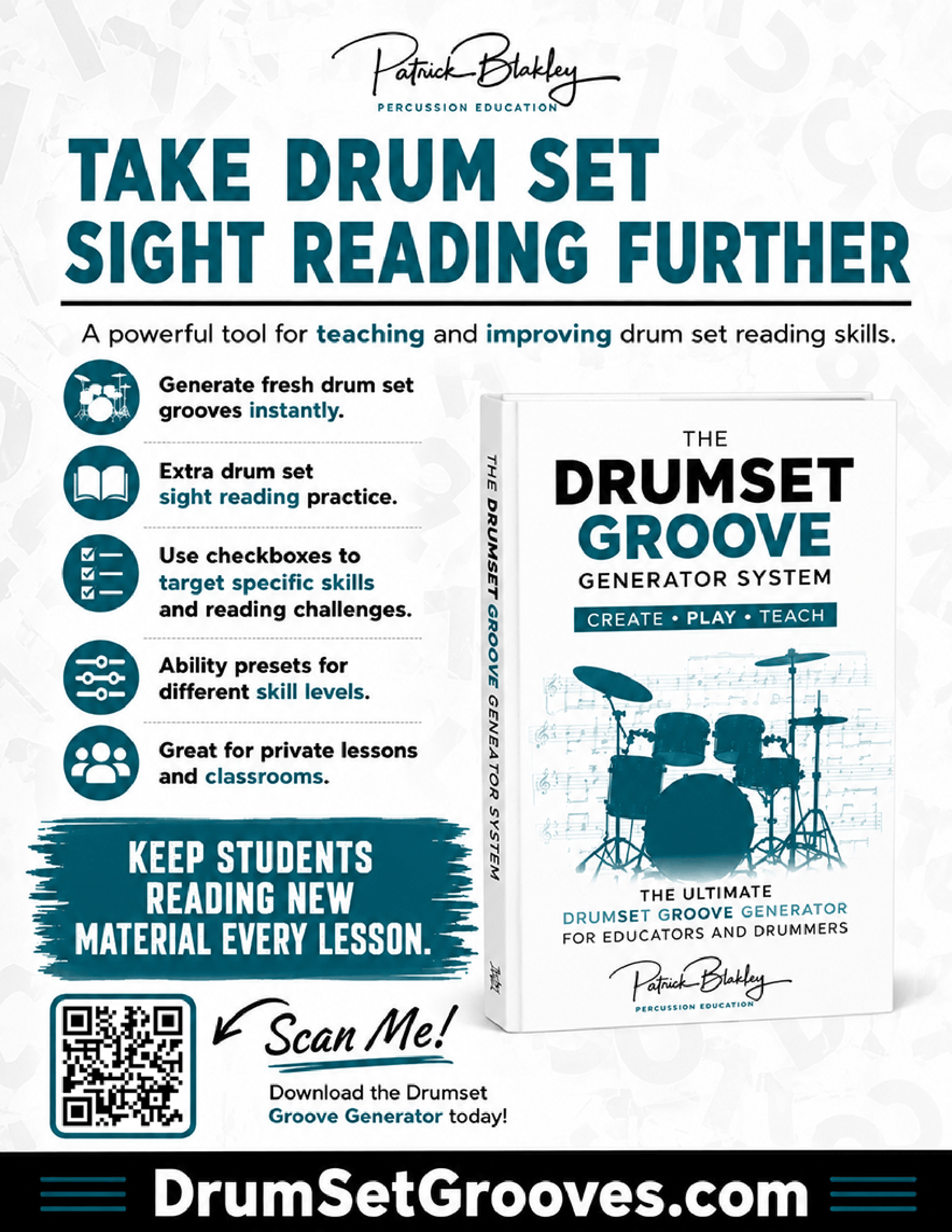
You may also be interested in my drumset groove generator tool:
The Groove Generator is an advanced sight-reading and rhythm development tool designed to dramatically improve reading fluency, timing accuracy, and real-time interpretation of written drum patterns.
It delivers structured groove studies that force consistent reading decisions under musical conditions, strengthening the connection between notation and execution. By working through progressively challenging material, drummers develop faster pattern recognition, improved limb coordination, and a more instinctive understanding of rhythmic phrasing across styles.
Used regularly, it builds stronger sight-reading skills, sharper groove awareness, and more confident performance ability when reading new material in real time.
Or, download the pre-built
drumline & pit warmup packet:
The pre-built drumline and pit warmup and technique packet is an advanced rehearsal system designed to accelerate ensemble development, improve sight-reading consistency, and standardize fundamental technique across the entire group.
It provides structured exercises that target timing precision, rhythmic clarity, ensemble balance, and technical control in both battery and front ensemble settings. Each segment is built to reinforce fast score reading, improve coordination between written parts and real-time execution, and establish repeatable rehearsal habits that translate directly into show performance.
Used consistently, it strengthens overall ensemble cohesion, increases rehearsal efficiency, and builds the kind of reading and technical confidence needed to perform complex arrangements with accuracy under pressure.
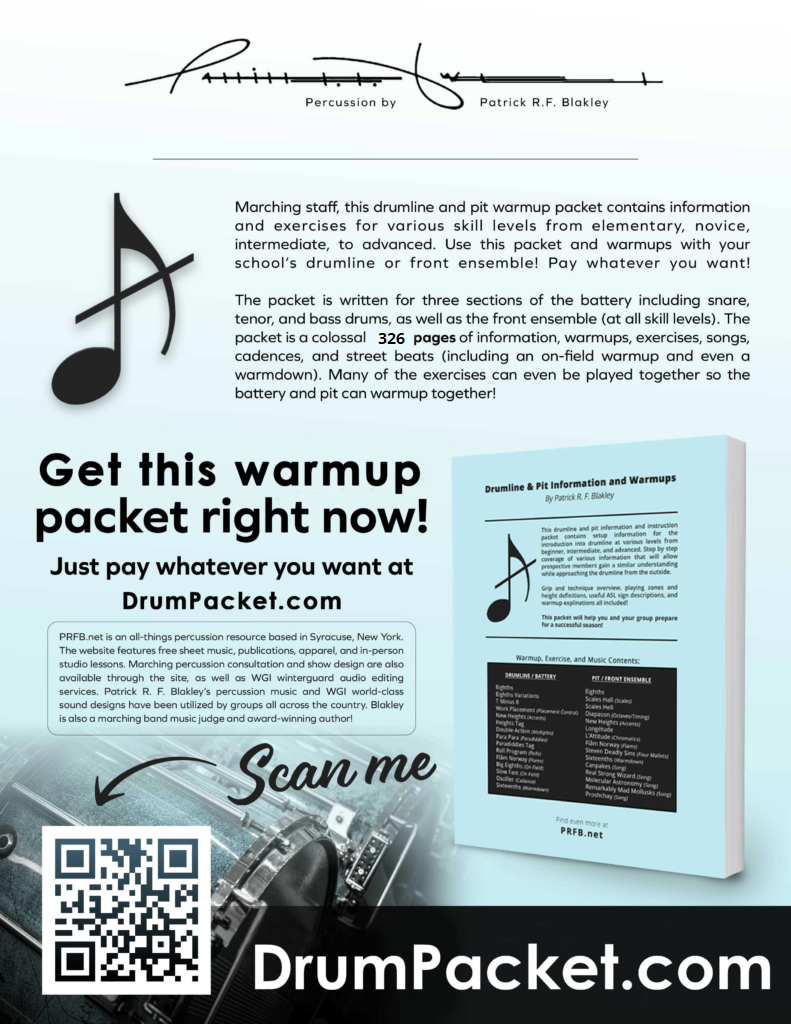

If you teach a drumline or pit you can use all of the pit and drumline music at no additional cost with your group!
This work, and all my other work, is licensed under a Creative Commons Attribution 4.0 International License.
For instructors, this booklet pairs perfectly with The Field Percussion User Manual!
(*Pit warmups, exercises, and songs may be used freely for practice and warmups, but not as part of a show or paid performance.
For performance permission, contact the composer using the URL listed at the bottom of each PDF, or contact Patrick Blakley above.)
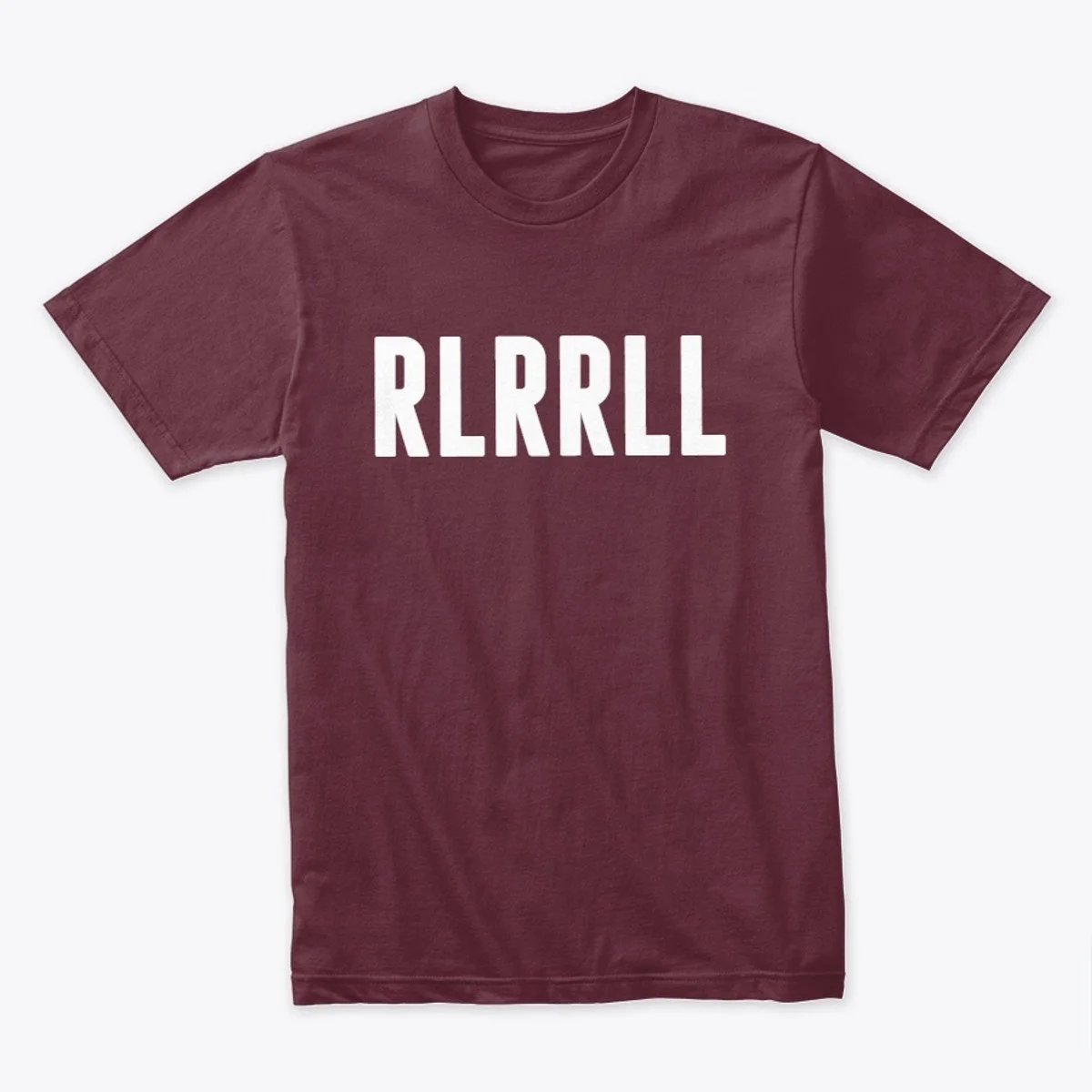
Do you know what goes great with playing drumline rudiments?
Wearing them!
Check out the drumline apparel and drumline clothes section for tons of great drumline shirts and accessories to wear to your next rehearsal. From things that the whole band will understand, to things that only the drumline will understand, and even things that nobody might understand!