
Easy to Learn - Steering Wheel Rhythms | Transcribed Rhythms from Real Songs
Steering Wheel Rhythms are Transcribed Rhythms from Real Songs
Have you ever been drumming along to a song in your car and couldn't quite get it right? Or maybe the rhythm was a little complicated, and you just want to see what's really going on? Well, look no further for an assortment of songs with very intricate rhythms that are so much fun to drum out on a steering wheel (while parked, of course!)
In the past, I’ve written out multiple posts for an assortment of songs, but now, I’ve decided to combine them all into one place! Below you’ll find several intricate rhythm sections of some of my favorite songs to bang out on a steering wheel. If you have any requests, feel free to contact me, and I’ll continue to update this post each time!
Have fun hammering out these rhythms on everyone’s favorite percussive instrument: The steering wheel! Maybe just don’t do it while you’re driving!
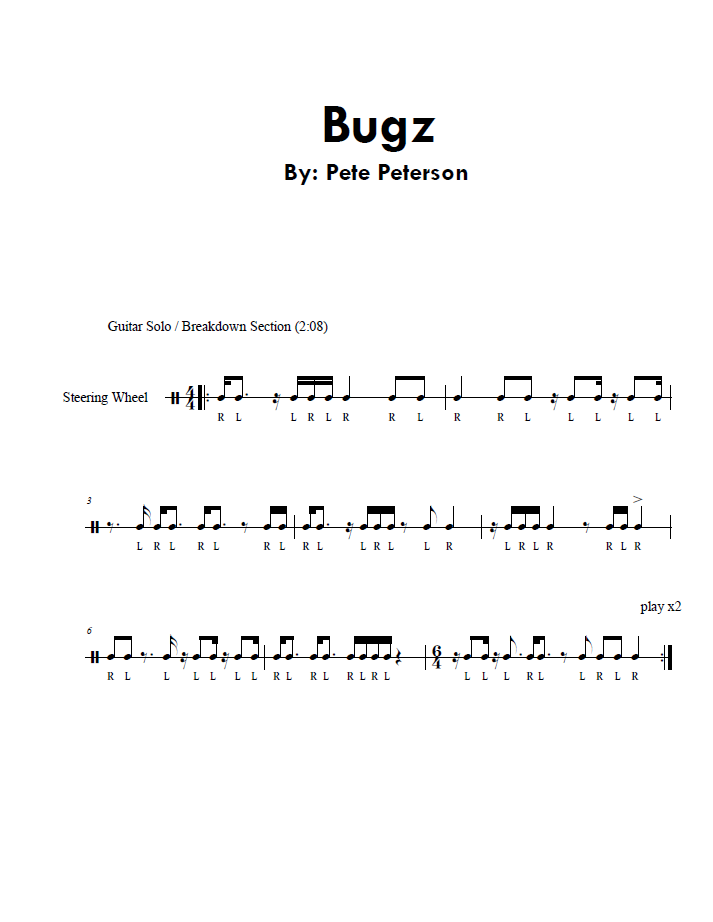
First up: Bugz by Pete Peterson (drums by Travis Orbin).
This is one of my all-time favorite drum tracks. Travis Orbin, a highly respected session drummer and educator known for his advanced coordination, ambidextrous technique, and work across progressive rock, metal, and experimental music, delivers a performance here that is both technical and musical. His ability to play complex, independent rhythms with both hands at a high level has made him a reference point for modern drumset coordination studies.
The track itself is written by Pete Peterson, a composer and producer known for intricate, rhythmically dense compositions that blend progressive rock elements with modern instrumental writing. His work often features layered harmonic movement and shifting rhythmic ideas that challenge both listeners and performers.
This transcription focuses on a middle section of the piece where a long, repeating syncopated pattern locks in and evolves over time. The coordination required to execute it cleanly is what makes it so compelling to study. I especially love how the rhythmic structure interacts with the guitar chord changes, along with the shift from shorter articulations into more sustained tones halfway through the phrase. It creates a strong sense of motion while still staying rhythmically tight and controlled.
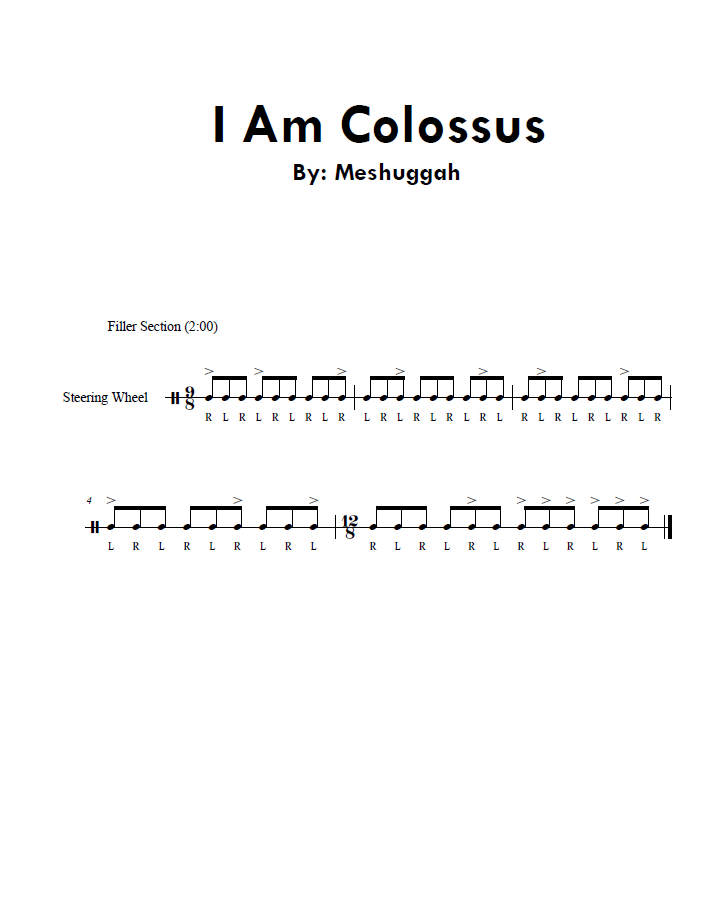
Next up: I Am Colossus by Meshuggah (drums by Tomas Haake).
This is a track that my friend specifically asked me to notate the rhythm for, so I am including it here for anyone who wants to dig into it more closely.
Meshuggah is widely known for pushing rhythmic structure into extremely complex territory, and I Am Colossus is a strong example of that approach. The band is built around tightly controlled polymetric ideas, where the guitar riffs, bass, and drums often imply different rhythmic cycles at the same time. Rather than relying on traditional groove placement, the music creates tension through displacement and repetition over shifting accents.
At the center of it all is Tomas Haake, one of the most influential drummers in modern metal and progressive rhythm design. Haake is known for his ability to perform extremely precise, mechanically consistent patterns that sit inside unusual metric frameworks without losing clarity or feel. His playing is less about traditional “fills and grooves” and more about acting as a structural anchor inside complex rhythmic systems. In many ways, he functions like a metronomic layer that still feels musical.
This transcription focuses on a section where the rhythmic phrasing locks into a repeating cycle that feels steady on the surface but shifts its internal accents in ways that can be difficult to immediately hear. When you break it down into pure rhythm, the structure becomes much clearer and reveals how intentional the patterning really is.
Meshuggah’s writing style rewards this kind of analysis. What sounds chaotic at first is actually built from extremely controlled repetition and layered metric ideas that gradually reveal themselves over time. This is exactly the type of material that benefits from slowing down and isolating rhythm away from pitch, which is the entire goal of these Steering Wheel Rhythms.
If you have seen the earlier entry for Gods of Rapture, also by Meshuggah, you will notice a similar approach to rhythmic density and phrasing. That track is included further below in this series for comparison.
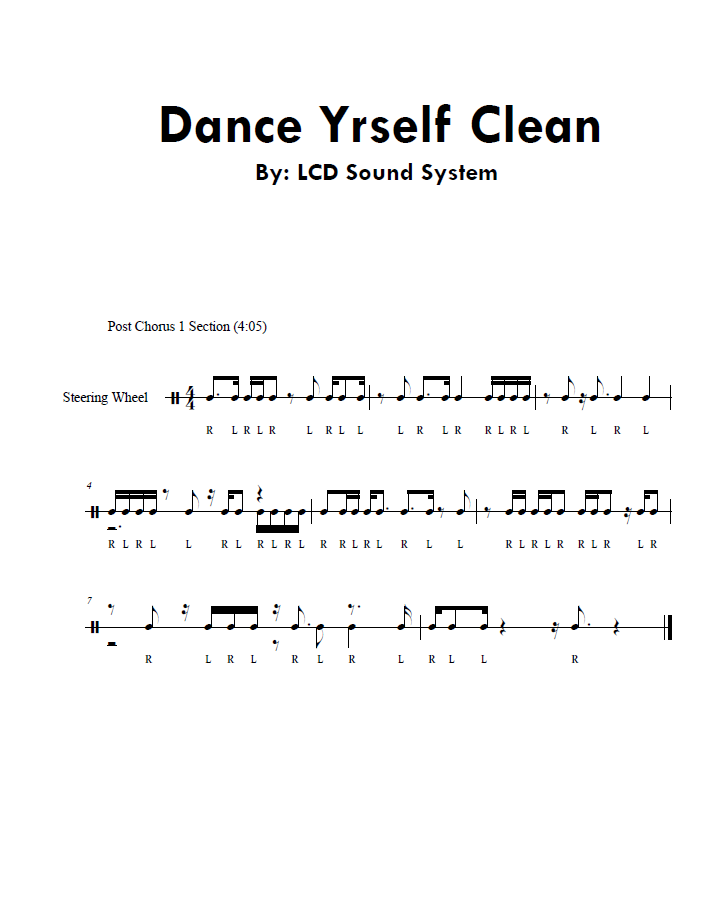
Next up: Dance Yrself Clean by LCD Soundsystem (drums by Pat Mahoney).
This song is so fun I had to include it here twice. The structure alone makes it a perfect candidate for rhythm transcription, especially the long build sections where everything slowly unfolds into a massive groove.
LCD Soundsystem, led by James Murphy, is known for blending electronic music, dance punk, and live band energy into extended arrangements that often evolve gradually instead of relying on traditional verse-chorus structure. One of the key elements that makes this approach work is the way rhythm is treated almost like architecture rather than just timekeeping.
Behind the kit is Pat Mahoney, the longtime drummer for LCD Soundsystem and a foundational part of their live and studio sound. Mahoney is known for his steady, hypnotic playing style that locks tightly into repetitive grooves while still allowing space for dynamic build and release. His drumming is not about constant variation, but about control, restraint, and precision timing that supports long-form rhythmic development.
In Dance Yrself Clean, that approach is on full display. The early sections feel deceptively simple, almost minimal, but they are carefully constructed to set up the explosive shift that follows. When the track opens up, the rhythmic density increases dramatically, and the contrast between sections becomes part of the impact.
For this transcription, I focused specifically on the interlude synth-driven sections. These moments are rhythmically consistent but subtly varied, which makes them especially interesting to break down. To my surprise, the patterns are not identical each time they appear. Small shifts in phrasing and emphasis give each repetition its own character, even when the underlying pulse remains steady.
That is exactly why this song fits so well into the Steering Wheel Rhythms concept. The rhythm is clear enough to isolate, but detailed enough to reward close attention. Once you strip away pitch and focus only on rhythmic placement, you start to hear how much detail is actually happening inside what initially feels like a simple groove.
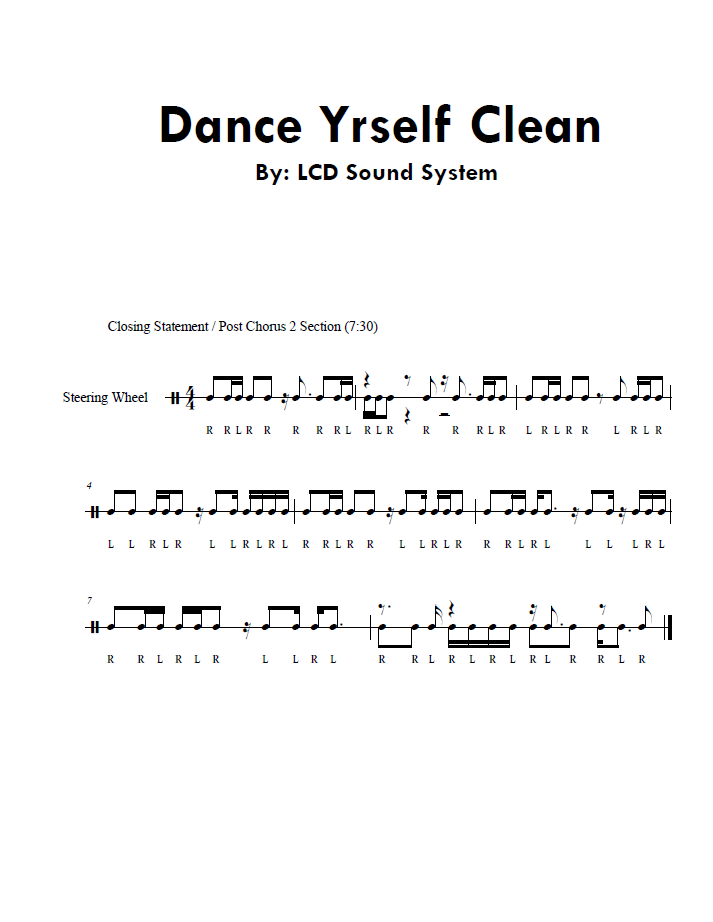
Below, you will find the first transcription of this section, followed by another variation that appears later in the track for comparison.
This is the second interlude section from this song because it’s so fun! I also included some of the connective bass synth tones under the staff that can either be used for reference or you can just play them all together. Enjoy!
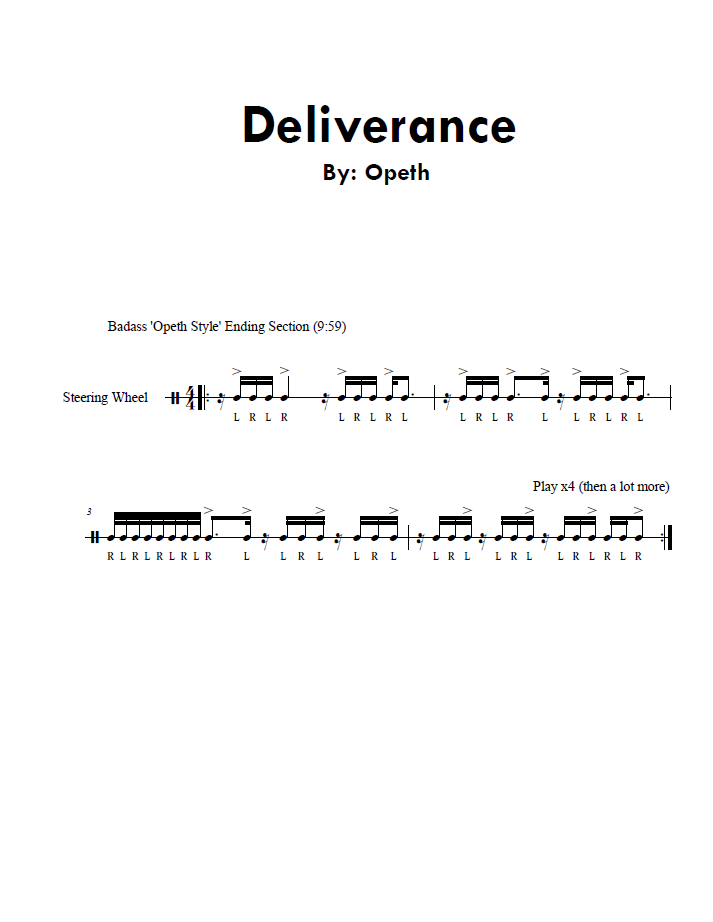
Next up: Deliverance by Opeth (drums by Martin Lopez).
This has got to be my favorite song outro of all time. Opeth is well known for structuring their songs like long narrative journeys, often blending progressive metal, death metal, and atmospheric transitions into a single continuous arc. Deliverance is one of the clearest examples of that approach, and the final section is where everything fully locks in.
After such a long and dynamic build, the outro erupts into a relentless rhythmic cycle that feels almost hypnotic. Instead of resolving in a traditional way, the music leans into repetition and momentum, creating a sense of controlled chaos that keeps pushing forward without release.
At the center of it is Martin Lopez, whose drumming on this track is widely regarded as some of his best work with Opeth. Lopez is known for his unique blend of progressive metal precision and jazz-influenced looseness, often playing slightly behind or ahead of the grid in a way that creates natural movement inside extremely heavy material. His ability to maintain clarity while still sounding organic is a defining part of Opeth’s early 2000s sound.
In this section, the rhythmic ideas start to push across the barline in a way that makes orientation intentionally unstable. Accents shift in unexpected places, patterns overlap, and the groove begins to feel less like a loop and more like a constantly evolving phrase. There is also a strong ostinato element that anchors everything underneath the movement, giving the chaos a structural foundation.
What makes this outro so effective is how it balances repetition with forward motion. It never feels static, even though the material is highly repetitive. Instead, it feels like it is constantly stretching time, pulling the listener forward until the final resolution finally arrives.
For rhythm study, this is exactly the kind of material that benefits from being stripped down to pure rhythmic notation. Once you remove pitch and harmonic context, what remains is a deeply intricate rhythmic system that reveals just how carefully constructed the “chaos” actually is.
And yes, it absolutely deserves the reputation.
Next up: Alien Hip Hop by Planet X (drums by Virgil Donati).
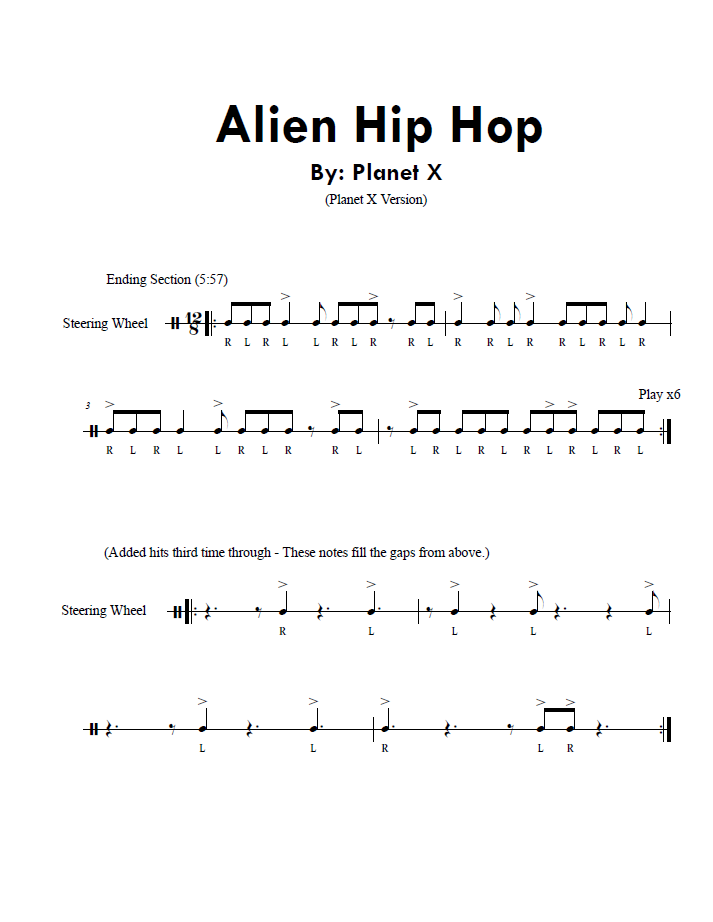
This version is the Planet X recording of Virgil Donati’s original composition from Serious Young Insects. It takes an already complex rhythmic concept and pushes it even further through the full band arrangement, creating one of the most rhythmically dense and fascinating fusion performances in modern instrumental music.
Planet X, led by keyboardist Derek Sherinian, is known for combining progressive metal, jazz fusion, and extreme technical musicianship into tightly arranged compositions. Their music often feels like controlled chaos, where every instrument is executing highly demanding parts that interlock in unusual and unexpected ways.
At the center of this piece is Virgil Donati, one of the most technically advanced drummers in modern music. Donati is widely recognized for his extreme independence, polymetric control, and ability to execute multiple-layered rhythmic ideas simultaneously. His work has influenced generations of drummers in progressive rock, fusion, and technical metal. What makes his playing so distinctive is not just speed or complexity, but the structural clarity he maintains inside extremely dense rhythmic environments.
In this Planet X version of Alien Hip Hop, the arrangement brings together multiple instrumental layers that each seem to operate with their own internal logic. The real magic happens in how Donati anchors everything, effectively acting as the central timing engine that holds the entire structure together while still navigating shifting accents and displaced rhythmic phrases.
The ending section is especially striking, where the parts begin to converge in a way that feels almost impossible on first listen. Layers that initially seem independent start locking together through carefully placed rhythmic alignment, creating a payoff that feels both chaotic and extremely precise at the same time.
From a transcription standpoint, this is exactly the kind of material that benefits from isolating rhythm only. When you strip away pitch and focus purely on rhythmic structure, the underlying architecture becomes much clearer, revealing just how intentional and mathematical the phrasing really is.
This is also a perfect example of why Virgil Donati is often considered one of the most advanced drummers of all time. The coordination required here goes beyond typical drumset independence and moves into fully integrated multi-limb rhythmic systems that interact with the entire ensemble.
If you study this closely, you start to understand why this piece is so respected in the progressive and fusion communities. It is not just fast or complex. It is structurally deep, tightly engineered, and executed at an extremely high level by every musician involved.
Next up: Gods of Rapture by Meshuggah (drums by Tomas Haake).
Gods of Rapture by Meshuggah is another deep dive into the band’s signature approach to rhythm, polymeter, and tightly controlled repetition. Meshuggah consistently builds entire compositions around rhythmic cycles that feel unstable on first listen but are actually extremely precise when broken down into their core patterns.
As with other Meshuggah material, the drumming is performed by Tomas Haake, whose role in the band goes far beyond traditional timekeeping. Haake is known for constructing drum parts that function as an independent rhythmic framework inside the larger guitar and bass structures. Rather than simply following the riff, his playing often defines how the riff is perceived, reinforcing or subtly shifting the listener’s sense of downbeat and cycle length.
In this entry, there are two primary sections being broken down. The first is the syncopated intro section, where accents are deliberately displaced against the underlying pulse, creating a sense of forward pull and rhythmic tension. What makes this section especially interesting is how consistent the pattern is while still sounding unpredictable due to accent placement and grouping shifts.
The second section is the repeated rhythmic figure under the guitar solo, included here as a bonus transcription. This part highlights Meshuggah’s ability to maintain a hypnotic, looping foundation while other musical elements move freely on top. The repetition is strict, but the perception of the groove changes depending on where your attention lands within the layered structure.
From a rhythm study perspective, this is exactly the kind of material that rewards stripping everything down to pure timing. Once the pitch content is removed, the internal logic of the patterns becomes clearer, revealing how deliberate the groupings and accents really are.
Gods of Rapture is a strong example of why Meshuggah continues to be referenced in discussions of advanced rhythmic composition. The complexity is not random. It is highly organized, cyclical, and built on carefully engineered displacement that becomes more understandable the more you isolate it.
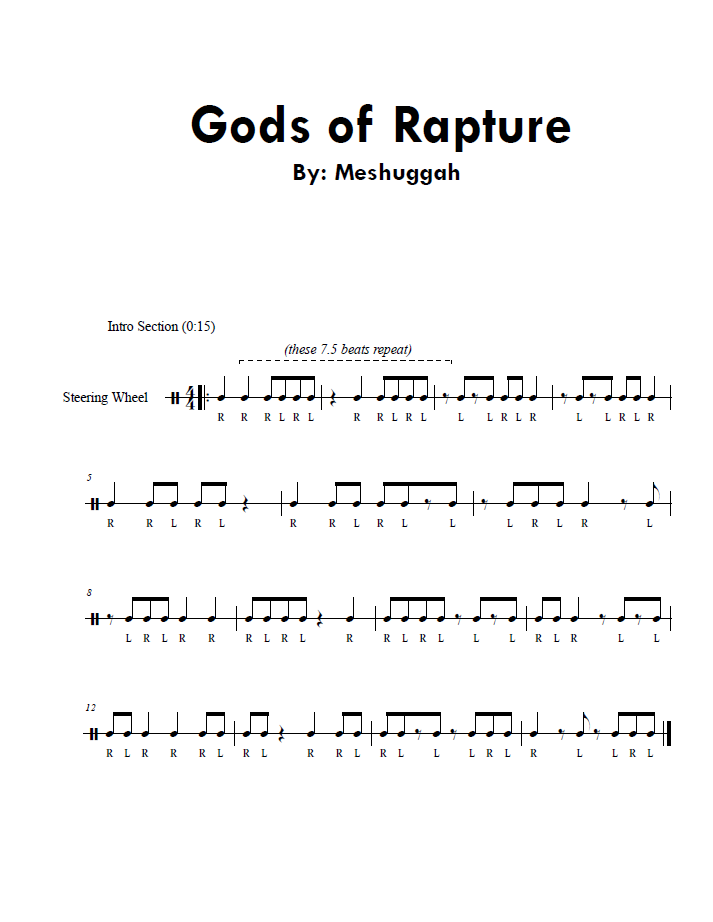
Meshuggah uses an interesting approach in this syncopated section by repeating an uneven rhythmic phrase while still firmly operating inside a 4/4 framework. On paper, this could easily be interpreted as something like 15/8 or a hybrid grouping such as 4/4 plus 7/8. However, the phrasing clearly resolves in alignment with the larger 4/4 structure, which suggests it is intentionally conceived as a displaced figure rather than a true meter change.
The result is a long-form ostinato that cycles across the barline without breaking the underlying pulse. Instead of “resetting” back to beat one in a predictable way, the pattern continues to unfold forward until it eventually realigns with the downbeat. This creates a strong sense of forward momentum driven by controlled rhythmic displacement rather than metric modulation.
Another subtle detail is the sticking approach. The part naturally falls into a very standard, almost “default” sticking pattern, which makes it a useful study example for drummers learning how natural sticking tends to emerge in real musical contexts. Nothing about the phrasing feels forced or artificially constructed for technical display. It is simply the most efficient way the hands organize the pattern at tempo.
Next, we move into the breakdown section, where a second repeated phrase is introduced. This time, the rhythmic structure uses significantly more negative space, which changes the feel entirely and highlights how Meshuggah uses silence and density as equally important compositional tools.
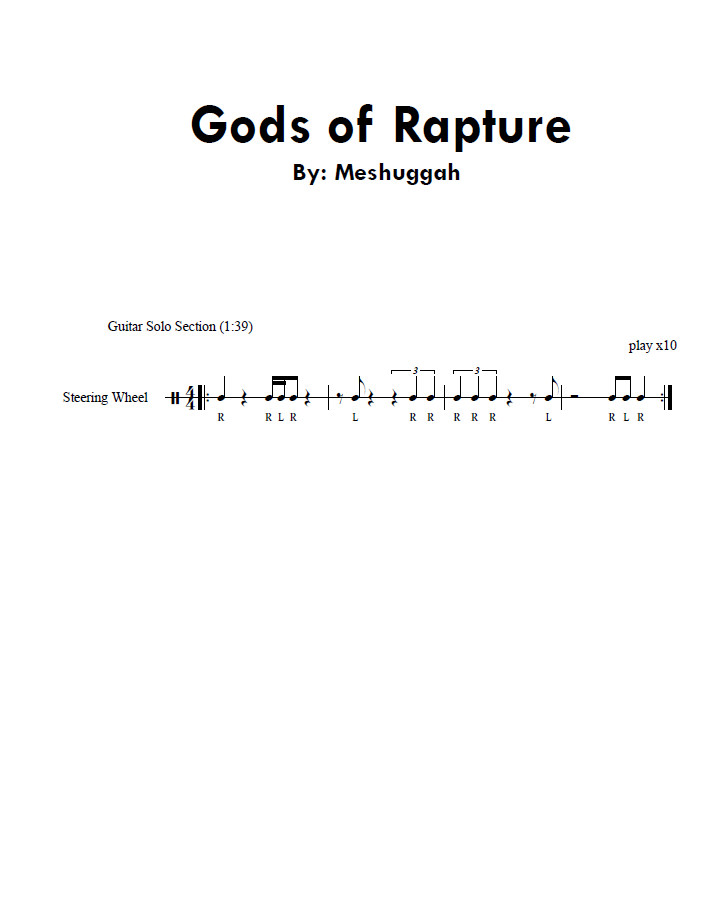
This breakdown section takes a slightly different approach by using a high amount of space between relatively short, sporadic note groupings. Instead of continuous motion, the rhythm is built from interruption and release, which gradually increases intensity as the phrase develops.
There is also a sense of metric shift that becomes more apparent as the section moves from measure two into measure three. The phrasing begins to imply a different internal grouping, creating a subtle modulation of feel across the barline. This effect is reinforced by the placement of rests, particularly the silence on beat three that initiates the triple-based subdivision. Because the expected downbeat does not re-establish itself cleanly on the next cycle, the listener is left in a slightly unsettled rhythmic space.
That unease is amplified by the surrounding empty space, which frames the triple feel rather than supporting it. The result is a phrase that feels exposed and deliberately unstable. On top of that, the inclusion of an irregular five-note grouping further disrupts any sense of symmetry, pushing the pattern away from predictable resolution.
From a musical perspective, this functions similarly to harmonic tension in theory. Much like a diminished seventh chord creates instability that demands resolution, this rhythmic structure creates forward pressure through imbalance rather than repetition. The tension is not accidental. It is a core feature of how the phrase is constructed.
What makes it especially effective is that this entire pattern repeats underneath increasingly intense vocals and guitar work. As the surface layers escalate, the rhythm underneath remains steady but uneasy, forcing the listener to anchor themselves to a pulse that never fully settles.
Overall, this section is both a strong listening example and a useful study tool. It highlights how space, displacement, and irregular grouping can be just as powerful as density when building rhythmic tension.
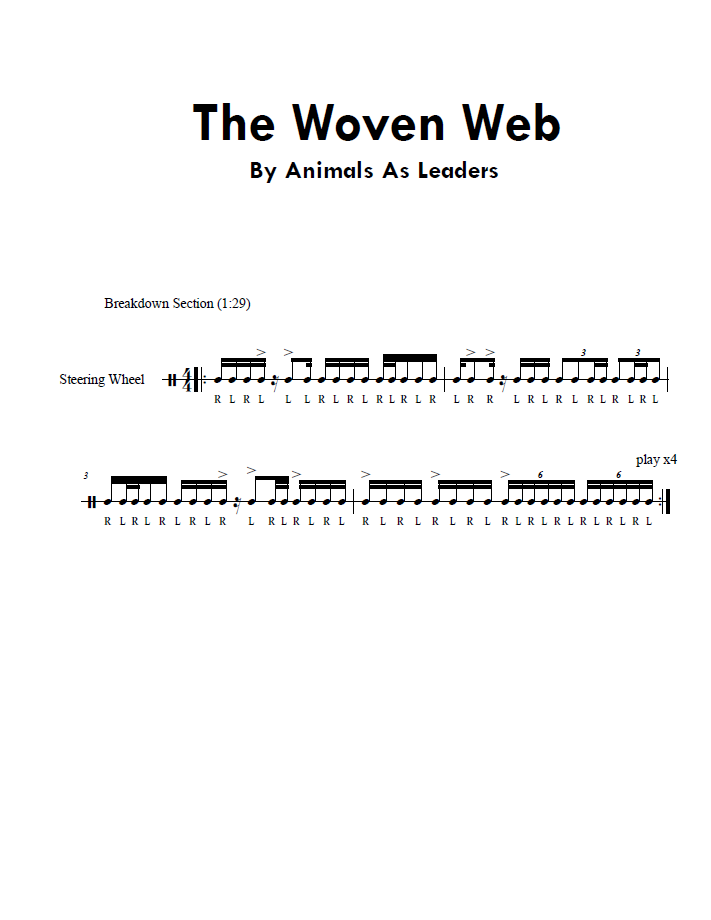
Next up: The Woven Web by Animals As Leaders (drums by Matt Garstka).
The Woven Web by Animals as Leaders, featuring drummer Matt Garstka, whose precision, independence, and control over layered rhythmic phrasing make him one of the most influential modern players in progressive metal and fusion.
Some important details in this rhythm come from how space and subdivision are used to shape the overall feel. At the surface level, there is a consistent interplay between sixteenth-note rests and bursts of thirty-second-note figures that are woven throughout the phrase.
The written sixteenth-note rests are easy to identify, but there are additional implied gaps that appear after groups of eighth notes as well. These moments of silence are just as important as the notes themselves, because they create separation between phrases and allow the rhythmic hits to land with more impact. When combined with the sustained guitar voicings, these spaces help define the contour of the breakdown and make the rhythmic structure feel more deliberate and segmented.
On the opposite end of the density spectrum are the thirty-second-note groupings, often referred to as “hertas.” There are several clear instances of these rapid note pairs, but the concept also extends into the use of sixteenth-note triplet groupings that create a similar accelerated feel through subdivision rather than raw speed.
One of the most interesting connections in this section is how these fast groupings interact across different rhythmic frameworks. In particular, the transition from triplet-based figures into straight sixteenth-note placement creates a subtle form of metric modulation. The result is a shifting perception of time that feels fluid, even though the underlying pulse remains consistent.
Another structural detail worth noting is the larger phrase architecture. The first two measures and the final two measures are built on the same underlying framework: six counts of duple feel followed by two counts of triple feel. Even with all the internal rhythmic variation happening inside the phrase, this macro structure remains consistent from beginning to end, which gives the entire section a strong sense of balance underneath the complexity.
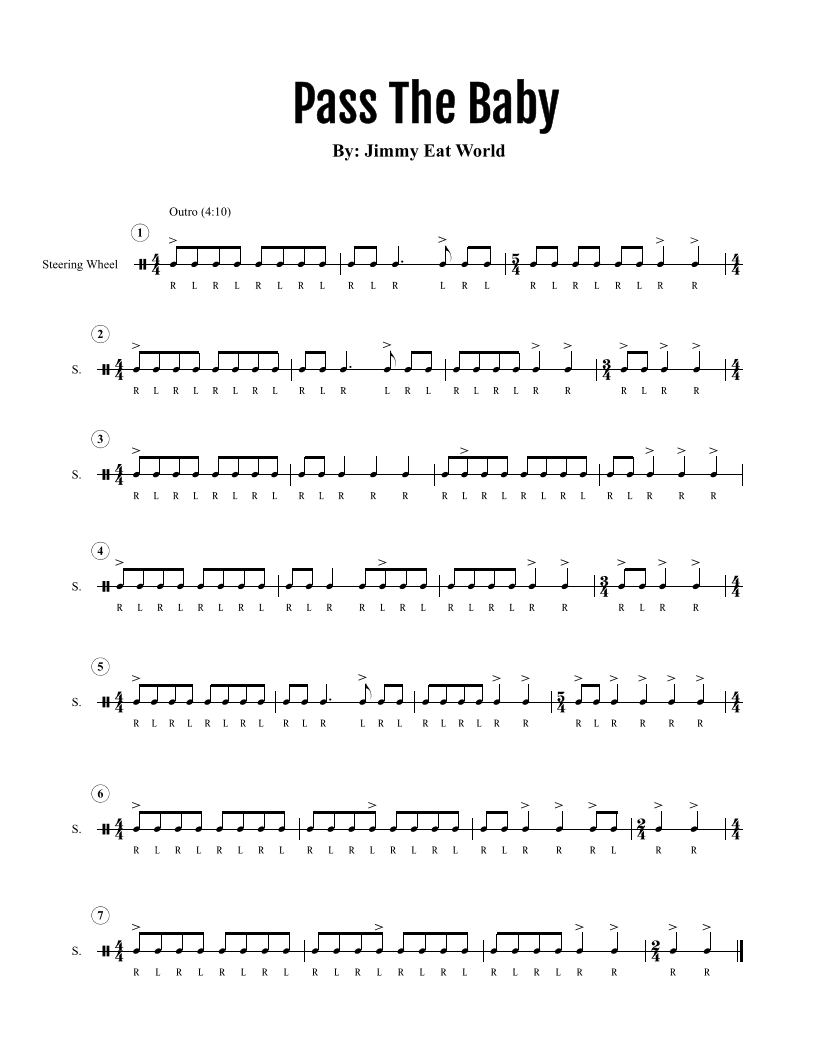
Last up: Pass The Baby by Jimmy Eat World (drums by Zach Lind).
The first time I heard this was at a live show, and I did not expect this kind of rhythmic direction from Jimmy Eat World. The ending of Pass the Baby, from their album Integrity Blues, completely caught me off guard. It is one of those sections that feels deceptively simple at first, but quickly reveals a much deeper rhythmic structure once you focus on what is actually happening.
At the center of the performance is drummer Zach Lind, a longtime member of Jimmy Eat World known for his steady, song-focused approach and ability to support dynamic shifts without overplaying. While the band is often associated with alternative rock and emo-influenced songwriting, Lind consistently brings a strong sense of control and restraint that allows more experimental sections like this one to land effectively without losing clarity.
In the live setting, especially, this ending section hits differently. The low end carries more physical impact, and the gradual buildup into the uneven rhythmic patterns becomes much more pronounced. What stands out most is how the meter feels like it is constantly stretching and folding back on itself, rather than sitting in a predictable loop.
From a transcription standpoint, this section was impossible to ignore. The phrasing is unusual enough that it naturally pulls your attention toward the timing, making it feel necessary to map out exactly how the rhythm is constructed. Once it is written down, the structure becomes much clearer, but in real time, it feels intentionally unstable in a way that keeps the listener slightly off balance while still grounded in pulse.
That combination of emotional impact and rhythmic ambiguity is what makes this ending so effective. It is not just a dramatic finish; it is a carefully controlled expansion of time that slowly dissolves into its own momentum.
Now it is broken down here in rhythm form so you can see exactly what is happening underneath it all and explore it from a purely rhythmic perspective.
Legal and safety note: PatrickRFBlakley.com and its authors assume no responsibility for any injury, loss, or damage resulting from the use of these materials. Steering Wheel Rhythms and all related content are intended for educational and practice purposes only and should never be used while operating or controlling a motor vehicle. All practice should be performed in a safe, stationary environment.
About the Author
Patrick Blakley is a percussion educator, author, adjudicator, and entrepreneur specializing in marching percussion and drumline education. He is the creator of DrumPacket.com, DrumlineWarmups.com, DrumAudit.com, DrumsetGrooves.com, and SyracuseDrums.com. His educational materials and performance audio edits through CompetitiveMusic.com are used by hundreds of schools and programs across the United States and beyond. He is the author of Quadratics: The Tenor Drum Equation, The Field Percussion User Manual, and other instructional music books. Read more about him by clicking here!
