
Drum Classes in Syracuse, NY!
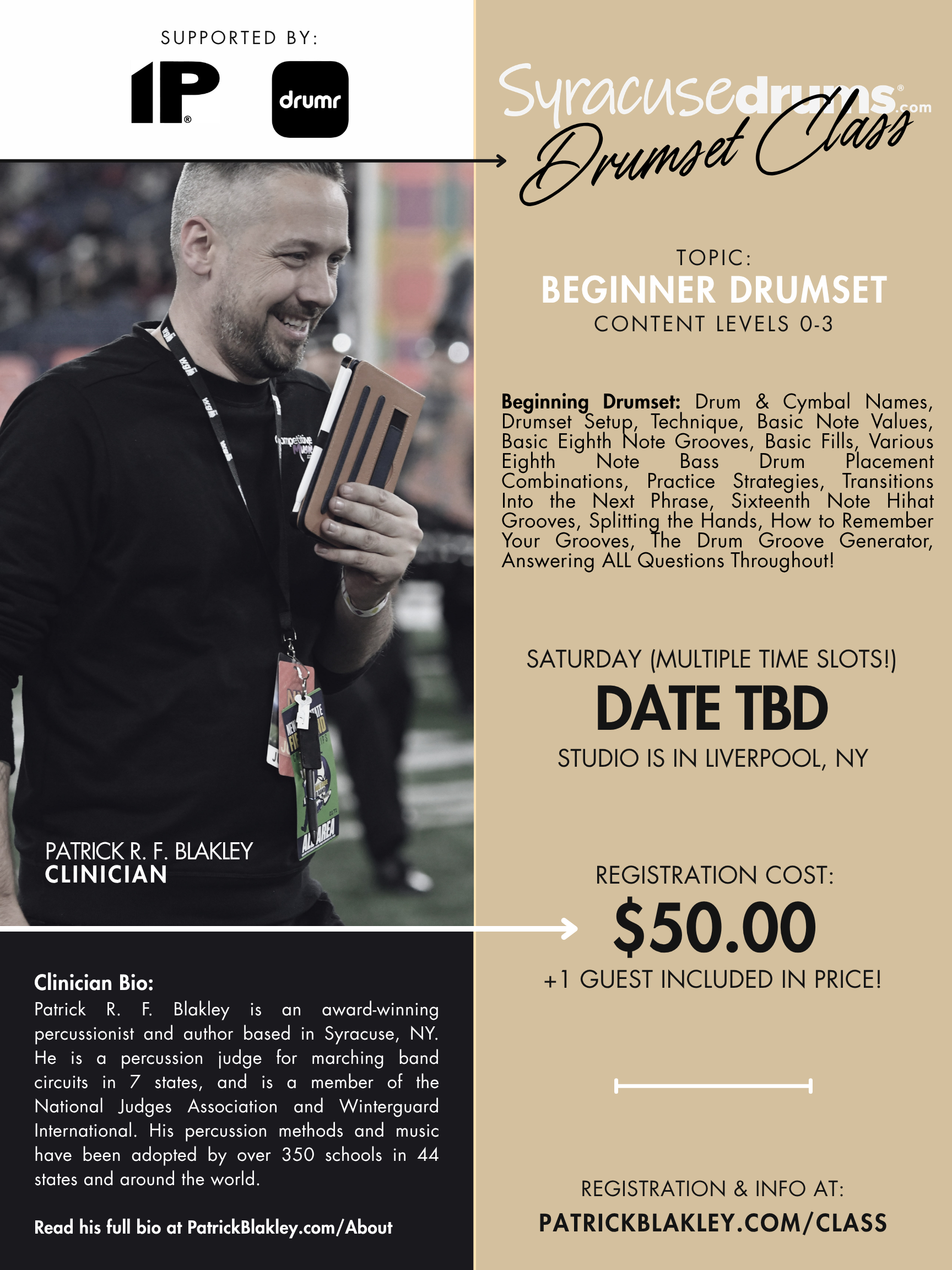
Next Upcoming Class:
⤵︎
Custom Drum Classes
Looking for something more specific? Custom group drum classes are also available for schools, businesses, organizations, and other groups. Classes can be arranged around your group’s experience level, goals, and schedule. Have custom drumset classes at your school!
All scheduled classes are held at the SyracuseDrums.com teaching studio in North Syracuse, NY. You can also contact me about bringing a custom drum class right to your school or business! See the consulting page for even more information on clinics!
SyracuseDrums.com offers small-group drumset classes in Syracuse, NY throughout the year for drummers who want to learn, and improve alongside other students. Each class is a focused session built around specific playing levels. Classes are designed to give anyone an opportunity to learn many practical drumset skills!
The annual schedule includes four level-specific drumset classes, offered approximately every other month from spring through fall. Students can choose the class that best matches their current experience and goals:
Beginner Drumset Class | April - Designed for students approximately level 0-3
Intermediate Drumset Class | June - Designed for students approximately level 3-5
Advanced Drumset Class | August - Designed for students approximately level 5+
Beginner Drumset Class | October - Designed for students approximately level 0-3
Class dates and enrollment are based on attendance and registration numbers. Because these are intentionally small-group classes, space is limited. If a class reaches capacity and there is enough additional interest, another session may be offered on the same day when scheduling allows.
🡆
(If you’d prefer to be invoiced, please contact me after filling out the form.)
Whether you're just getting started on the drums or looking to take your playing to the next level, these classes provide a structured way to spend a Saturday working on your drumset skills with other musicians in a dedicated teaching environment.
If you have any suggestions for what you’d like covered in any classes, please reach out here!
Drumset Class Levels
Whether you are picking up drumsticks for the first time or you have been playing drumset for years, the right instruction should meet you where you are and give you a clear path toward becoming a better drummer.
These drumset classes are organized by playing level so that each class can focus on the skills that are most useful at that stage of development. Beginning, Intermediate, and Advanced drumset classes each introduce new concepts while building on the musical, technical, and practical skills learned previously.
The goal is not simply to teach you a collection of drum beats and drum fills. You will learn how to understand what you are playing, how to practice it effectively, how to move from one musical idea to another, and how to create your own drumset parts.
Classes include instruction, demonstrations, playing examples, practical exercises, and opportunities to ask questions throughout the class. You will also be introduced to tools and concepts that can help you continue practicing after class.
Learn more by selecting a class level here:
Beginning Drumset Class
The Beginning Drumset class is designed for newer drummers who are learning the fundamentals of playing a complete drum set. This class focuses on the building blocks that make it possible to play basic drum grooves, understand rhythm, create fills, and move confidently from one musical phrase to another.
Beginning drummers often try to learn songs by memorizing individual beats without understanding how those beats are constructed. This class takes a different approach. You will learn the components that make up common drumset grooves and then learn how those components can be combined in different ways.
Drum and Cymbal Names
Before learning complicated drum beats, it helps to know exactly what everything on the drumset is called.
The class introduces the names and basic functions of the major drums and cymbals found on a typical drum set. This includes the bass drum, snare drum, toms, hi-hat, crash cymbals, ride cymbal, and other common components.
Knowing the correct terminology makes communication much easier during lessons, rehearsals, and future instruction. If someone tells you to move the floor tom, play the ride bell, or open the hi-hat, you should know exactly what they mean.
Drumset Setup
A properly arranged drumset can make playing easier, more comfortable, and more efficient.
Beginning students learn practical drumset setup concepts including tom positioning, cymbal placement, hi-hat adjustment, and the general arrangement of the kit.
The focus is on creating a setup that allows you to move naturally around the drumset rather than forcing you to reach unnecessarily or play from awkward positions.
Drum Technique
Good technique is one of the most important parts of becoming a capable drummer.
Beginning instruction introduces basic playing technique and the importance of using consistent motions on different playing surfaces. The snare drum, toms, cymbals, and other parts of the kit feel different, but your basic approach to movement should remain controlled and efficient.
Learning good habits early can make future technical development much easier.
Basic Note Values
Rhythm is the foundation of drumming.
Beginning students are introduced to basic note values including quarter notes, eighth notes, and sixteenth notes. Rather than simply memorizing the names of notes, the class explains how these note values relate to the pulse and subdivision of music.
You will learn why rhythmic subdivisions are important and how they apply directly to drum grooves and fills.
Basic Eighth Note Drum Grooves
One of the first major goals for a beginning drummer is learning to play a steady eighth note drum groove.
The class explores common eighth note groove patterns using the bass drum, snare drum, and hi-hat. You will learn how these individual parts fit together to create a groove that can be repeated consistently.
The emphasis is on understanding the structure of the groove instead of relying entirely on memorization.
Basic Drum Fills
Drum fills are an important part of playing drumset.
Beginning students learn how fills work within the structure of a musical phrase. You will learn basic fill concepts and how to place fills without losing the beat.
A fill should not simply be a random collection of notes. It should connect one musical phrase to the next.
Eighth Note Bass Drum Combinations
There are many possible ways to place the bass drum underneath an eighth note hi-hat pattern.
Students learn various combinations of bass drum placements and how those combinations affect the feel of a groove.
This gives beginning drummers a much larger vocabulary than learning one or two standard beats. Once you understand the possible placements, you can begin creating your own grooves.
Practice Strategies
Knowing what to practice is almost as important as knowing how to play.
Beginning students learn practical strategies for breaking difficult material into manageable pieces. This includes slowing down, isolating individual parts, repeating small sections, and gradually combining those sections into complete grooves.
Effective drum practice should have a purpose. Simply playing the same thing over and over does not automatically make practice productive.
Transitions Into the Next Phrase
One of the most useful skills a drummer can develop is the ability to move smoothly from one musical phrase into the next.
Students learn how drum grooves, fills, and transitions work together. This helps prevent one of the most common problems among beginning drummers: being able to play a groove by itself but losing the beat when attempting a fill or transition.
Sixteenth Note Hi-Hat Grooves
Once basic eighth note grooves are comfortable, the next step is introducing sixteenth note hi-hat patterns.
Students learn how sixteenth note subdivisions can create more movement and variety while the basic pulse remains consistent.
Understanding this relationship between subdivision and pulse is an important step toward more advanced drumset playing.
Splitting the Hands
Playing both hands on the same rhythmic subdivision opens up many possibilities on the drumset.
Students are introduced to the concept of splitting the hands between different surfaces. This can involve moving between the hi-hat, snare drum, ride cymbal, and other parts of the kit.
The goal is to develop coordination while also understanding how the same rhythm can be distributed across the drumset.
How to Remember Your Grooves
Memorizing a drum groove becomes much easier when you understand how the groove is constructed.
Students learn ways to think about grooves rather than trying to remember every individual note as an isolated event.
Understanding the relationship between the hi-hat, snare, and bass drum can make grooves easier to recall and reproduce.
The Drum Groove Generator
Beginning students are also introduced to the Drum Groove Generator, a tool designed to help explore different drum groove possibilities.
Instead of relying exclusively on a fixed list of beats, you can use systematic combinations to discover new patterns and develop a larger vocabulary of drum grooves.
This concept reinforces an important idea: there are far more useful drum grooves available than the handful of beats most beginners initially learn.
Questions Throughout the Class
Questions are encouraged throughout the entire class.
If something does not make sense, ask. If you want to know why a particular technique works, ask. If you are struggling with a groove or wondering how a particular concept applies to a song, ask.
The class is intended to be instructional rather than simply a presentation where information is delivered without interaction.
Intermediate Drumset Class
The Intermediate Drumset class builds on fundamental drumset skills and begins introducing more advanced coordination, technique, rhythm, notation, rudiments, dynamics, and groove construction.
At this stage, the goal is to move beyond simply playing basic drum beats and fills. Intermediate drummers begin learning how to control the details of their playing and how to create more sophisticated musical parts.
Compound Note Values and Counting
Intermediate drummers begin working with more complex rhythmic relationships.
Compound note values and counting methods help you understand rhythms that cannot be comfortably explained using only basic quarter note and eighth note concepts.
The ability to count accurately becomes increasingly important as rhythms become more complicated.
Basic Drum Notation
Reading drum notation gives you another way to understand and communicate musical ideas.
Students are introduced to basic drum notation and learn how written rhythms can represent what is being played on the drumset.
Notation is particularly useful when learning new exercises, transcribing music, writing original parts, or communicating with other musicians.
Movable Fulcrum Technique
The fulcrum is an important part of efficient stick control.
Intermediate instruction introduces the concept of a movable fulcrum and how changing the relationship between the fingers, thumb, and stick can improve control and movement.
This provides a foundation for developing more efficient technique as playing speeds increase.
Multiple Stickings
There is often more than one way to play a rhythmic pattern.
Students explore multiple sticking possibilities and learn why one sticking may be more useful than another depending on the musical situation.
Understanding different sticking options can make fills smoother, more consistent, and easier to execute.
Avoiding Shifts
Unnecessary movement can make a drum fill or pattern harder to play.
Intermediate students learn to identify and avoid shifts that create inefficient movement around the drumset.
The objective is not simply to play a pattern correctly once. It is to develop a repeatable technique that remains reliable as tempo increases.
Triplets
Triplets introduce a different type of rhythmic subdivision and open up many new possibilities for grooves, fills, and improvisation.
Students learn how to count and feel triplets and how they can be applied to the drumset.
Triplet concepts can also become an important bridge between basic rhythms and more advanced rhythmic vocabulary.
Better Drum Fills
Intermediate drummers begin moving beyond simple fills and start thinking more carefully about musical phrasing.
Students learn how to construct fills that have direction, appropriate sticking, rhythmic variety, and a clear connection to the groove.
A good drum fill should serve the music rather than simply demonstrate how many notes you can play.
Double-Strokes
Double-stroke technique is a fundamental skill for developing speed, control, and rudimental vocabulary.
Students learn the mechanics of double strokes and how they can be applied to the drumset.
Double strokes can become useful in fills, grooves, rudiments, and more advanced technical exercises.
Basic Rudiments
Rudiments provide a vocabulary for developing control and coordination.
Intermediate students are introduced to basic rudimental concepts and learn how those concepts can be applied directly to drumset playing.
The objective is not to treat rudiments as isolated exercises. The goal is to understand how rudimental techniques can become part of actual musical playing.
Faster Drum Fills
Once sticking, technique, and rhythmic understanding improve, students can begin working toward faster fills.
Speed is treated as a result of efficient movement rather than simply forcing the sticks to move faster.
Students learn how to approach faster playing while maintaining control, timing, consistency, and musicality.
Accents and Dynamics
Playing the correct notes is only part of being a good drummer.
Accents and dynamics determine how those notes sound and how they function within the music.
Intermediate students learn how controlled accents, softer notes, and changes in volume can dramatically change the character of a groove or fill.
Dynamic control is one of the skills that can make a drummer sound substantially more mature without necessarily playing more complicated patterns.
Rudimental Grooves
Rudimental concepts can be combined with standard drumset grooves to create more sophisticated patterns.
Students explore the idea of applying rudimental vocabulary to the drumset rather than keeping rudiments confined to traditional practice exercises.
This can expand both technical ability and creative vocabulary.
Splitting the Hands
The concept of splitting the hands becomes more advanced at the Intermediate level.
Students work with more complicated combinations between cymbals, snare drum, and other surfaces.
This develops coordination while providing additional options for arranging rhythmic patterns around the kit.
Basic Snare Drum Offset Grooves
Offset grooves introduce rhythmic displacement between different parts of the drumset.
Students begin exploring basic snare drum offset patterns and how shifting the placement of the snare changes the character of a groove.
This is an important step toward understanding more complex groove construction.
Basic Bass Drum Offset Grooves
Bass drum displacement provides another way to create unusual and interesting grooves.
Students explore basic bass drum offset patterns and learn how the bass drum can interact with the snare and cymbal patterns in unexpected ways.
These concepts can be used for both structured exercises and original groove creation.
The Drum Groove Generator
The Drum Groove Generator continues to be useful at the Intermediate level.
At this stage, it can be used to explore increasingly complex combinations and to help students understand how different rhythmic choices affect a groove.
The goal is to develop a process for creating drum grooves rather than depending entirely on memorized patterns.
Questions Throughout the Class
Intermediate students are encouraged to ask questions throughout the class.
Drumming becomes increasingly complex as your vocabulary grows, and understanding why something works can be just as important as learning how to play it.
Advanced Drumset Class
The Advanced Drumset class is designed for experienced drummers who are ready to work with more sophisticated rhythmic concepts, technical approaches, coordination challenges, and creative applications.
Advanced drumset playing is not simply about playing faster. It is about having greater control over rhythm, technique, dynamics, coordination, phrasing, and musical choices.
The Advanced class explores concepts that can be applied to contemporary drumset playing, composition, improvisation, groove development, and technical performance.
Counting Syncopated Rhythms
Syncopation creates rhythmic movement by placing notes in unexpected locations within the beat.
Advanced students learn strategies for counting and understanding syncopated rhythms so they can approach difficult patterns systematically rather than relying entirely on feel or trial and error.
Strong internal counting can make complicated rhythms much easier to learn and perform accurately.
Notation for Composition
Drum notation can be used for much more than reading exercises.
Advanced students explore notation as a tool for composing and documenting original drum parts.
Being able to write down an idea allows you to preserve it, analyze it, modify it, and communicate it to another musician.
This is particularly useful for drummers who want to write original music or create specific drum parts for a band.
Back Finger Technique for Speed
Advanced technique requires efficient control of the stick.
Students explore back finger technique as a way to develop speed and control while minimizing unnecessary movement.
The focus is on developing efficient motion that can be repeated consistently rather than simply trying to force higher tempos.
Using the Hi-Hat in Drum Fills
The hi-hat does not have to remain a fixed part of the groove.
Advanced students explore ways to incorporate the hi-hat into fills, creating additional movement and texture around the drumset.
This expands the traditional concept of a drum fill and provides another musical surface for rhythmic ideas.
Using the Hi-Hat Foot in Grooves
The hi-hat foot can become an important independent voice in a drum groove.
Students explore how the foot can contribute rhythmic information while the hands and bass drum perform other patterns.
Developing this type of independence can significantly expand the number of grooves and coordination patterns available to an experienced drummer.
Combined Snare and Bass Drum Offset Grooves
Advanced offset grooves combine displaced snare and bass drum patterns.
These patterns require a strong understanding of subdivision, coordination, and internal pulse.
Students learn how different offsets can interact and how these concepts can be used to create grooves that sound complex while still maintaining a strong underlying pulse.
Sixteenth Note Bass Drum Placements
Advanced students explore a wider range of possible bass drum placements within sixteenth note subdivisions.
Instead of treating the bass drum as a fixed part of a handful of standard grooves, students learn to think of bass drum placement as a compositional tool.
This can produce a large number of possible groove variations and can be applied to many different musical styles.
Flam Rudiments
Flams add another dimension to rudimental playing.
Advanced instruction introduces flam rudiments and explores the mechanics necessary to play them cleanly.
Students can then begin transferring those concepts from rudimental exercises to the drumset.
Adding Flams to Existing Grooves
A useful technical concept is learning how to modify something you already know.
Students explore ways to add flams to existing drum grooves rather than treating flam exercises as completely separate material.
This encourages creative application and demonstrates how a technical exercise can become a musical idea.
Fivelets
Five-note subdivisions create rhythmic possibilities beyond traditional binary and ternary subdivisions.
Students explore fivelets and learn how to count and apply them to the drumset.
These patterns can be used in fills, phrasing, technical exercises, and creative applications.
Sevenlets
Sevenlets introduce another advanced subdivision that requires careful rhythmic control.
Students learn strategies for understanding and applying seven-note groupings without losing the underlying pulse.
This type of rhythmic vocabulary can add a very different character to advanced fills and phrases.
Ninelets
Ninelets provide another way to divide rhythmic space into larger groupings.
Advanced students explore how nine-note subdivisions can be counted, practiced, and applied musically.
The emphasis remains on maintaining a strong pulse while navigating increasingly complex subdivisions.
Patrick's Favorite Grooves
The Advanced class also includes some of Patrick's favorite grooves and concepts from years of playing, teaching, writing, and studying percussion.
These examples provide opportunities to take the technical and rhythmic concepts covered throughout the class and hear how they can be applied in actual musical situations.
The goal is not simply to copy a groove. It is to understand what makes it work and how similar ideas can be developed into your own playing.
The Drum Groove Generator
The Drum Groove Generator becomes an especially useful creative tool for advanced drummers.
With a larger technical and rhythmic vocabulary, students can use systematic groove combinations to explore possibilities that may not occur naturally through memorization alone.
This can be useful for practice, composition, improvisation, and developing a unique personal vocabulary.
Questions Throughout the Class
Advanced drummers are encouraged to ask questions throughout the entire class.
At an advanced level, seemingly small technical or musical questions can lead to significant improvements in playing.
The class provides an opportunity to examine not only how a pattern is played, but why it works, how it can be practiced, and how it can be adapted to other musical situations.
From Beginner Drumset to Advanced Drumset
The three drumset class levels are designed to create a logical progression.
A beginning drummer first needs to understand the instrument, basic rhythm, fundamental coordination, and simple grooves. Once those skills become comfortable, an intermediate drummer can begin exploring more complex rhythmic structures, technical approaches, rudiments, dynamics, and groove construction.
Advanced players can then use those skills as a foundation for more demanding coordination, syncopation, advanced subdivisions, offset grooves, technical development, and composition.
This progression is important because advanced drumming is built from fundamental skills. A complicated drum groove is still made from individual rhythmic components. A fast fill still depends on efficient technique. A difficult coordination pattern still depends on understanding the underlying subdivision.
Learning these concepts in a structured way can make advanced material much easier to understand.
What You Will Actually Learn in These Drumset Classes
These classes cover more than simply learning drum beats.
You will work with:
Drumset technique
Drumset coordination
Rhythm and counting
Drum notation
Drum grooves
Bass drum patterns
Snare drum patterns
Hi-hat patterns
Drum fills
Rudiments
Double strokes
Flams
Accents and dynamics
Syncopation
Triplets
Sixteenth note rhythms
Advanced subdivisions
Groove construction
Offset grooves
Hand independence
Foot independence
Practice strategies
Musical transitions
Composition concepts
Creative groove development
The purpose of covering these areas is to help you become a more complete drummer who can understand what you are playing rather than simply reproducing memorized patterns.
A Drumset Class Should Give You Tools, Not Just Patterns
One of the biggest differences between learning a list of drum beats and actually learning how to play drumset is understanding the system behind the patterns.
If you learn one groove, you know one groove.
If you understand how the parts of that groove work, you can begin creating dozens or even hundreds of variations.
That distinction becomes increasingly important as you progress.
The same principle applies to drum fills. Instead of memorizing a handful of fills and hoping they work in every song, you can learn how rhythm, sticking, dynamics, and movement can be combined to create fills that fit the music.
That is why these classes emphasize concepts that can be reused.
Learning to Create Your Own Drum Grooves
Creating your own drum grooves is an important part of becoming an independent drummer.
A drummer should eventually be able to hear an idea, understand what is happening rhythmically, and find a way to play it on the drumset.
The Drum Groove Generator is one tool used to reinforce this concept. It provides a structured way to explore possible combinations instead of relying entirely on memorized drum beats.
As your knowledge of rhythm, coordination, and technique increases, the number of musical possibilities available to you increases as well.
Learning How to Practice Drumset
Good drum instruction should also teach you how to practice.
When a pattern is difficult, there are usually several ways to approach it. You can reduce the tempo, isolate one limb, simplify the rhythm, practice a small section, work on the sticking, or separate the coordination problem from the musical problem.
Learning how to identify the actual source of a problem can save a tremendous amount of practice time.
The goal is not to spend more hours practicing incorrectly. The goal is to make your practice more productive.
Building Real Drumset Independence
Drumset independence means being able to control different parts of the drumset independently while keeping the underlying pulse stable.
This becomes increasingly important as you progress from basic grooves to more complicated patterns.
Beginning students start with simple combinations. Intermediate students begin splitting the hands, working with offset patterns, and incorporating more complex coordination. Advanced students work with combined offsets, hi-hat foot patterns, more complicated subdivisions, and advanced coordination.
Independence is not developed by one magic exercise. It is developed gradually through increasingly challenging combinations.
Why Rhythm and Counting Matter
A drummer's job is fundamentally connected to time.
Even impressive technique becomes much less useful if the drummer loses the pulse.
Counting provides a way to understand where notes occur within the beat. It also gives you a practical method for learning difficult rhythms.
As the material becomes more advanced, counting becomes increasingly useful for syncopation, compound rhythms, triplets, sixteenth notes, fivelets, sevenlets, ninelets, and other subdivisions.
The better you understand rhythm, the more control you have over your playing.
Drumset Technique and Musicality
Technique and musicality are not competing goals.
Good technique gives you the physical ability to execute musical ideas. Musicality gives you a reason to execute them.
A drummer does not need to use the most complicated fill available simply because it can be played. The better choice may be a simpler fill that fits the song.
These classes therefore approach technique as a means of expanding your musical options.
The objective is greater control, greater understanding, and a larger vocabulary that you can use when the music calls for it.
Which Drumset Class Level Is Right for You?
The Beginning Drumset class is generally the appropriate starting point for newer players who are still developing basic grooves, note values, coordination, and drumset familiarity.
The Intermediate Drumset class is intended for drummers who already have a working knowledge of basic grooves and fills and are ready for more sophisticated coordination, technique, notation, rudiments, dynamics, and groove construction.
The Advanced Drumset class is intended for experienced drummers who are comfortable with fundamental drumset playing and are ready to explore advanced coordination, syncopation, offset grooves, advanced subdivisions, technical development, and creative applications.
If you are unsure which level is appropriate, the most important consideration is not how many years you have played. It is what you can currently play and understand.
Drumset Classes in Syracuse, NY
These drumset classes are offered through SyracuseDrums.com in the Syracuse, New York area.
The classes are designed to provide focused instruction in a small-group setting while covering practical skills that drummers can immediately apply to their playing.
Whether you are looking for a beginning drumset class, intermediate drumset instruction, or an advanced drumset class, the curriculum is designed around actual playing skills rather than simply moving through a generic textbook.
The result is a class experience focused on understanding the drumset, developing coordination and technique, improving rhythmic knowledge, and giving you practical tools for becoming a better drummer.
Continue Developing Your Drumset Skills
Learning drumset is an ongoing process.
There is always another groove to understand, another rhythmic concept to explore, another technical problem to solve, and another musical idea to develop.
The goal of these classes is to give you a stronger foundation for that process so that you can continue learning long after the class ends.